Mini Schnauzer Haircut: Complete Guide for Schnauzer Owners
Your Miniature Schnauzer’s signature look depends on one decision: hand-strip or clip. The breed standard requires hand-stripping to maintain the wiry, dirt-repelling outer coat, but clipping is faster, easier, and perfectly fine for family pets. Most owners clip at home. Here’s exactly how to do it safely.

The First Decision: Hand-Strip or Clip?
This matters more than any technique detail. Here’s what changes based on your choice.
Hand-stripping removes dead outer hairs by hand or with a stripping knife. It preserves the harsh texture that repels water and dirt. Show dogs require it. But it takes 45–90 minutes, requires practice, and many Mini Schnauzers find it uncomfortable until they’re accustomed to it.
Clipping uses electric clippers with a guard comb. It’s faster (30–45 minutes), easier to learn, and less stressful for most dogs and owners. The trade-off: repeated clipping softens the outer coat over time, making it fluffier and less wiry.
Your decision rule:
- Clip if your dog is a family pet, you groom at home, or you’re removing existing mats. Most owners should clip.
- Strip if you plan to show your dog, or you want to preserve the exact breed-standard texture. Start with a professional groomer who can teach you.
If you clip, your Mini Schnauzer will still look like a Schnauzer. It just won’t have the same feel to the touch.
What You Actually Need (No More, No Less)
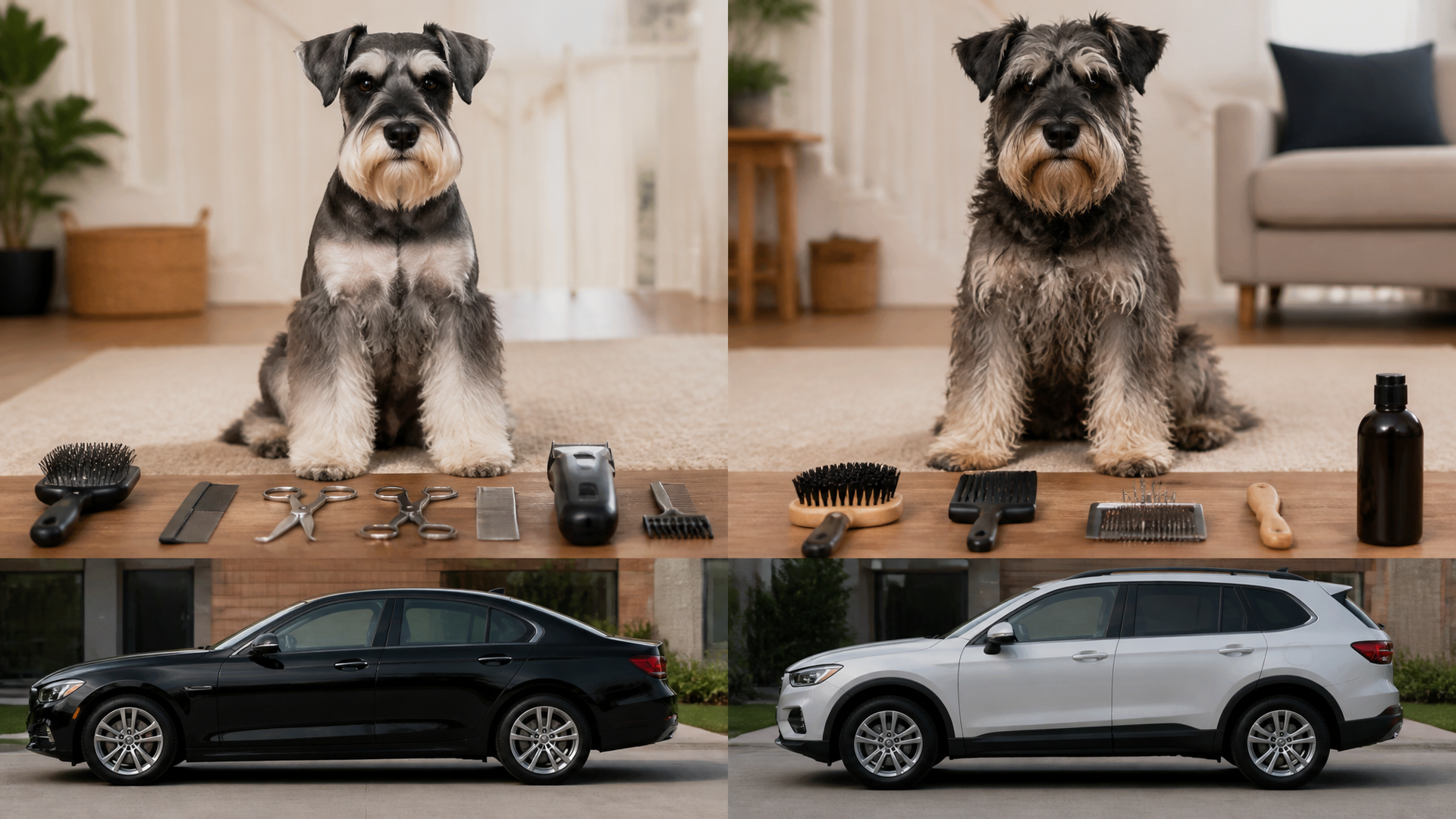
Mini Schnauzers have thick double coats. Wrong tools create tangles, uneven cuts, or skin irritation. Buy these and nothing else until you know what works for your dog.
| Tool | What It Does | What to Look For |
|---|---|---|
| Slicker brush | Removes loose undercoat | Medium-firm bristles; avoid cheap plastic pins that bend |
| Metal comb | Checks for tangles after brushing | Wide-tooth on one end, fine on the other |
| Clippers with adjustable speed | Body and back trimming | Use #10 blade for sanitary areas, #7F or #5F for body |
| Guard combs | Controls hair length | ⅜” to ½” for body, ½” to ¾” for legs |
| Thinning shears | Blends lines on face and legs | Straight shears for bulk removal |
| Round-tip scissors | Trims around eyes and feet | Never use sharp-pointed scissors near eyes |
| Nail clippers or grinder | Trims nails before bath | Grinders are quieter for anxious dogs |
| Ear cleaner and cotton balls | Cleans ears during grooming | Avoid cotton swabs inside the ear canal |
Affiliate disclosure: If you purchase grooming tools through links in this guide, we may earn a small commission at no extra cost to you.
Step-by-Step: Clip Method at Home
1. Prep the Coat – The Make-or-Break Step
Brush your Mini Schnauzer thoroughly before the bath. Work in sections from back to belly, lifting the outer coat to reach the soft undercoat. A slicker brush removes loose undercoat that otherwise clogs clippers.
If you hit a mat, stop and work it out with your fingers or a de-matting tool. Do not wet a mat – it sets tighter and becomes nearly impossible to remove.
Checkpoint: Run a metal comb through the full coat. If the comb snags anywhere, go back and brush that spot again.
Realistic branch: If you find a mat tighter than a dime, close to the skin, and you can’t work it out in 2 minutes of gentle effort, stop brushing and skip to the stop/escalate section below. Attempting to brush out tight mats tears the skin. Some mats require a shave-down, not more brushing.
2. Bath and Dry – Must Be Bone-Dry
Use a dog-specific shampoo. Human shampoo strips oils from the double coat, and Mini Schnauzers have sensitive skin prone to flaking. Rinse completely – leftover soap causes itching.
Towel dry first, then use a blow dryer on low heat while brushing with your slicker brush. The coat should be completely dry before you clip. Wet hair clogs clippers, cuts unevenly, and can cause clipper burn (red, irritated skin from friction).
Verification step: Part the coat down to the skin in three places – back, behind the ears, and belly. If you see moisture or feel dampness, dry more. Pull a small tuft of hair and run it between your fingers. It should feel dry and separate easily, not clump.
3. Body Trim – Straight Lines, Flat Clipper
Fit your clipper with a guard comb (⅜” for most of the body, ½” if you want a slightly longer coat). Start behind the neck and work toward the tail. Clip against the direction of hair growth for a closer cut. Go with the grain for a longer, softer finish.
Keep the clipper flat against the skin. Tilting it creates uneven patches. Mini Schnauzers often fidget around the belly and back legs. Go slow, talk calmly, and take breaks. Never force a struggling dog.
Quick check after body trim: Run your hand over the body from neck to tail. The coat should feel even and smooth in all directions. If you feel ridges or uneven spots, go over that area again with the guard comb still on.
4. Face Trim – The Beard and Eyebrows
This defines the Schnauzer look. Use round-tip scissors, not clippers, near the eyes.
- Eyebrows: Trim the hairs between the eyes down to about ¼”. Leave the longer wiry hairs above the eyes for the classic bushy look. Use thinning shears to blend.
- Beard: Comb it forward. Trim the bottom edge straight across. Then use thinning shears to blend the sides. The beard should be full but tidy – at least 1″ long. The beard protects the muzzle from dirt and food debris.
- Ears: Remove long tufts on the ear edges with scissors. Keep the ear leathers clean inside.
Warning sign: If your Schnauzer flinches or pulls away when you touch the face, stop using scissors. Switch to a smaller clipper with a #10 blade (no guard) and carefully trace the shape. Scissors near the eyes require absolute trust.
5. Legs and Feet – The Column Look
The legs should look like columns – full, straight, and even. Use a guard comb (½” to ¾”) and clip from the top of the leg downward. Blend the body-to-leg transition with thinning shears so there’s no harsh line.
For the feet, trim hair between the paw pads with small scissors or a #10 clipper blade. Shape the top of the foot to a rounded edge. Schnauzers have “cat feet” – trim tight enough that dirt and snow don’t mat between the pads, but leave a little cushion for protection.
6. Tail and Sanitary Areas
The tail gets a short, even trim with the same guard comb you used on the body.
The sanitary areas (belly, groin, rear) need a bare #10 blade without a guard comb. Go slowly and keep the clipper flat to avoid nicks. If your dog is uncomfortable here, skip it and let a professional handle it.
Clean Ears or Not? What to Check
Mini Schnauzers grow thick hair inside the ear canal. If left too long, it traps moisture and causes infections. Pluck ear hair every 4–6 weeks, or have your groomer do it.
Critical checkpoint: If you see redness, swelling, discharge, or a foul smell from either ear, stop grooming and see your vet first. Grooming over an ear infection can push debris deeper and make the infection worse. Your vet should clear any ear issues before you continue with a full groom.
Check Before You Start Grooming
Run through this quick pass/fail check before you put your dog on the table. If you flunk any item, address it first.
- [ ] Brush-through test: Metal comb passes through the full coat without snagging
- [ ] Mat-free body: No mats on back, belly, behind ears, or under legs
- [ ] Clean ears and dry coat: Ears odor-free; coat fully dry from bath
- [ ] Clipper inspection: Blade is sharp, cool, and properly oiled
- [ ] Dog ready: Walked and pottied before grooming; calm enough to stand still for 5-minute intervals
What Can Go Wrong – and How to Fix It
- Clipping over mats – The clipper snags, pulls skin, and leaves bald patches. Always brush first. If you missed a mat, stop and work it out before continuing.
- Guard comb too short – ¼” guards expose the skin and remove the outer coat entirely. Stick with ⅜” or ½” for your first few grooms.
- Beard too short – The beard protects the muzzle. Leave at least 1″ of length.
- Skipping regular grooming – A full trim every 6–8 weeks prevents matting. Waiting 12 weeks means you’ll need to shave down very short to remove all tangles.
Stop If You See Blood, Scabs, or Clipper Burn
Some situations mean you stop DIY grooming and go to a professional. Here’s the exact threshold:
- Severe matting close to the skin – If a mat is tighter than a dime and touching the skin, attempting to brush it out can tear the skin. A groomer will shave the coat and start fresh. Do not cut mats out with scissors – you can cut the dog.
- Signs of skin infection – Red, flaky, or bumpy skin anywhere on the body. A vet should evaluate first. Grooming over irritated skin makes it worse.
- Dog becomes anxious or aggressive – A struggling dog can be injured by clippers or scissors. A professional has experience with nervous dogs. Pack up and try again another day, or schedule a pro.
- Clipper burn appears – Red, tender skin where you clipped. This means your blade was dull, too hot, or you pressed too hard. Stop clipping that area. Apply a dog-safe wound ointment if the skin is broken. Let the area heal completely before grooming again.
Save This Guide
Your takeaway: Clip your Mini Schnauzer at home using this order: de-mat, bathe, dry, clip. The face and legs define the breed look – take extra time there and use thinning shears to blend. Groom every 6–8 weeks to maintain the coat and catch problems early. If you hit tight mats, red ears, or clipper burn, stop and call a professional. Bookmark this page so you have the checklist ready before every grooming session.