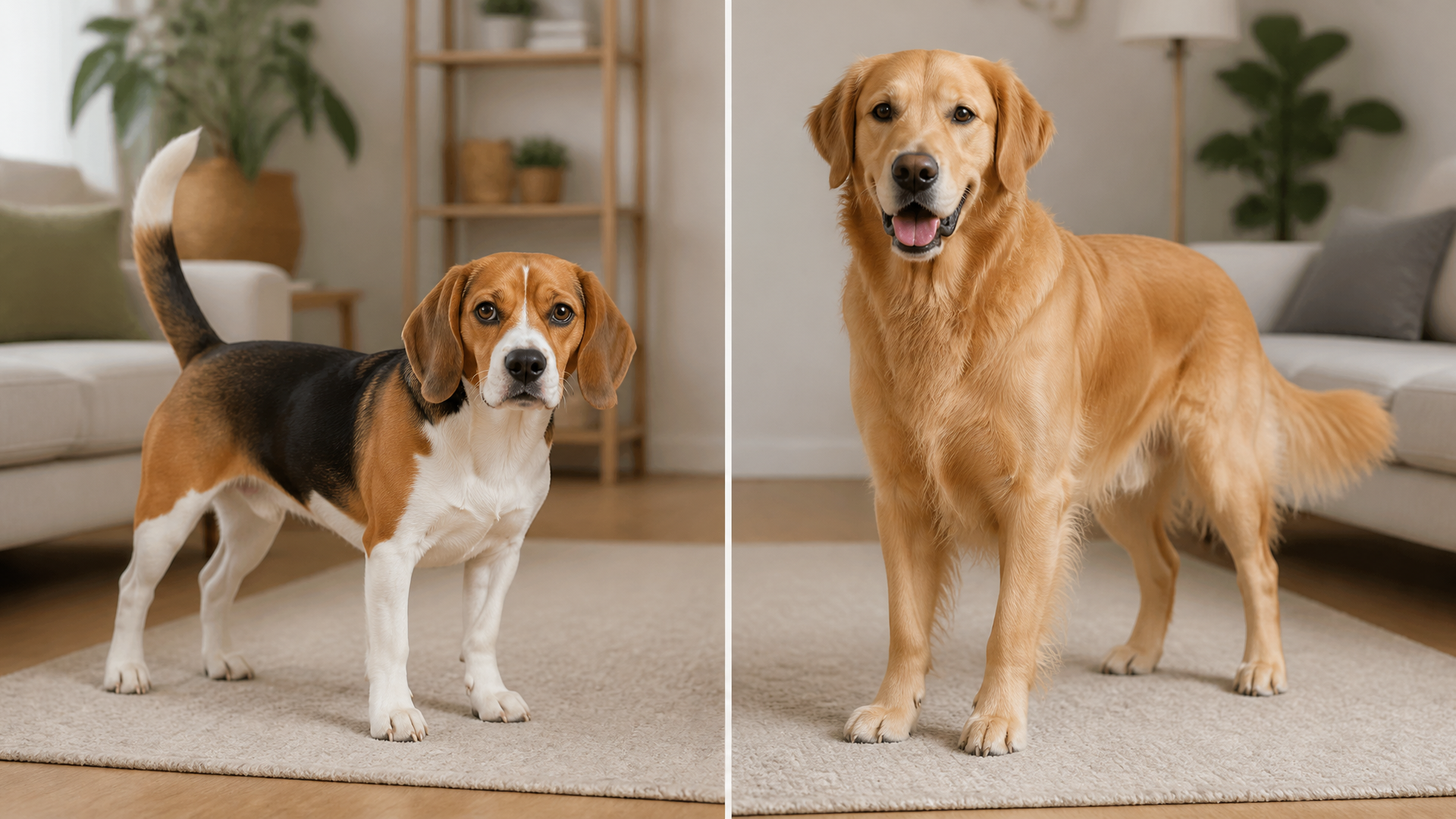
is a Beagleconsidered a Small or Medium Size Dog?
Yes, a Beagle is a medium-sized dog. Adult Beagles weigh 20–30 pounds and stand 13–15 inches at the shoulder. That’s not small like a Chihuahua or Pomeranian, and not large like a Lab. If you’re buying a crate, bed, harness, or coat, choose medium size. Don’t let the short legs fool you.

What Size Is a Beagle – Small or Medium?
The American Kennel Club (AKC) splits Beagles into two varieties—13-inch (under 13 inches tall) and 15-inch (13–15 inches tall)—and classifies both as medium dogs. Here’s how they compare with other common breeds:
| Breed | Height (at shoulder) | Weight | Size Category |
|---|---|---|---|
| Chihuahua | 6–9 inches | 4–8 lbs | Small |
| Boston Terrier | 15–17 inches | 12–25 lbs | Small (bantam) |
| Beagle (13-inch) | 13 inches | 20–25 lbs | Medium |
| Beagle (15-inch) | 13–15 inches | 25–30 lbs | Medium |
| Cocker Spaniel | 13–15 inches | 20–30 lbs | Medium |
| Labrador Retriever | 21–24 inches | 55–80 lbs | Large |
The confusion comes from the Beagle’s short legs and long, sturdy body — they look smaller than they are. But by weight and bone structure, they’re squarely in the medium range. A 25-pound Beagle isn’t a lap dog; it’s a compact, athletic medium breed.
When the Answer Changes (Applicability Boundary)
This classification applies to purebred Beagles registered with the AKC or UKC. If your dog is:
- A Beagle mix (e.g., Beagle-Lab or Beagle-Pug)
- From unregistered backyard breeding lines
- A “pocket Beagle” (not an official variety)
…then weight and height can fall outside the 20–30 lb range. For a mixed-breed Beagle, size classification depends entirely on the other breed involved. Measure your dog using the steps below and compare to the chart — don’t assume “medium” fits just because it’s part Beagle.
How to Measure Your Beagle to Confirm Its Size
Grab a flexible tape measure and a digital scale. This three-step check will tell you exactly where your dog lands.
Step 1 – Measure height at the withers
Stand your Beagle square on a flat floor. Place the tape at the ground and run it straight up to the highest point of the shoulder blades (the withers). That’s your height reading.
Friction point: Your Beagle probably won’t stand still. Use a treat held at nose level, or have a helper distract. If you can’t get an exact standing measurement, measure while your dog lies flat on its side — it’s close enough for a size check.
Step 2 – Weigh your Beagle
Use a bathroom scale: weigh yourself holding your dog, then subtract your weight. For best accuracy, use a pet scale at your vet’s office. Common mistake: Underestimating by 5–10 pounds because your dog wriggled while you held them. Record the weight from three attempts and take the average.
Step 3 – Check against the standard
- Under 13 inches + under 20 lbs → smaller end of medium (still medium by weight if over 20 lbs)
- 13–15 inches + 20–30 lbs → classic medium
- Over 15 inches or over 30 lbs → may be mixed breed or overweight — check with your vet
Likely cause for misclassification: Puppy size. A 12-week-old Beagle weighs 8–10 lbs, so owners assume the adult will stay small. But they nearly triple that weight by 18 months.
Escalation signal: If your adult Beagle weighs under 15 lbs or over 35 lbs, schedule a vet visit. Extreme weight can signal a different breed mix, obesity, or an underlying health issue.
Expert Tips for Assessing Your Beagle’s Size
Tip 1 – Don’t go by looks alone
Beagles have a heavy bone structure for their height. A 25-pound Beagle looks the same size as a 15-pound Jack Russell, but the Beagle’s wider chest and thicker legs need medium-sized gear.
- Actionable step: Measure chest girth (around the widest part of the rib cage, just behind the front legs) before buying a harness or coat.
- Common mistake: Buying “small” based on height — the harness will be too tight around the ribs and restrict breathing during walks.
Tip 2 – Use a reliable scale and weigh regularly
Many owners rely on old adoption records or eyeball estimates. Beagles can gain or lose 5–10 pounds after a change in diet, activity, or season.
- Actionable step: Weigh your Beagle every month (same scale, same time of day).
- Common mistake: Calling a 32-pound Beagle “medium” — that’s overweight. The AKC cap for the largest variety is around 30 lbs.
Tip 3 – Compare to the AKC Beagle standard, not other breeds
“Medium” varies wildly by breed. A 30-pound Beagle is medium; a 30-pound Border Collie is on the small side.
- Actionable step: Download the official AKC Beagle breed standard PDF and use it as your reference.
- Common mistake: Assuming your Beagle is small because it looks tiny next to a Golden Retriever.
What Goes Wrong if You Size Incorrectly (Mismatch & Tradeoffs)
Crate too small (24-inch): Your Beagle can’t stand fully or turn around. This leads to anxiety, refusal to enter the crate, and potential injury if the dog tries to squeeze out.
Crate too large (42-inch): For house-training purposes, a too-large crate gives your dog room to eliminate in one corner and sleep in another, undermining bladder training.
Harness too small: Straps dig into the armpits and chest, causing chafing and restricted breathing during walks or hikes.
Harness too large: The harness can slip over the head or around the body, especially with a Beagle’s barrel chest and shorter neck — you risk a loose dog in an open area.
Correct sizing rule of thumb: For crates, choose a 30-inch intermediate model (e.g., Midwest iCrate 30-inch or Petmate Sky Kennel Medium). For harnesses, pick a medium with adjustable chest girth (e.g., Rabbitgoo or Blue-9 Balance Harness). Always measure chest girth and compare to the product’s size chart; if your Beagle falls between sizes, size up for comfort.
How to Confirm Fit Before Buying (Verification Step)
Before ordering any gear, do this quick check:
1. Crate: Measure your Beagle from nose tip to base of tail (length) and from floor to top of head (height while standing). Add 4–6 inches in each dimension for comfort. Match those numbers to the crate’s interior dimensions listed in the product description.
2. Harness: Use a soft measuring tape to take chest girth (widest part of the rib cage, just behind the front legs). Write down the inch range. Open the product’s size chart and confirm the corresponding size — if your Beagle’s chest girth is 22–24 inches, a medium harness that fits 20–26 inches is safe; if the range is 18–22 inches, it will be too tight.
3. Bed: Measure your Beagle from nose to tail while lying down. Add 8–12 inches. Choose a bed labeled “medium” that meets or exceeds that length. A too-small bed will force your dog to sleep curled in a tight ball, which can cause stiffness over time.
If you can’t find interior dimensions listed, message the seller or skip the product — guesswork leads to returns.
Beagle Size Quick-Reference Card (Save-Worthy)
| Category | Weight Range | Examples | Is Your Beagle Here? |
|---|---|---|---|
| Small | Under 20 lbs | Chihuahua, Pomeranian, French Bulldog | No |
| Medium (light) | 20–30 lbs | Beagle, Cocker Spaniel | Yes |
| Medium (heavy) | 30–50 lbs | American Pit Bull Terrier, Australian Shepherd | No (Beagle too light) |
| Large | 50+ lbs | Labrador, German Shepherd | No |
What this means in practice:
- Crate size: 30–36 inch intermediate crate (interior dimensions: 30″L x 19″W x 21″H minimum)
- Bed size: Medium (30″ x 20″ or larger)
- Harness: Medium with adjustable chest girth (e.g., Rabbitgoo or Blue-9 Balance Harness)
- Daily food: 1–1.5 cups of high-quality kibble, split into two meals
- Coat: Medium, with chest girth measurement handy
Save This Guide
Key takeaway: A Beagle is a medium-sized dog weighing 20–30 pounds and standing 13–15 inches tall. Measure your dog, buy medium-size gear, and don’t trust your eyes — use a scale. For any mixed-breed Beagle, measure first and compare to the size chart above.
Affiliate Disclosure: Some product links in this article help support our content at no extra cost to you. We only recommend items we’d use with our own Beagles.