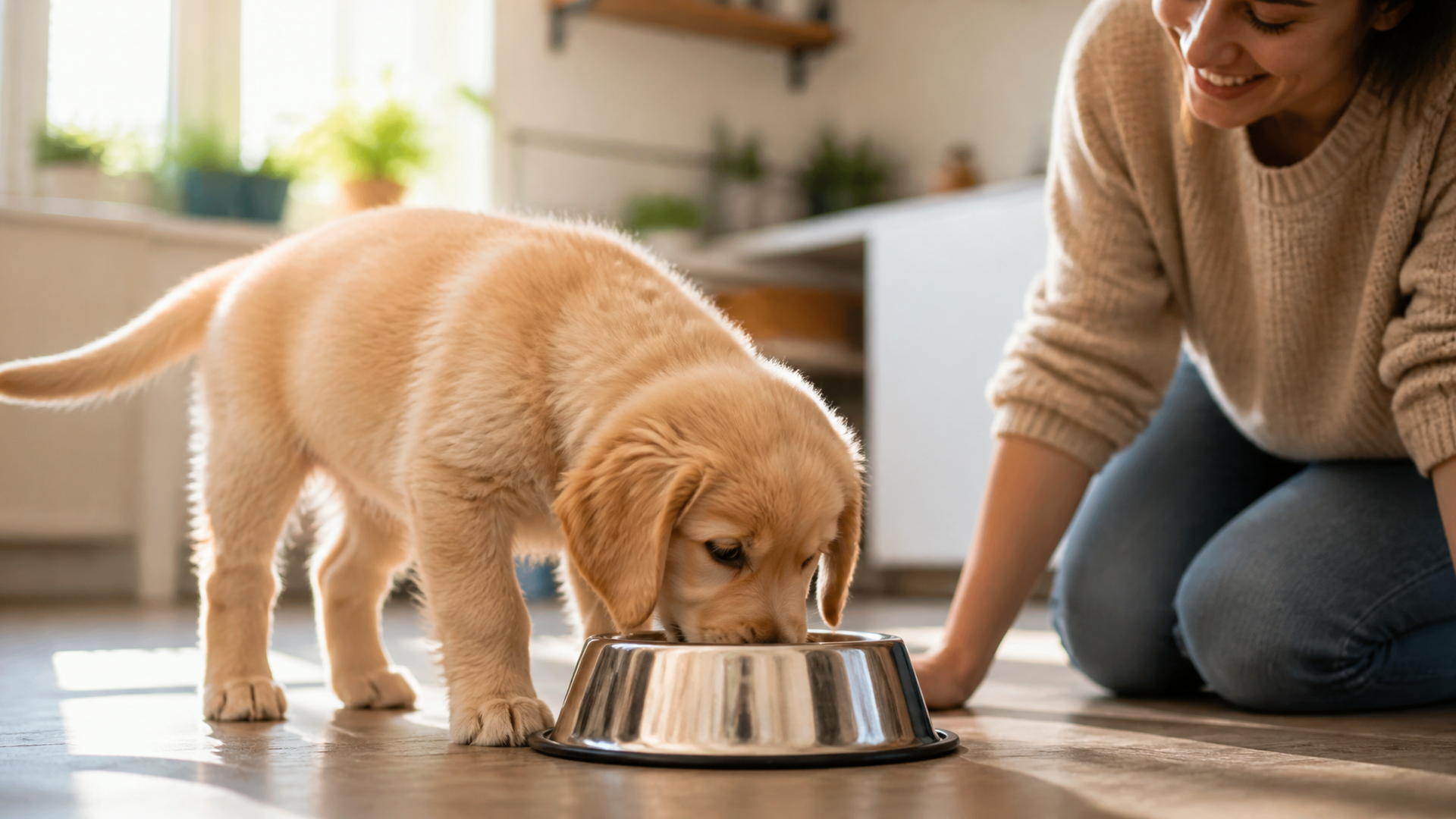
Best Puppy Dog Food on a Budget
Feeding a growing puppy well doesn’t mean emptying your wallet. The best budget-friendly puppy foods deliver complete nutrition with real protein as the first ingredient, DHA for brain development, and meet AAFCO requirements — all at a fraction of the premium brand price. One standout option is Purina ONE Plus Healthy Puppy Formula High Protein Natural Dry Puppy Food with added vitamins, minerals and nutrients – 31.1 lb. Bag, which uses real chicken first and includes DHA, prebiotic fiber, and antioxidants. A 31-pound bag typically lasts a medium-breed puppy 6–8 weeks, making it one of the most cost-per-feeding efficient choices available.

Affiliate Disclosure: This article contains affiliate links. If you purchase through them, we may earn a small commission at no extra cost to you.
Important applicability note: This guide covers the most common feeding situation — healthy puppies from toy to large breeds with no special medical needs. If your puppy has confirmed food allergies, a veterinary diagnosis (like kidney or liver issues), or is a giant breed (over 75 lbs adult weight), your food choice requires breed-specific large-breed puppy formulas with controlled calcium levels. For those cases, consult your vet before switching to any budget brand.
How to pick a budget food your puppy can thrive on
Not all budget foods support growth equally. Use this checklist to quickly evaluate any bag before you buy. Each item represents a pass/fail test you can run in 30 seconds at the store.
Puppy food budget checklist
- [ ] AAFCO statement for growth – Look for “complete and balanced for growth” or “all life stages” on the back panel. Skip any bag that only says “maintenance.”
- [ ] Named protein first ingredient – Real chicken, beef, salmon, or turkey should be listed first, not “meat meal” or “poultry by-product.”
- [ ] DHA listed – Docosahexaenoic acid supports vision and brain development. Check the guaranteed analysis or ingredients list for “DHA.”
- [ ] Calorie density matches breed size – Small breeds need 350–400 kcal/cup; large breeds need 300–350 kcal/cup to avoid overfeeding or orthopedic stress.
- [ ] No artificial colors, flavors, or preservatives – Budget food can still avoid junk. Purina ONE, for example, uses no artificial flavors or preservatives.
- [ ] Price per pound under $2.00 – For puppy food, anything above $2.50/lb is not budget territory unless you have a very small breed.
- [ ] Guaranteed analysis for protein ≥28% and fat ≥12% (dry matter basis). Lower numbers may not support rapid growth.
Why DHA matters in budget foods
Many cheaper puppy foods omit DHA to cut costs. But DHA is critical for learning ability and eye development during the first year. Purina ONE Plus Healthy Puppy Formula includes DHA derived from fish oil, a smart inclusion at its price point. If you’re choosing between a budget brand without DHA and one that includes it, the difference in brain development outcomes is measurable — puppies fed DHA-rich diets tend to learn basic commands faster during months 3–6.
Breed-size considerations
- Small breeds (under 20 lbs adult weight) – Need smaller kibble and higher calorie density (around 380–400 kcal/cup). Look for “small breed” formulas.
- Medium breeds (20–50 lbs) – Standard kibble works. Aim for 340–370 kcal/cup.
- Large breeds (over 50 lbs) – Require controlled calcium and phosphorus levels to prevent skeletal issues. Budget large-breed puppy foods are rarer; Purina ONE does not offer a specific large-breed puppy formula, so check labels for Ca:P ratio near 1.2:1.
A smart budget pick that checks every box
| Product | Best for | Key feature | Typical price |
|---|---|---|---|
| Purina ONE Plus Healthy Puppy | All breeds (except giant) | Real chicken #1, DHA, prebiotic fiber | ~$1.35/lb (31.1 lb bag) |
This formula consistently meets the checklist above at a price point that undercuts many premium brands by 30–40%. The 31.1-pound bag offers the best per-feeding cost for medium and large breed puppies.
Decision implication: If you buy Purina ONE, you’ll pay roughly $1.35 per pound — that saves you $10–15 per month compared to premium brands like Royal Canin or Hill’s. For most owners of medium to large breed puppies, this formula checks every nutritional box, so you can buy the largest bag with confidence. The only reason to avoid it would be a confirmed poultry allergy in your puppy. In that case, look for a budget fish-based option like Purina ONE True Instinct (turkey and venison) instead.
Store brands like Kirkland (Costco) or Member’s Mark (Sam’s Club) also produce AAFCO-approved puppy foods often under $1.20/lb. Their ingredient lists vary by batch, so verify the AAFCO statement and named protein on each bag before buying.
How to confirm the food fits your puppy
Once you have a bag in hand, take 60 seconds to verify it’s right:
1. Check the AAFCO statement on the back panel — it must say “growth” or “all life stages.”
2. Weigh your puppy and compare to the feeding chart on the bag. Start in the middle of the recommended range.
3. Monitor stool consistency over the first 3 days. Firm, brown logs are good. Loose yellow or green stools mean the food’s fat content or ingredient mix may not agree with your puppy.
4. Check body condition after one week. You should feel ribs with a thin fat layer — not see them. If ribs are visible, increase portions by 10%. If you can’t feel ribs, reduce by 10%.
Feeding guide for growing puppies
Use this general chart as a starting point. Adjust based on your puppy’s body condition and activity level. The real success check comes after one week: consistent firm stools and steady weight gain of 2–5% body weight per week.
| Puppy weight | Cups per day (split into 3–4 meals) | Ideal for breeds |
|---|---|---|
| 5–10 lbs | ¾ – 1¼ cups | Chihuahua, Pomeranian, Yorkie |
| 10–25 lbs | 1¼ – 2 cups | Beagle, French Bulldog, Corgi |
| 25–50 lbs | 2 – 3 cups | Bulldog, Border Collie, Boxer |
| 50–75 lbs | 3 – 4 cups | Labrador, Golden Retriever, German Shepherd |
| 75+ lbs | 4 – 5 cups | Great Dane, Mastiff (use large-breed formula) |
Reduce to 2 meals per day after 6 months for most breeds. For large/giant breeds, continue 3 meals until 8–12 months to reduce bloat risk.
Success checkpoint: After a full week on the new food, your puppy should have consistent firm stools, steady weight gain (2–5% body weight per week), good energy levels, and a shiny coat. If any of these are missing, check portion size first, then consider a protein-switch if symptoms persist beyond two weeks.
Trade-offs to know
Corn and grains aren’t evil. Many budget foods use corn as a carbohydrate source. For most puppies, corn is digestible and provides energy. Grain-free diets are $0.50–$1.00 more per pound and can be linked to dilated cardiomyopathy (DCM) in some dogs; unless your vet advises otherwise, stick with grain-inclusive budget foods.
Kibble size varies by formula — here’s where it can go wrong. The Purina ONE Healthy Puppy has medium-sized kibble. For toy breeds like Chihuahuas or Teacup Poodles, the pieces may be too large for tiny mouths. The consequence: your puppy might struggle to chew, leading to gulping without proper breaking, which can cause choking hazards or upset stomach. If you own a toy breed, you have two options: crush the kibble in a sealed bag with a rolling pin (works fine) or switch to a small-breed specific budget option like Pedigree Puppy (smaller kibble but no DHA). The trade-off is convenience versus brain development support.
Price per pound vs. feeding cost. A $2.00/lb bag that requires 4 cups per day costs more over a month than a $1.50/lb bag that needs only 3 cups. Compare the “cost per feeding” by dividing bag price by number of feedings it provides. For example, the Purina ONE 31.1 lb bag at $1.35/lb requires about $0.42 per feeding for a 30-lb puppy (4 cups/day, bag lasts ~48 feedings). A similarly priced smaller bag at $1.80/lb would cost $0.55 per feeding for the same puppy.
Quick answers to common follow-ups
Can I mix adult dog food with puppy food to save money?
No. Puppies need higher protein, fat, and calcium for bone development. Mixing dilutes those nutrients. Stick with a complete puppy food until your dog reaches 90% of adult weight.
How long should I feed puppy food?
For small breeds, switch to adult food at 9–12 months. Medium breeds at 12–14 months. Large breeds at 18–24 months. Giant breeds can stay on large-breed puppy food up to 2 years.
Is Purina ONE a good budget brand for sensitive stomachs?
Many owners report success with this formula for mild digestive issues, thanks to the prebiotic fiber. If your puppy has chronic loose stool or vomiting, consult your vet before relying on any single brand.
What if my puppy refuses to eat the budget food?
Try a gradual transition over 7 days (75% old food for 3 days, 50/50 for 2 days, 25% old for 2 days). If refusal continues, the kibble size or protein source may be the issue. Consider trying a different budget brand with a different first protein, or mix in a small amount of warm water to release aroma.
Choosing a budget puppy food with named protein first, DHA, and an AAFCO growth statement gives your growing dog what they need without overspending. Buying the largest bag that stays fresh (stored in an airtight container) brings the cost per feeding even lower. This approach works for the vast majority of healthy puppies and leaves your wallet intact.