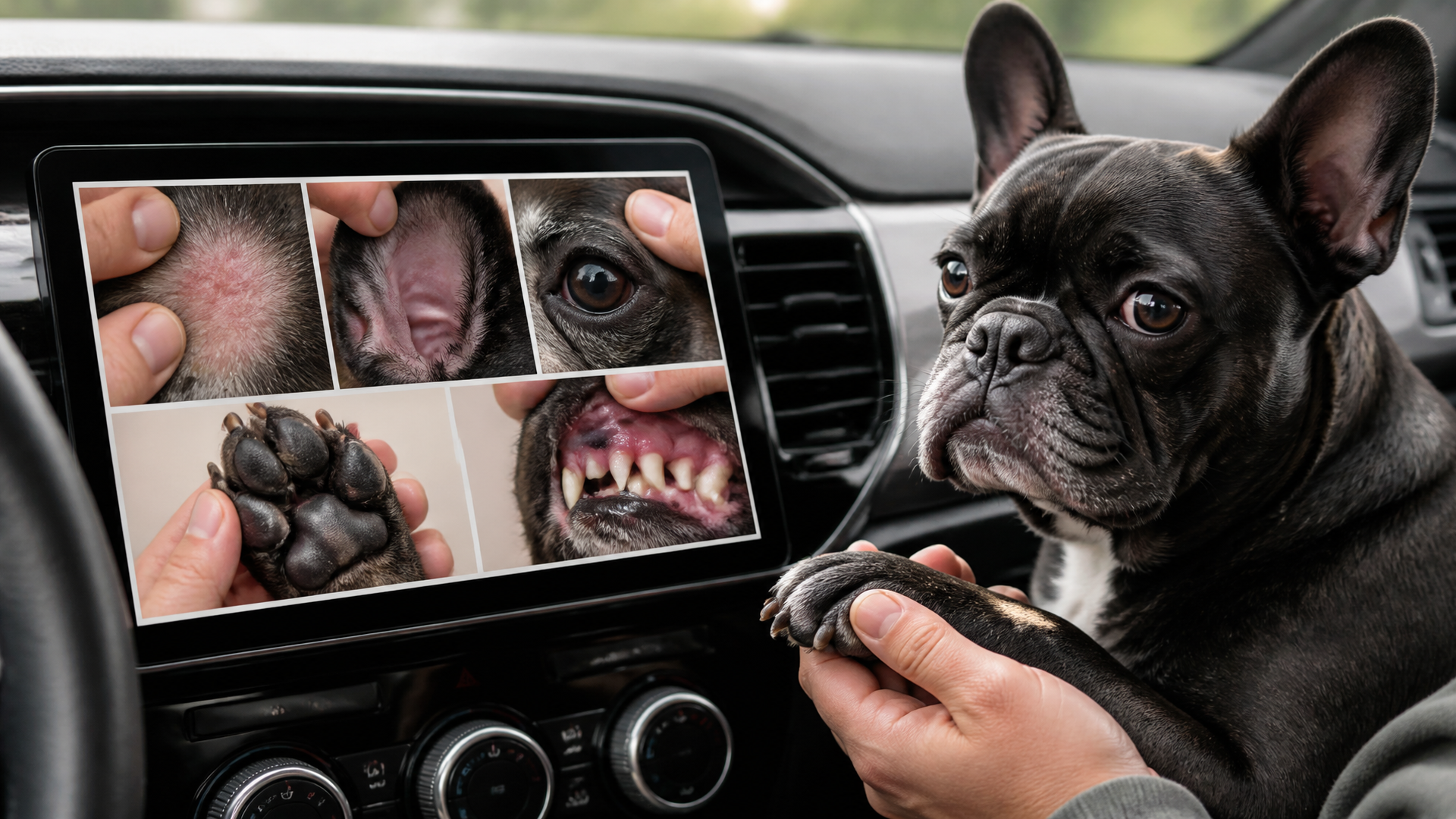
French Bulldog Limping Symptoms: Warning Signs & What To Do
Your French Bulldog is limping. Here’s what to check first — and when a vet visit can’t wait. French Bulldogs have a vulnerable spine and joint structure that makes a limp more than a minor inconvenience. This guide gives you the triage steps, common causes, safe home care, and the red flags that mean “call the vet now.”

Is This an Emergency? Quick Triage Check
Before anything else, run through these three checks:
- Is your Frenchie bearing any weight on the leg? Holding it completely off the ground is more urgent than a slight favor.
- Are they whining, shaking, or refusing to move? Pain beyond the limp matters.
- Can you see swelling, an odd angle, or an open wound? Visible deformity or blood means an immediate vet trip.
If you answered yes to any, go to the vet today. If they’re putting weight down but limping lightly, you can assess further.
What Makes a Frenchie’s Limp Different
Frenchies aren’t built like other dogs. Short legs, heavy chest, and compact spine create unique vulnerabilities. The most common causes include:
- Intervertebral Disc Disease (IVDD) — a slipped disc causing hind-leg weakness or dragging. This is a Frenchie emergency.
- Hip Dysplasia — loose hip joints that worsen with age. Look for a bunny-hop gait or stiffness after rest.
- Patellar Luxation — a kneecap that pops out. Your Frenchie might skip a step, then be fine a minute later.
- Elbow or Shoulder Dysplasia — joint malformations causing front-leg limping.
- Paw Injuries — cuts, torn nails, or debris between pads. Frenchies’ heavy front-end landing makes paw injuries common.
- Cranial Cruciate Ligament (CCL) Tears — the dog version of an ACL tear. Partial tears cause mild limping; full tears mean no weight-bearing.
Check These 4 Things at Home Before Calling the Vet
You don’t need a vet degree for a safe first look. Examine in this order.
Paw & Nail Check
Run your fingers gently between each toe pad. Look for thorns, burrs, broken glass, or matted fur hiding a wound. Check each nail for splits or cracks. French Bulldogs often tear a nail jumping off furniture — light-colored claws let you see if bleeding has stopped.
Leg & Joint Feel
With your Frenchie lying on their side, gently run your hand down the leg from shoulder or hip to paw. Stop if they flinch or pull away. Feel for heat, swelling, or lumps. Compare both legs — if one feels warmer or thicker, that joint may be inflamed.
Movement Observation
Watch them walk on a flat, non-slip surface. Does the limp get worse after rest? That points to arthritis or dysplasia. Does it come and go randomly? That often matches patellar luxation. If the limp disappears after 5–10 steps and only returns after long naps, arthritis is likely — but still worth a vet check for a plan.
Back Sensitivity Check
Lightly run your hand along your Frenchie’s spine from neck to tail. If they flinch, tuck their tail, or sit down suddenly, this could be IVDD. Stop immediately and call your vet. A Frenchie with back pain should not jump, play, or climb stairs until evaluated.
The French Bulldog Limping Symptom Checklist
Use this quick reference to decide your next step and verify the fix worked.
| Symptom | Likely Cause | Action Needed | How to Confirm Fix |
|---|---|---|---|
| Mild limp, still playing | Muscle strain or paw issue | 24–48 hours rest, then reassess | After rest, watch for even weight-bearing on flat ground for 2 minutes |
| Limp worse after rest, better with movement | Arthritis or dysplasia | Vet visit; joint supplements may help long-term | Improvement within 3–5 steps after getting up suggests arthritis |
| Leg held completely up, no weight-bearing | Fracture, CCL tear, or dislocation | Vet today — do not force walking | No home confirmation; if still non-weight-bearing after 2 hours, go now |
| Hind-leg weakness or dragging | IVDD (slipped disc) | Emergency vet — crate rest, no jumping or stairs | No home confirmation; any dragging = vet immediately |
| Skipping step then fine | Patellar luxation | Vet can confirm; many cases managed with weight control | Watch for skip frequency; if more than once per day, mention to vet |
| Swelling or heat in one joint | Infection or inflammatory arthritis | Vet visit — may need antibiotics or anti-inflammatories | Compare temperature with other leg; if warmer after 24 hours, don’t wait |
| Limping + fever, lethargy, or not eating | Systemic illness (e.g., tick disease) | Vet today | Take temperature rectally — above 103°F means urgent visit |
Safe Home Care: What You Can Do (And What Not To)
If your Frenchie has a mild limp with no red flags, here’s what helps.
What’s safe:
- Restrict activity for 48 hours — no jumping on/off furniture, no stairs, no rough play. Crate rest or a small pen works best.
- Offer an elevated bowl so they don’t strain their neck to eat or drink.
- Apply a cold pack wrapped in a thin towel to any swollen joint for 10 minutes, twice a day.
- Keep them at a healthy weight. Extra pounds hit Frenchie joints hard — a 5-pound difference can mean far less pain over time.
What’s NOT safe:
- Don’t give human pain relievers like ibuprofen, acetaminophen, or aspirin. They are toxic to dogs.
- Don’t stretch or massage a leg that seems painful — you can make an injury worse.
- Don’t let them “play it off.” French Bulldogs will push through pain and can worsen a tear or disc issue.
How to Confirm the Rest Worked
After 48 hours of strict rest, test your Frenchie’s recovery. Lead them on a short leash across a flat, non-slippery floor. Watch for 10–15 steps:
- Success: No limp, even weight on all four legs, normal tail carriage. Gradually return to normal activity over 2–3 days.
- Partial improvement: Still favoring the leg but putting weight down. Continue 24 more hours of rest. If no improvement after 72 hours total, call your vet.
- No improvement or worse: Leg still lifted or visible pain. Do not continue resting — schedule a vet visit today.
When the Vet Must Get Involved
Some situations need a professional — no amount of home rest will fix them.
- Limping that doesn’t improve after 48 hours of rest.
- Any hind-leg weakness, wobbling, or dragging — hallmark sign of IVDD.
- Limping in a puppy under one year. Growth-plate injuries need early treatment.
- Limping that shifts between legs — often a systemic issue like tick-borne disease.
- Swelling, heat, or redness around a joint.
- Your Frenchie stops eating, has a fever, or seems unusually tired.
At the vet, expect a physical exam, possibly X-rays, and sometimes advanced imaging (MRI or CT) for spine or ligament issues. Treatment ranges from anti-inflammatories and strict rest to surgery, depending on the diagnosis.
How to Prevent Future Limping Episodes
You can’t prevent every injury, but these steps reduce the odds.
- Use ramps instead of stairs. Frenchies’ spines can’t handle repeated stair impact. Place ramps at beds, couches, and cars — a sturdy, nonslip ramp like the PetSafe CozyUp works well.
- Keep them lean. A 28-pound Frenchie is far less likely to develop joint problems than a 35-pound one. Ask your vet for a body condition score.
- Skip high-impact exercise. No long runs, no intense fetch on pavement, no jumping for frisbees. Short walks and gentle play are better.
- Add joint support. Talk to your vet about fish oil (Omega-3s) or a glucosamine/chondroitin supplement such as Zesty Paws Advanced Joint Support.
- Check paws after every walk. Groom between toe pads. Keep nails trimmed to avoid catching and tearing.
- Use a harness, not a collar. A collar puts pressure on the neck and spine — a harness like Gooby Comfort X distributes force safely.
Frequently Asked Questions
Why does my French Bulldog limp after sleeping?
That’s classic arthritis or hip dysplasia. Joints stiffen during rest. A few gentle steps usually loosen them up. If the limp doesn’t fade within a minute or two, have your vet evaluate.
Can a French Bulldog limp from an ear infection?
Yes — ear infections cause head-tilting and balance issues that can look like a limp. Check for smell, discharge, or scratching at the ear. If those are present, treat the ear first.
How long should I wait before taking my Frenchie to the vet for limping?
If they’re weight-bearing and otherwise happy, 48 hours of strict rest is reasonable. If not improving, in pain, or any red flags from the checklist above, go sooner.
Is limping always serious in French Bulldogs?
No, but it deserves attention. Many limps are minor paw injuries or mild strains. But because Frenchies are prone to IVDD and joint dysplasia, take every limp seriously and monitor closely.
Save This Guide
French Bulldogs limp for different reasons than most dogs — their short legs, heavy build, and vulnerable spine change the stakes. Use the checklist above to decide if your Frenchie needs a vet or just rest, and keep the prevention tips handy to protect their joints long-term. This guide covers Frenchie limping symptoms, home checks, and when to call the vet.
This page contains affiliate links. As an Amazon Associate, I earn from qualifying purchases at no extra cost to you.