Congenital Hip Dysplasia in Beagles
is a developmental condition where the hip joint doesn’t form properly, causing looseness, pain, and eventually arthritis. While larger breeds are more commonly affected, Beagles have a moderate risk — about 4–6% of the breed develops it. The key is catching it early: most signs appear between 4 and 12 months old, and early intervention can drastically slow joint damage.

If you notice your Beagle bunny-hopping when running, hesitating to jump on furniture, or showing stiffness after exercise, these could be early clues. This guide covers what to look for, how vets diagnose it, treatment options, and a daily care flow tailored specifically to Beagles.
Why Beagles Are Prone to Hip Dysplasia
Hip dysplasia is polygenic — inherited through multiple genes. Beagles also have a body type that contributes: a deep chest and relatively narrow hips put extra stress on the joint. Their active, bouncy nature (especially as puppies) can exaggerate underlying joint looseness.
Breed-specific risk factors include weight management challenges since Beagles easily gain weight, and extra pounds increase joint load. A 25-pound dog carrying 2 extra pounds is like a 150-pound person carrying 12 extra pounds. They’re also high-energy for their size — recall training, fetch, and squirrel-chasing all stress the hips. Their growth rate plays a role too, as Beagles reach adult size around 12–18 months, and rapid growth during puppyhood can worsen dysplasia if genetics are predisposed.
Tip: Keep your Beagle lean. Use a kitchen scale to measure kibble — not a scoop — to avoid overfeeding.
Early Warning Signs Every Beagle Owner Should Know
Beagles are stoic — they often hide pain until it’s severe. Watch for these subtle changes:
| Sign | What It Looks Like |
|---|---|
| Bunny-hopping gait | Both hind legs move together when running |
| Hesitation to jump | Pauses before getting on the couch or into the car |
| Stiffness after rest | Rising like a senior dog after naps |
| Reluctance to go up or down stairs | Whining, slowing, or refusing |
| Shifting weight off one hind leg | Swaying hips, tucking one leg under |
| Difficulty rising from a down position | Rocks back, uses front legs to push up |
| Reduced play drive | Less interest in fetch or tug-of-war |
| Muscle loss in hindquarters | Noticeable shrinking of thigh muscles |
Many owners mistake early signs for a pulled muscle or growing pains. If symptoms last more than 2–3 days, see a vet.
How Vets Diagnose Hip Dysplasia in Beagles
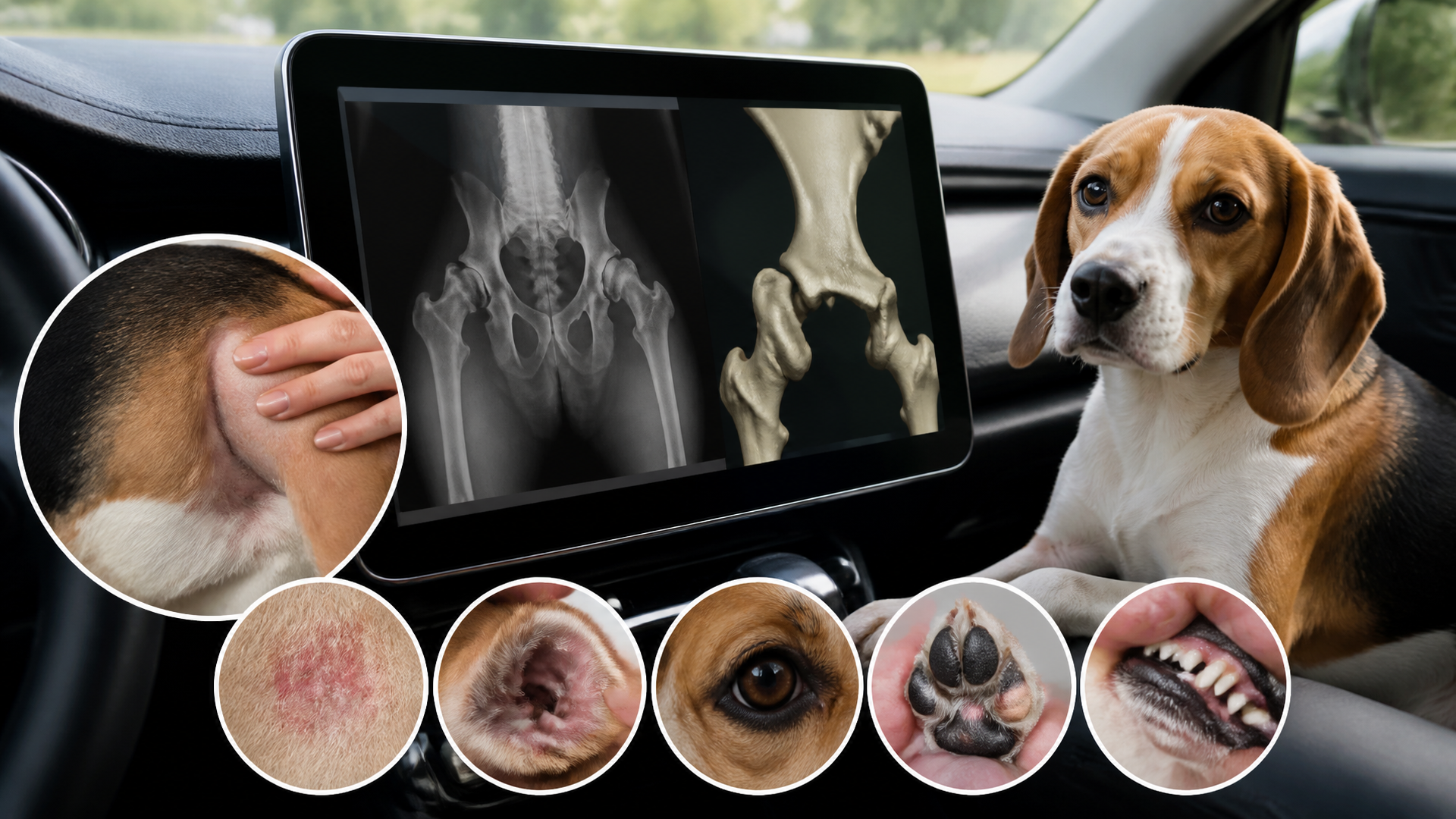
The diagnostic process is straightforward. During a physical exam, the vet will check joint looseness using the Ortolani and Barlow maneuvers while your Beagle is sedated. Sedated X-rays let the vet evaluate joint fit and any early arthritic changes. For puppies under 2 years old, special positioning (PennHIP or OFA) gives a more accurate looseness measurement. CT or MRI may be used for complex cases or surgical planning.
Verification step you can take: Ask your vet to perform a PennHIP evaluation at 4 months of age. This is more accurate than standard X-rays for predicting future arthritis risk. If your Beagle is from a breeder who doesn’t certify hips (OFA or PennHIP), consider screening at 12 months. Screening X-rays typically run $200–$500 depending on location and sedation.
Treatment Options: From Conservative Care to Surgery
The best approach depends on your Beagle’s age, severity, and your budget. Here’s a comparison to help you discuss options with your vet:
| Approach | Best For | What It Involves | Typical Cost Range |
|---|---|---|---|
| Conservative management | Mild to moderate cases (young or adult) | Weight control, joint supplements, physical therapy, anti-inflammatory meds as needed | $50–$150/month ongoing |
| Juvenile pubic symphysiodesis (JPS) | Puppies under 20 weeks with mild looseness | Outpatient surgery that fuses the growth plate to tighten the hip socket | $800–$1,500 |
| Triple pelvic osteotomy (TPO) | Puppies 4–12 months with good joint shape | Cutting and rotating the pelvis to improve socket coverage | $2,500–$4,500 per hip |
| Total hip replacement (THR) | Severe cases (any age, most common in adults) | Replaces the entire joint with metal and plastic components | $3,500–$7,000 per hip |
| Femoral head ostectomy (FHO) | Severe cases where THR isn’t an option (budget or health) | Removes the femoral head; creates a false joint with scar tissue | $1,500–$3,000 |
Conservative management is the foundation — even dogs that later get surgery benefit from it. For most Beagles with mild-to-moderate dysplasia, a good management protocol can keep them comfortable and active for years. But it requires daily commitment. If you can’t maintain strict weight control and joint supplements, surgery may be a better long-term choice.
While total hip replacement offers the best long-term outcome, it requires strict post-op confinement (8–12 weeks) — challenging for an active Beagle. The cheaper FHO may result in a permanent limp and muscle loss. Discuss both with your vet based on your Beagle’s temperament and your lifestyle.
Product suggestions for conservative care:
- Orthopedic bed: A thick memory-foam bed (like the Big Barker or similar) reduces pressure points.
- Joint supplements: Look for glucosamine + chondroitin + MSM, plus omega-3 oils (fish oil).
- Ramps: For car or couch access — prevents jumping stress.
- Non-slip flooring: Rubber-backed runners or yoga mats on slippery floors.
(Disclosure: Some links in this article may be affiliate links. We may earn a small commission at no extra cost to you.)
Daily Care Flow for Beagles with Hip Dysplasia
This management plan applies to Beagles with mild-to-moderate hip dysplasia confirmed by a vet. If your Beagle has severe dysplasia or is a candidate for surgery, your vet may recommend a different protocol. Use this step-by-step flow at home.
Preparation
Get an orthopedic bed and place it in a warm, draft-free spot. Buy a ramp for furniture and car access. Have joint supplements and anti-inflammatory meds (vet-prescribed) on hand. Use a kitchen scale to measure kibble portions.
Early Checkpoints (Every Morning)
Observe your Beagle’s movement as they get up. Any stiffness, whining, or reluctance to stand? Check weight weekly. A 1-pound gain in a 25-pound Beagle is significant. Look for limp or bunny-hop during the first potty break. If present, reduce activity for the day.
Ordered Action Plan
Step 1: Feed measured meals on a schedule. Weigh food using a kitchen scale (not a scoop) to avoid overfeeding. Divide daily portion into 2 meals. No free-feeding.
Step 2: Give joint supplements with breakfast. Follow label dosage based on your Beagle’s current weight. Most chewable tablets work well.
Step 3: Short, low-impact walk (10–15 minutes). Walk on grass or soft dirt. Avoid pavement. Use a harness — no collar to reduce neck strain.
Step 4: Midday rest with ice or warm compress if needed. Apply a warm compress (not hot) for 10 minutes if your Beagle seems stiff. Let them nap on their orthopedic bed.
Step 5: Afternoon structured play (5–10 minutes). Use a flirt pole or gentle fetch on grass. Stop if they start limping.
Step 6: Evening walk (10–15 minutes) and joint supplement again. Repeat the morning walk style.
Step 7: Final potty break and nighttime comfort. Provide a soft, supportive sleeping area.
Likely Causes of Flare-Ups
Weight gain — even 1–2 extra pounds increases pain. High-impact play (jumping, twisting, running uphill) can trigger flare-ups. Slippery floors cause dogs with dysplasia to slide and overextend. Cold weather stiffens joints, and missed medication or supplement doses can also lead to problems.
Friction Points and Fixes
| Friction | Fix |
|---|---|
| Beagle won’t stop eating | Use a slow feeder bowl or puzzle toy for meals |
| Refuses to walk on leash | Try a front-clip harness to reduce pulling |
| Hates joint supplements | Crush and mix with wet food or use soft chews |
| Slides on floors | Lay down rubber-backed runners on high-traffic paths |
Escalation Signals (Call the Vet)
Sudden non-weight-bearing lameness (won’t put any weight on a leg). Yelping or crying when moving or being touched. Inability to stand or walk for more than 5 minutes. Loss of appetite or lethargy along with joint stiffness. Progressively worsening signs despite faithful conservative management.
Success Check
Your Beagle is doing well if they rise easily from a down position, show a normal happy greeting when you come home, can walk 20–30 minutes total per day without limping afterward, and maintain a steady lean weight.
3 Practical Tips for Beagles with Hip Dysplasia
Tip 1: Keep your Beagle lean — and measure food
Actionable step: Weigh your Beagle every two weeks and adjust food by 10% if weight shifts. Use a kitchen scale for kibble, not a scoop.
Common mistake: Allowing free-choice feeding or grazing. Beagles are food-motivated and will overeat. Measure portions and feed on a schedule.
Tip 2: Use short, frequent walks instead of one long run
Actionable step: Three 15-minute walks per day are better than one 45-minute hike. Stick to soft surfaces like grass or dirt paths.
Common mistake: Pushing through the warm-up when your Beagle limps. If they limp after the first 5 minutes, stop and rest. Limping is a signal to back off, not push harder.
Tip 3: Build muscle with low-impact activities
Actionable step: Use a flotation vest for swimming (even in a bathtub or kiddie pool) 2–3 times a week. Swimming strengthens hindquarters without joint impact.
Common mistake: Tossing a ball for fetch on hard pavement. Instead, play fetch on grass or use a flirt pole that encourages turns and stops — but keep sessions under 10 minutes.
When to Call the Vet
Escalate care if your Beagle experiences sudden non-weight-bearing lameness, yelping or crying when moving or being touched, inability to stand or walk for more than 5 minutes, loss of appetite or lethargy along with joint stiffness, or progressively worsening signs despite conservative management.
During a flare-up (acute pain episode), restrict activity to short leashed potty breaks only for 3–5 days. Apply a warm compress (not hot) to the hip for 10 minutes, 2–3 times daily. Give prescribed anti-inflammatories exactly as directed — never give human NSAIDs like ibuprofen.
Frequently Asked Questions
Can hip dysplasia in Beagles be prevented?
You can’t change genetics, but you can reduce risk by maintaining a healthy weight, avoiding high-impact exercise during growth (no jogging on pavement before 12 months), and choosing a breeder who screens for hip dysplasia.
Is hip dysplasia painful for Beagles?
Yes, but Beagles often hide pain. Watch for subtle behavioral changes — less eager to greet at the door, more sleeping, or flinching when touched near the hips. If you see these signs for more than 2–3 days, schedule a vet visit.
What’s the difference between PennHIP and OFA screening?
PennHIP measures joint looseness (distraction index) and can be done as early as 4 months. OFA evaluates X-rays after 24 months and assigns a rating (excellent, good, fair). PennHIP is better for early prediction; OFA is the breed club standard for breeding decisions.
Can a Beagle with hip dysplasia still go on hikes?
With careful management, yes — if your Beagle is lean, well-supplemented, and you stick to moderate trails (flat, soft surfaces) with short distances. Avoid steep inclines and long hikes over 2 miles. Watch for signs of fatigue and stop immediately if limping appears.
Save This Guide: Congenital hip dysplasia in Beagles is manageable with early detection, consistent daily care, and close attention to weight. Bookmark this page to reference the daily care flow and escalation signals whenever your Beagle’s hip health changes. The key takeaway: keep your Beagle lean, use short low-impact walks, and don’t ignore subtle signs — they’re your best tool for slowing arthritis and maintaining quality of life.