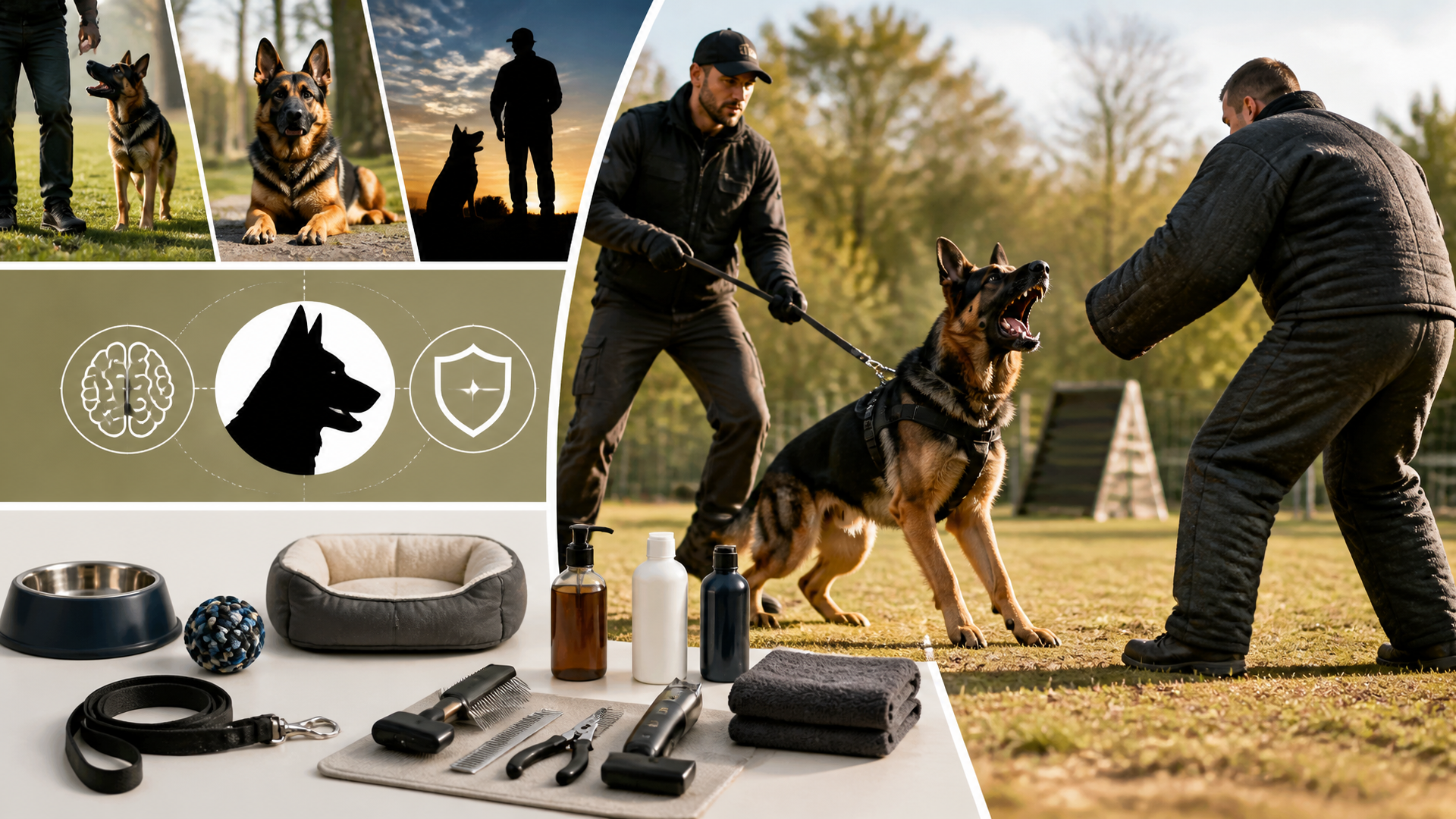
German Shepherd Protective Behaviors: Step-by-Step Training Guide
Your German Shepherd’s protective instinct isn’t a flaw — it’s hardwired into the breed. The goal isn’t to suppress it, but to shape it so your dog learns when to guard and when to stand down. This guide walks you through training that builds reliable protective behaviors without creating a reactive or anxious dog.

Quick Answer: What Protective Behaviors Look Like in a Well-Trained GSD
A trained German Shepherd shows alertness, controlled barking, and a calm body stance when something feels off — then immediately relaxes when you signal “all clear.” The dog looks to you for direction rather than acting on impulse. Untrained protective behavior looks different: lunging, non-stop barking, hackles raised, and refusal to disengage.
Your job as handler is to teach three things: the alert, the hold, and the release. Every training session builds toward that sequence.
Tools and Prerequisites Before You Begin
Gear you’ll need:
- A well-fitted flat or martingale collar (no prong or e-collar for early sessions)
- A 6-foot leather or biothane leash for control work
- High-value treats cut into pea-sized pieces (boiled chicken, freeze-dried liver, string cheese)
- A long line (15–20 feet) for distance work once basics are solid
- A quiet training space indoors or in a fenced yard
Prerequisite skills your GSD should already have:
- Reliable sit, down, stay, and come (at least 80% compliance in low distraction)
- Loose-leash walking in your house or yard
- No resource-guarding issues with people or other dogs
If your German Shepherd hasn’t mastered those basics, stop here. Protective training layered on top of poor obedience will backfire every time.
The 3-Stage Training Plan for Protective Behaviors
Stage 1: Teach the Alert (Weeks 1–2)
The alert is a controlled bark-and-look. Your dog learns to signal something unusual without escalating.
1. Set up a trigger. Have a helper knock on the door or ring a doorbell from outside. You stand beside your GSD on leash.
2. Mark the moment. The instant your dog’s ears perk or head turns toward the sound, say “guard” in a calm, firm voice.
3. Reward the look, not the lunge. If your dog stays planted and just watches, treat. If they lunge forward, take a step back and reset.
4. Add one bark. Once your dog reliably looks at the sound, wait for a single bark. Mark it (“yes”) and reward. Then immediately cue “quiet” and treat again.
Checkpoint: Your dog should be able to alert with one or two barks, then look to you for the next cue. If they’re still barking past three seconds, go back to rewarding silence before the alert.
Stage 2: Teach the Hold (Weeks 3–4)
The hold is the middle ground — your dog stays alert and ready but does not advance.
1. Use the same door-knock or yard approach scenario. Your helper triggers the alert.
2. Give a hand signal (open palm toward your dog’s face) and say “steady.”
3. Reward every second of calm alertness. Keep treats coming in a slow, steady stream as long as your dog stays beside you with soft focus.
4. Release with “okay.” After 5–10 seconds of holding, use your release word and let your dog sniff where the sound came from. This closes the loop.
Friction point: Many German Shepherds want to physically block or circle. If your dog moves in front of you, pivot and step into their space to reclaim position. Do not let them rehearse guarding your front door alone.
Stage 3: Teach the Stand-Down (Weeks 5–6)
Stand-down is the most important skill. Your dog must learn to switch from alert mode to neutral on one cue.
1. Cue “place.” Send your dog to a bed or mat. The physical distance helps break the protection mindset.
2. Reward duration. Start with 10 seconds on the mat, then build to 2 minutes. Use a chew or frozen Kong to make the mat rewarding.
3. Proof with helpers. Have your helper walk past the window or knock again while your dog is on the mat. If your dog breaks, reset without scolding — just guide back.
4. Vary the intensity. Practice stand-down at the front door, in the yard, and eventually on walks when encountering another dog or person.
Success check: You should be able to say “quiet, place,” and your dog moves to their mat within 5 seconds, stays until released, and does not re-engage the trigger.
Training Troubleshooting for Common GSD Challenges
My dog won’t stop barking. You’re moving too fast. Go back to Stage 1 and reward only silence before the alert. If your dog barks past two times, end the session and try again at a lower intensity (helper farther away, door closed).
My dog growls and shows teeth. This is escalation, not protection. Stop the exercise immediately. This is your escalation threshold: contact a certified behavior consultant (CPDT-KA or IAABC) before continuing. Protective training should never produce aggressive displays at people. Do not attempt another session until a professional evaluates your dog.
My dog ignores me when they’re alerting. The trigger is too intense. Move the helper to the other side of the yard or have them stand still instead of moving. Your GSD should always have one ear tuned to you. If they can’t look away from the trigger, the distance is too close.
The behaviors work indoors but not on walks. This is normal. German Shepherds generalize slowly. Practice the same three-stage sequence in your yard, then on a quiet sidewalk, then at a park edge. Each new environment requires a brief back-to-basics refresher.
Quick Decision Aid: Is Your GSD Ready for Protective Training?
| Check | Pass | Needs Work |
|---|---|---|
| Sits on first cue in your kitchen | ✅ | Go back to basic obedience |
| Walks calmly past a stranger on leash | ✅ | Practice neutrality first |
| Can settle on a mat for 5 minutes | ✅ | Build duration before adding triggers |
| Stops barking when you say “quiet” | ✅ | Train quiet cue separately first |
| Recalls away from the front door | ✅ | Proof recall at higher distraction |
If you checked “Needs Work” on more than one, spend two weeks on the missing skills before starting Stage 1.
Breed-Specific Reasons This Works for German Shepherds
German Shepherds were bred to think independently while taking direction. Unlike some protection breeds that act first and ask later, the GSD benefits from a clear chain: alert — hold — stand-down. This uses their natural discernment (the breed’s famous “good judgment”) while keeping you as the decision-maker.
A trained GSD will also generalize protective cues to the home, car, and walking routes — but they need you to keep testing each context. A dog that alerts appropriately at the front door may not automatically do the same on a trail. Test regularly and refresh as needed.
Related Questions Owners Often Ask
Can I train my German Shepherd puppy to be protective? Not directly. Puppies under 12 months should focus on socialization, neutrality, and basic obedience. Protective training starts after the dog has a stable temperament and reliable recall — usually around 18–24 months.
Will protective training make my dog aggressive? Only if done poorly. Proper protective training teaches controlled responses with clear start and stop cues. If you ever see stiff posture, hard staring, or refusal to disengage, scale back immediately. If you see growling or teeth-baring, stop and call a professional.
How long does it take to train protective behaviors? Expect 6–8 weeks of consistent practice (three short sessions per week) to see reliable alert-and-stand-down behavior. Full generalization to all environments takes 4–6 months.
Should I use a prong collar or e-collar for protection training? No. Balanced tools are best left to experienced sport trainers working in structured decoy scenarios. For home protection training, a flat collar and positive-reinforcement sequence produce a more reliable, less stressed dog.
When should I stop DIY training and call a professional? Stop immediately if your German Shepherd growls, shows teeth, or makes contact with a person during training. This is not protective behavior — it’s aggression. Do not attempt another session. Seek a certified behavior consultant (CPDT-KA or IAABC) for evaluation.
Save This Guide
Protective training for your German Shepherd comes down to one sequence: alert, hold, stand-down. Train each stage separately, test in new environments, and never push past the point where your dog can still look to you for direction. The best protection dog is the one that follows your lead. Bookmark this page to reference during each training stage.
This article contains affiliate links. If you purchase a product through these links, we may earn a small commission at no extra cost to you.