Evolution of The Poodle Cut
That perfectly round “poodle puff” isn’t just for looks — every clip in the classic poodle cut evolution started as a working solution to cold water and heavy coats. The modern version prioritizes your dog’s comfort and your maintenance reality. Here’s how each major cut developed, which ones actually work for pet owners, and the one mistake that forces most poodles into a full shave-down.

From Water Retriever to Show Ring Icon
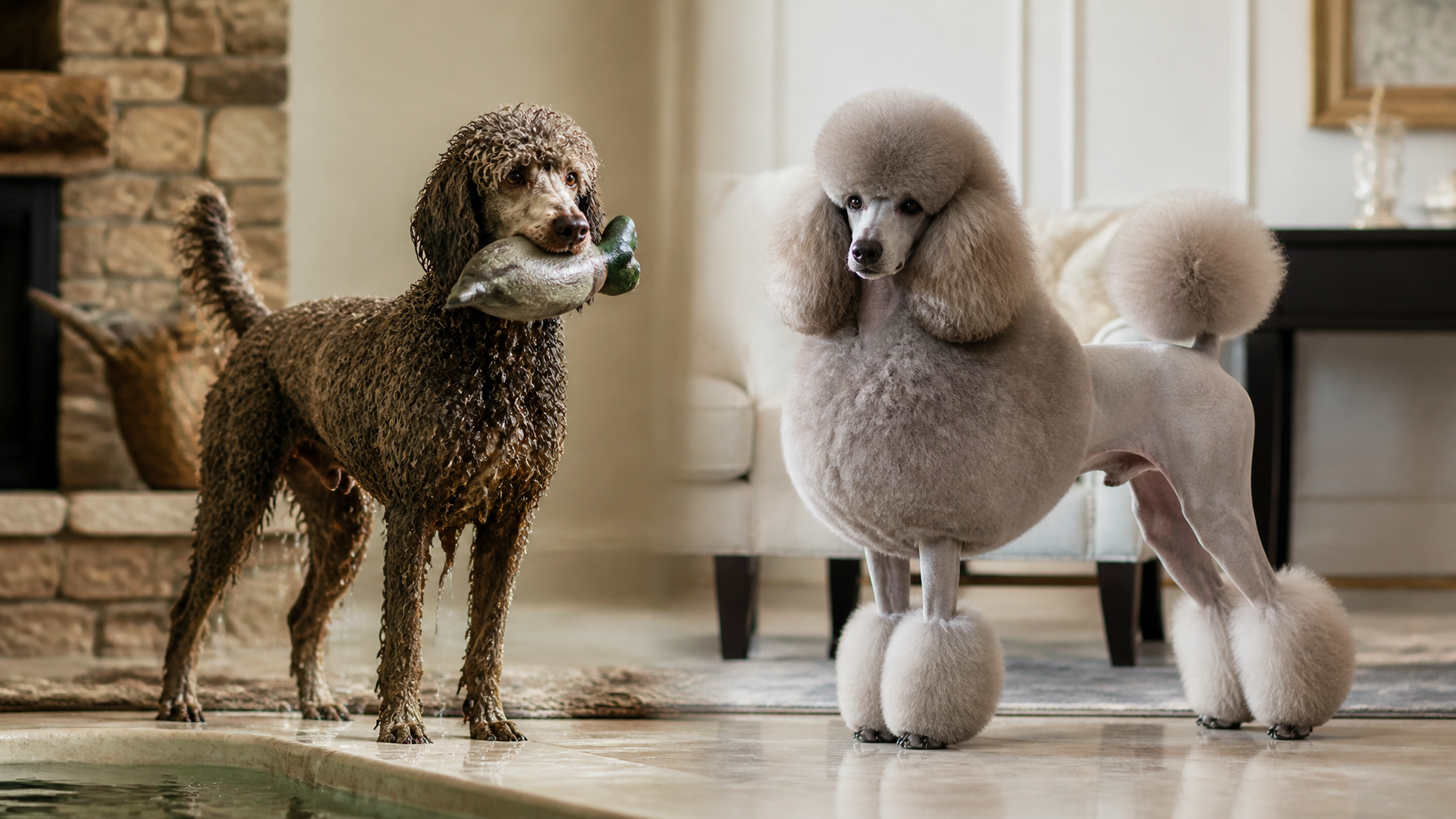
Poodles were bred as water retrievers in Germany and France. Their curly, dense coat kept them warm in icy water — but it also trapped water and weighed them down. Hunters began shaving parts of the coat to reduce drag while leaving hair on the chest and joints for warmth and protection.
| Era | Purpose | Key Features |
|---|---|---|
| 1500s–1700s | Working dog function | Shaved rear/legs for swimming efficiency; hair left on chest/joints for warmth |
| 1800s | Early show ring | “Lion clip” standardized; pom-pons became decorative |
| 1900s–1950s | Pet refinement | Simpler, easier-to-maintain versions emerged |
| 1960s–present | Customization explosion | Puppy clip, teddy bear, sporting clip, Asian fusion, creative coloring |
The original “lion clip” (full mane, shaved rear, pom-poms on legs and tail) was the first standardized poodle cut in dog shows. Breeders refined it for aesthetics rather than function, and two distinct show-ring standards emerged.
Continental vs. English Saddle: What Still Matters
These two cuts are the most recognizable historic poodle clips, and they’re still required in AKC conformation rings. But here’s the applicability boundary: unless you’re showing your poodle, these cuts are impractical for nearly every pet owner.
Continental Clip
- Shaved hindquarters with pom-poms on hips
- Shaved face, throat, feet, and base of tail
- Bracelets on legs
- Requires professional grooming every 3–4 weeks
English Saddle Clip
- Shaved hindquarters with hair left on rear legs (no pom-poms)
- Distinct “saddle” shape along the back
- Shaved face, throat, and feet
- Same maintenance commitment as Continental
The trade-off: Both expose large areas of skin to sunburn, cold, and debris. Unless you’re competing, you’ll spend more time managing skin irritation than enjoying your dog. Most professional groomers will actively discourage these cuts for pets.
The Pet Cuts That Actually Work
Most poodle owners today choose one of these four cuts. They’re comfortable for the dog and realistic to maintain.
| Cut | Coat Length | Grooming Frequency | Best For |
|---|---|---|---|
| Puppy Clip | 1–2 inches all over | Every 4–6 weeks | First-time owners, active dogs |
| Teddy Bear | 1–3 inches, rounder face | Every 4–8 weeks | Owners who want a softer look |
| Sporting Clip | 1/2–1 inch all over | Every 6–8 weeks | High-energy dogs, warm climates |
| Biddable Cut | 1–2 inches, shorter for ease | Every 4–6 weeks | Owners who want show-style shape without full maintenance |
Critical boundary: The teddy bear cut is the most requested poodle style in the US — but it’s also the most likely to fail. If you can’t brush 3–4 times per week minimum, skip the teddy bear and go with a sporting clip. The consequence of choosing based on looks alone: painful mats at the skin line and a forced full-body shave-down that resets weeks of growth.
How to Choose the Right Cut for Your Poodle (Operator Flow)
Start with an honest assessment of your lifestyle and your dog’s actual needs. Follow this sequence to avoid the most common failure mode — picking a cute cut you can’t maintain.
Preparation – What You Need Before Deciding
Before you call the groomer, run this quick test. Verification step: After three days without brushing, run a metal comb through your poodle’s coat — from skin outward, not just the surface. If you feel resistance or see small “cocoon” tangles near the skin, you already know your brushing habit can’t support a longer cut. Choose a shorter clip.
Checkpoint 1 – Grooming commitment reality check
- Can you brush 3–4 times per week? → Any cut works, including teddy bear
- Can you manage weekly brushing? → Stick to sporting or puppy clip only
- Rarely brush? → Sporting clip at 1/2 inch max; plan professional grooms every 4 weeks
Checkpoint 2 – Climate and environment
- Hot/humid summers → Sporting clip or short teddy bear (leave 1 inch max)
- Cold winters → Longer puppy clip or full teddy bear; add a sweater for outdoor time
- Mixed seasons → Adjust clip length seasonally; keep winter coat longer, go shorter in spring
Checkpoint 3 – Age and activity level
- Active dogs under 3 years → Sporting clip (less matting from mud, water, and rough play)
- Senior dogs (8+ years) → Shorter puppy clip with extra face clearance (easier bathroom clean-up, less pressure on joints during grooming)
- Show prospects → Work with a breeder on show clip timing; don’t guess
Likely Cause of Matting
If you chose a longer cut but aren’t brushing daily, the problem isn’t the cut — it’s the routine. Typical friction point: owners fall in love with the teddy bear look but skip brushing for two days. Result: mats form at the skin line within 72 hours, painful dematting, and a forced shave-down that costs $60–$100 and removes months of coat growth.
Escalation Signal
If you see patches of irritated skin, razor burn, or your poodle becomes sensitive to touch after a groom, switch to a longer clip immediately and check grooming technique. Poodle skin is sensitive — modern grooming should leave no visible irritation. If the irritation persists beyond 48 hours, consult your vet.
Success Check
Your poodle’s coat stays mat-free between professional grooms. You can run a comb through without resistance from skin to tip, and the skin underneath looks pink and healthy with no redness, flakes, or hot spots.
The One Failure Mode Most Owners Hit
This is the mistake that wastes the most time, money, and coat growth: assuming “doodle” cuts are the same as poodle cuts. They’re not.
The mismatch: Poodle coats grow continuously (like human hair) and don’t shed. Doodle coats can have mixed textures from genetic crosses — some mat within hours, others shed heavily. If you have a doodle mix, poodle-specific grooming rules apply only to the poodle-coated areas.
How to detect it early:
- Curly patches that mat fast → These need daily brushing like a pure poodle
- Straight, shedding areas → These behave like the non-poodle parent breed
- Mixed-coat dogs → May need two different brushing approaches on one body
The consequence of ignoring this: Owners treat the whole dog like a poodle or like a non-poodle, and the mismatch areas mat so badly that the dog needs a full shave-down within two weeks. The fix: run the comb test on each body section separately and adjust your routine for each zone.
Expert Tips for a Healthy Poodle Coat
Tip 1: Use the line-brushing method for any coat over 1 inch.
- Actionable step: Part the coat section by section (about 1 inch wide) and brush from skin outward, holding the hair at the root to prevent pulling.
- Common mistake: Brushing only the top layer. This leaves mats hidden at the skin. Always divide the coat to expose the base — if you can’t see the skin, you’re not brushing deep enough.
Tip 2: Never go shorter than a #10 blade on the body.
- Actionable step: For a close sporty look, ask your groomer for a #10 blade (1/16 inch) or a #7F (1/8 inch). Avoid #30, #40, or surgical blades.
- Common mistake: Shaving a poodle completely bald with a #40 blade can trigger clipper alopecia — the coat may grow back thin, wavy, or not at all in older dogs. If you want a short cut, #10 is the safe limit.
Tip 3: Phase in a cut change over two grooming cycles.
- Actionable step: If you’re switching from a short sporting clip to a longer teddy bear, ask your groomer to leave 1/2 inch more each visit until you reach the desired length.
- Common mistake: Jumping from short to very long in one groom. The sudden weight change stresses the coat and often leads to mats within a week because the owner isn’t prepared to brush that much. Take it slow.
Grooming Tools That Actually Work for Poodle Coats
You don’t need a full salon setup, but you do need the right brushes. Wrong tools damage poodle coats and cause pain.
| Tool | Purpose | How Often to Use |
|---|---|---|
| Slicker brush (medium) | Remove tangles, lift loose undercoat | Daily for longer coats, 3x/week for short cuts |
| Metal comb (wide-tooth) | Check for mats between brushing sessions | Every session after brushing |
| Dematting tool | Break up light mats before they worsen | As needed; stop if mat is too tight (cut it out instead) |
| Detangling spray | Reduce breakage during brushing | Spritz before each brushing session for any cut over 1 inch |
Common mistake: Never use a Furminator-style deshedding tool on poodle coats. Poodles have single-layer hair, not double coats. Deshedding tools pull and break the hair, causing patchy regrowth that can take months to even out.
Disclosure: As an Amazon Associate, we may earn from qualifying purchases on products mentioned. This doesn’t affect your price.
FAQ: Evolution of the Poodle Cut
Why do poodles have pom-poms on their legs and tail?
Those pom-poms started as protective hair left on joints and tail tip during hunting. The tail pom-pom acted as a flag so hunters could spot the dog in water. Today they’re purely decorative, but they remain in show ring standards.
Can I give my poodle any cut I want, or are there restrictions?
Any cut is fine for a pet. Show dogs must use one of the approved clips for their class. For pet cuts, just avoid extreme shaving that risks clipper alopecia — stay at #10 blade or longer on the body.
When did the teddy bear cut become popular?
The teddy bear cut gained traction in the 1990s as pet owners moved away from high-maintenance show clips toward more practical, softer styles. It’s now the most requested poodle cut in the US, but it also has the highest failure rate because owners underestimate the brushing commitment.
Does the poodle cut evolution apply to miniature and toy poodles too?
Yes — all three poodle sizes share the same coat type, grooming history, and cut options. The only difference is scale. Toy poodle pom-poms are proportionally smaller, and their smaller skin surface area means even faster mat formation if brushing is skipped.
How do I know if a historical cut is right for my poodle?
Only use show cuts (Continental or English Saddle) if you’re competing or willing to commit to professional grooming every 3–4 weeks. For everyone else, modern pet cuts are more comfortable for the dog, easier to maintain, and less likely to cause skin problems.
Save This Guide
Poodle cuts evolved from functional hunting tools to pet-friendly styles that keep your dog comfortable and healthy. The key shift is knowing which cut matches your actual lifestyle — not just what looks cute on Instagram. Run the comb test before your next groom, choose a cut you can maintain, and your poodle will stay comfortable year-round.