Dog Jacket Size For Doberman
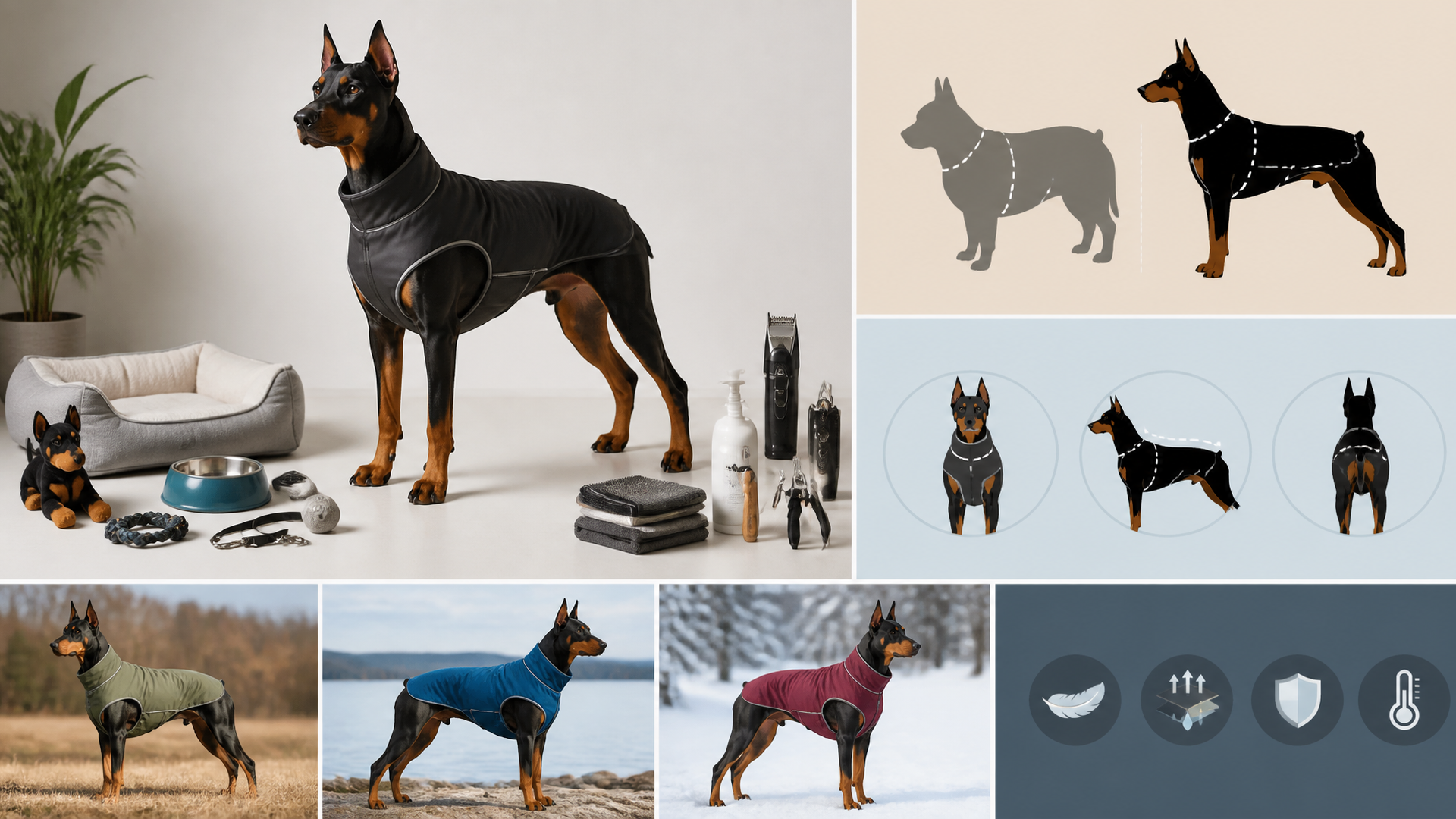
Most Dobermans need a jacket in the Large to X-Large range, but breed-specific body shape matters more than the label on the tag. A Doberman’s deep chest, narrow waist, and long back mean off-the-shelf sizes often fit poorly — too tight in the chest or too loose around the belly.

The short answer: Measure your Doberman’s chest girth at the widest point (behind the front legs), back length from the base of the neck to the base of the tail, and neck circumference. Use those numbers, not the dog’s weight, to pick a jacket. For most adult males, expect chest girth of 30–34 inches, back length of 28–32 inches, and a size Large or X-Large. For most females, chest girth of 26–30 inches, back length of 24–28 inches, and a size Medium to Large.
Why Dobermans Need a Different Fit Than Other Breeds
Dobermans aren’t built like Labradors or Golden Retrievers. Their body shape creates three specific fit challenges:
Deep chest. A Doberman’s chest is proportionally deeper than many other large breeds. Jackets designed for a barrel-chested dog often squeeze across the sternum while leaving extra fabric around the shoulders.
Tucked waist. The classic Doberman silhouette tucks up sharply behind the rib cage. A jacket that fits the chest will often sag or bunch around the belly, letting cold air in and rubbing against the skin.
Long back-to-leg ratio. Dobermans have a relatively long back compared to leg height. Jackets that hit the right length on a shorter-backed breed can ride up or restrict movement on a Doberman.
The practical takeaway: Look for jackets labeled “deep chest,” “narrow waist,” or “Doberman-friendly fit.” Many outdoor gear brands and breed-specific retailers now offer cuts that account for this body type.
How to Measure Your Doberman for a Jacket in 3 Steps
Use a flexible measuring tape. Measure while your dog is standing squarely on all four paws, not sitting or lying down.
1. Chest Girth (Most Important)
Wrap the tape around the widest part of your Doberman’s chest, just behind the front legs. Pull snug but not tight — you should be able to slide one finger between the tape and the fur. This measurement determines whether the jacket will close comfortably across the chest.
Common mistake: Measuring too far forward near the shoulders. That gives a smaller number, and the jacket will be too tight over the rib cage.
2. Back Length
Measure from the base of the neck (where the collar sits) to the base of the tail. Keep the tape along the spine, not curving down the side. This tells you whether the jacket covers the torso without riding up or dragging past the tail.
Common mistake: Measuring from the top of the neck. That adds 2–3 inches and leads to a jacket that bunches behind the shoulders.
3. Neck Circumference
Measure around the base of the neck where a collar normally sits. Leave two fingers of slack. Dobermans have thick, muscular necks — a too-tight neck opening will cause rubbing and resistance to wearing the jacket.
Size Guide: Male vs Female Dobermans
Use this as a starting point, then check the specific brand’s size chart. Jacket sizing varies significantly between manufacturers.
| Measurement | Male Doberman (adult) | Female Doberman (adult) |
|---|---|---|
| Chest girth | 30–34 inches | 26–30 inches |
| Back length | 28–32 inches | 24–28 inches |
| Neck | 18–22 inches | 16–20 inches |
| Typical jacket size | Large to X-Large | Medium to Large |
The decision criterion that changes the recommendation: If your Doberman has a particularly deep chest (32+ inches for a male, 28+ for a female) but a narrow waist, prioritize adjustable belly straps over size. A jacket that fits the chest in Large but has no waist adjustment will hang loose on the belly. A jacket with side gussets or elastic cinch straps lets you buy for the chest and tighten for the waist.
3 Expert Tips for Getting the Perfect Fit
Tip 1: Test Range of Motion Before You Buy
Put the jacket on your Doberman and watch them walk, trot, and sit. The jacket should not pull across the shoulders or bunch behind the front legs when they move. Your dog should be able to squat fully without the jacket riding up the back.
Common mistake: Assuming a jacket fits if it closes easily. A jacket that passes the “snaps closed” test can still restrict the front legs or rub the armpits during active movement.
Tip 2: Check for a Second Chest Strap
Dobermans with deep chests and narrow waists benefit from jackets that have a secondary girth strap behind the front legs, not just a single neck-to-belly closure. This strap prevents the jacket from shifting backward during walks or runs.
Common mistake: Buying a jacket with only one strap or buckle. On a Doberman’s shape, a single strap allows the jacket to rotate toward the tail, exposing the chest.
Tip 3: Use the Two-Finger Rule at the Neck and Chest
After fastening the jacket, you should be able to slide two flat fingers (stacked) between the fabric and your dog’s neck, and again between the fabric and the chest behind the front legs. Less than two fingers means the jacket is too tight. More than two fingers means air and moisture will get in.
Common mistake: Leaving extra room “for growth” or “for comfort.” A Doberman’s coat doesn’t need significant buffer space — oversizing causes chafing as the fabric shifts on movement.
Quick Fit Checklist: Is Your Doberman’s Jacket the Right Size?
Run through these five checks before your first full walk. If any item fails, exchange or adjust the jacket.
- [ ] Chest girth matches brand size chart. You measured at the widest point, and the jacket closes without stretching the seams or leaving a visible gap.
- [ ] Back length ends at the tail base. The jacket does not extend past the tail or fall short by more than 1–2 inches.
- [ ] Neck opening allows two fingers. No gaping or tightness around the throat.
- [ ] Front legs move freely. Your Doberman can walk, trot, and sit without the jacket pulling behind the elbows or bunching on the shoulders.
- [ ] Belly strap is snug but not dug in. The waist strap holds the jacket in place without leaving red marks or causing your dog to stop and scratch.
If all five checks pass, the jacket fits. If not, adjust the straps if the jacket allows it, or move to a different size or cut.
FAQ
My Doberman is between sizes on the brand chart. Which one should I pick?
Choose the larger size if the chest measurement is the one pushing you into the next bracket. You can adjust belly straps for a snugger waist. A jacket that is too tight across the chest will restrict breathing and movement — you can’t fix that with adjustments.
Do Dobermans really need a jacket? They have short coats.
Yes, especially in temperatures below 40°F or in wet, windy conditions. Dobermans have single coats with no insulating underlayer. They lose body heat quickly and can develop hypothermia faster than double-coated breeds. A weatherproof jacket is essential for winter walks, not a luxury.
Can I use a standard dog jacket made for Labradors?
You can, but expect a poor fit around the waist. Standard jackets cut for barrel-chested breeds will gap at the belly on a Doberman. Look for jackets with adjustable side straps or a “sighthound-style” cut that accommodates the tucked waist.
Should I buy a jacket with a hood?
Only if your Doberman tolerates hoods and you regularly walk in heavy rain or snow. Many Dobermans find hoods irritating and will try to shake them off. A high collar or neck gaiter provides wind protection without the annoyance.
Save This Guide — Bookmark this page or screenshot the three measurement steps and the fit checklist. With chest girth, back length, and neck circumference, plus the five checks, you’ll have everything you need to find a jacket that fits your Doberman’s unique build on the first try.