Norwegian Forest Cat Colors
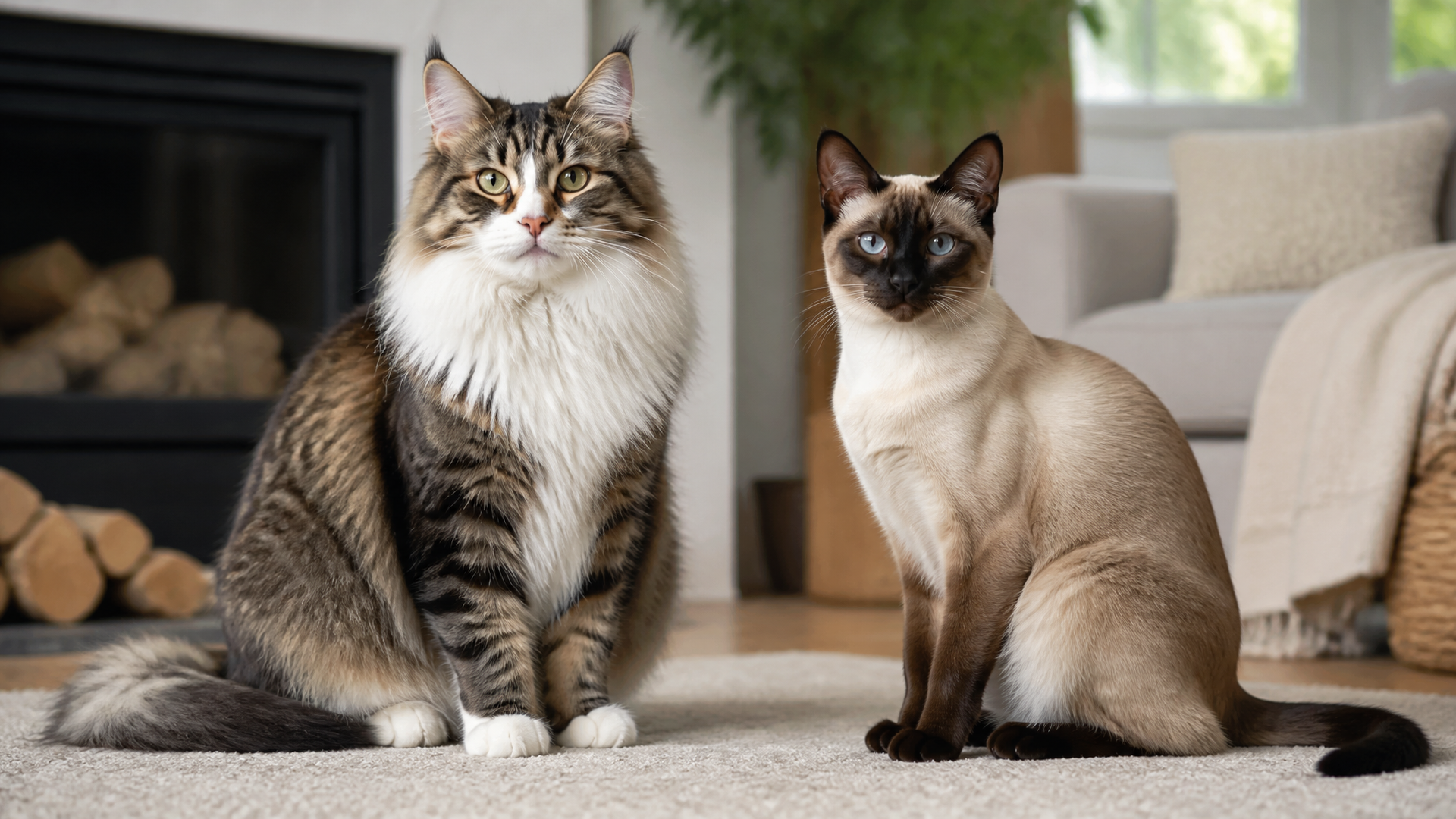
Norwegian Forest Cats come in nearly every color and pattern except chocolate, lavender, pointed (Siamese-style), and ticked tabby. If you’re trying to identify your cat’s coat or just curious about what’s possible, here’s the short answer: most solid colors, all tabby patterns except ticked, bicolor and tricolor, plus shaded and smoke varieties are all fair game. The breed standard is remarkably open — so open that two litter siblings can look like completely different breeds.

This guide covers what’s accepted, what’s not, and how to tell the difference before you register, show, or buy from a breeder.
When Color Rules Actually Matter
The color rules above apply specifically to conformation show standards set by CFA and TICA. If you’re buying a pet-only Norwegian Forest Cat, color doesn’t affect health, temperament, or lifespan — but it does affect price. Breeders often charge less for non-standard colors or kittens with minor pattern faults, even if the cat is purebred.
Practical implication: If you want a show cat, only buy from a breeder who guarantees standard-legal color on the registration paperwork. If you want a healthy family pet, you can safely consider chocolate, lavender, or pointed kittens from a reputable breeder — just know they can’t compete in conformation events. The cat itself is still a purebred Norwegian Forest Cat with the same wonderful personality.
All Accepted Colors and Patterns
Solid Colors
Solid (self) coats are one color from root to tip with no stripes or shading.
| Color | What It Looks Like | Notes |
|---|---|---|
| White | Pure white from root to tip | Can have blue, amber, or odd eyes |
| Black | Deep coal black | Sun-bleaching can turn it rust-toned in summer |
| Blue | Soft slate gray | Dilute of black; very common |
| Red | Rich orange-red | Almost always shows some tabby ghosting |
| Cream | Pale buff | Dilute of red; subtle, warm tone |
Red and cream solids almost never appear truly solid — some tabby markings are normal and accepted. If your red cat looks like a red tabby, that’s fine by the standard.
Tabby Patterns
Tabby is the most common pattern in the breed. Four tabby types exist, but only three are accepted.
- Classic tabby — Bold swirled patterns on the sides, like a marble cake. A butterfly shape on the shoulders is typical.
- Mackerel tabby — Narrow vertical stripes running down the spine, like a fish skeleton. This is the most common tabby pattern in the breed.
- Spotted tabby — Broken stripes form distinct spots along the sides. Less common but accepted.
- Ticked tabby — NOT accepted. Each hair has alternating bands of color with no visible stripes. If your cat has a ticked coat, it’s likely a mix or a different breed.
Tabby colors include black, silver, blue, red, cream — basically any color except white. Silver tabby (a white undercoat with dark markings) is especially striking on this breed.
Bicolor and Tricolor
- Bicolor — Any solid or tabby color combined with white. Tuxedo (black with white chest and paws) is a classic bicolor.
- Van pattern — Mostly white with color only on the head and tail.
- Calico — White coat with black and red patches (or blue and cream in dilute calico). Almost always female.
- Tortoiseshell (tortie) — Black and red blended together, no white. Also almost always female.
Shaded and Smoke
- Shaded — Only the tips of the hair are colored, with a white undercoat. Chinchilla (very light tipping) and shaded (darker tipping) variations exist.
- Smoke — Colored tips with a white root band. Looks solid at rest, flashes white when the cat moves.
How Color Changes With Age
Norwegian Forest kittens are born with a fuzzy baby coat that makes adult colors hard to read until about 4–6 months.
- White kittens — Pure white from birth, but some have a small colored patch on the forehead that fades by adulthood.
- Black kittens — Often look brownish-gray until their first adult shed. True black comes in around 6–8 months.
- Red kittens — Usually show bold tabby stripes that may soften but never fully disappear.
- Silver kittens — The silver undercoat isn’t visible until the kitten coat sheds out.
- Older cats — Sun exposure lightens dark coats, especially on the back and tail. An outdoor cat may look rusty by late summer.
Tip: Photograph your kitten monthly in the same lighting. The color shift between 8 weeks and 8 months can be dramatic.
How to Verify Your Cat’s True Color
You can’t rely on your eyes alone — lighting and age fool almost everyone. Here’s a concrete verification method:
1. Part the fur to the skin at three spots: shoulder, flank, and base of tail. Look for white roots (smoke), banding (shaded), or hidden white patches (bicolor).
2. Check in indirect window light — phone flash washes out silver and makes cream look red.
3. Wait for the first full adult coat (10–14 months). Before that, you’re guessing.
4. Compare to a breed color chart from CFA or TICA, not a random internet image.
5. For registration: ask your breeder for the color listed on the pedigree or registration certificate. If the breeder lists it as “blue tabby with white,” that’s your official answer.
3 Expert Tips for Accurate Color ID
Tip 1: Check the roots, not just the tips
Part the fur down to the skin in three places: the shoulder, the flank, and the base of the tail. Smoke and shaded cats look solid from above but reveal their white undercoat when parted.
- Common mistake: Assuming a solid-looking cat is actually solid. Many “black” Norwegian Forest Cats are smoke — the darkness hides the white root band until you look closely.
Tip 2: Use natural light, not phone flash
Phone flash washes out subtle tones and makes silver look white and cream look red. Stand your cat in indirect window light and compare their coat to a color chart.
- Common mistake: Identifying a blue cat as gray and assuming it’s not a purebred. Blue is the breed term for a specific cool-toned gray — it’s standard-legal and common.
Tip 3: Wait for the adult coat to confirm
The first winter coat (around 10–14 months) is when true colors settle. Before that, you’re guessing. If you’re registering or showing your cat, don’t submit color paperwork until after the first full adult shed.
- Common mistake: Registering a kitten as a solid color, only to discover at 1 year old that it’s a smoke or has white spots that were hidden in the baby coat.
What Can Go Wrong: Mismatch and Misidentification Risks
Misidentifying your cat’s color has real consequences. Registering a kitten with the wrong color on paperwork means the breeder may have to pay for a corrected registration later. If you’re buying from a breeder and they can’t clearly state the color and pattern on the contract, that’s a red flag — they may not be tracking genetics properly.
Trade-off to know: A cat that looks like a Norwegian Forest Cat but has a ticked tabby coat, a pointed pattern, or chocolate/lavender coloring is almost certainly a mixed breed or a different breed entirely (like a Maine Coon mix or a domestic longhair). No amount of eye color, ear tufts, or fluffy tail changes that genetic fact. If you paid purebred prices for a cat with one of these colors, you may have been misled.
A note on white cats: Only about 40–50% of white cats with blue eyes are deaf, and the risk is lower if the cat has one gold eye. A white Norwegian Forest Cat with gold or odd eyes has a very low chance of deafness. If you have a white blue-eyed kitten, a BAER hearing test from your vet can confirm either way.
Quick Decision Aid: Is This Color Standard?
Run through these five checks if you’re unsure whether your Norwegian Forest Cat’s color is breed-acceptable.
1. Is the coat chocolate or lavender? → No. These colors are not accepted. Your cat may be a mix or a different breed.
2. Does the cat have a pointed (Siamese-style) pattern with darker ears, face, paws, and tail? → No. Pointed is not accepted.
3. Is the tabby pattern ticked (no visible stripes, just a grainy look)? → No. Ticked tabby is not accepted.
4. Is the white distributed in a way that leaves large color patches on a white base? → Yes. Bicolor, van, calico, and tortie-with-white are all standard.
5. Is the coat solid, classic/mackerel/spotted tabby, shaded, or smoke in any color except chocolate/lavender? → Yes. You’re in the clear.
If you answered “no” to 1, 2, or 3, your cat may still be a wonderful companion — they just wouldn’t compete in conformation shows as a Norwegian Forest Cat.
FAQ
Can a Norwegian Forest Cat be a calico?
Yes. Calico (white with black and red patches) is accepted. It is almost always female because the genetics require two X chromosomes.
What is the rarest Norwegian Forest Cat color?
Pure solid white is the least common color in the breed. Silver tabby and shaded silver are also relatively rare. The most common colors are black, blue, and red tabby.
Can two black Norwegian Forest Cats have a white kitten?
Yes, if both parents carry the recessive white-spotting gene. Two solid black cats can produce a bicolor kitten with white patches. This is not a breed fault.
Norwegian Forest Cat colors are broad — the main rules are no chocolate, no lavender, no pointed, and no ticked tabby. Everything else is fair game, and your cat’s final color won’t settle until the full adult coat grows in around their first birthday. Save this guide for quick reference when your kitten’s coat starts changing or when you’re evaluating a breeder’s litter.
This article contains affiliate links. If you purchase through these links, we may earn a small commission at no extra cost to you.