Scottish Fold Cats Suffer a Lot From Arthritis.
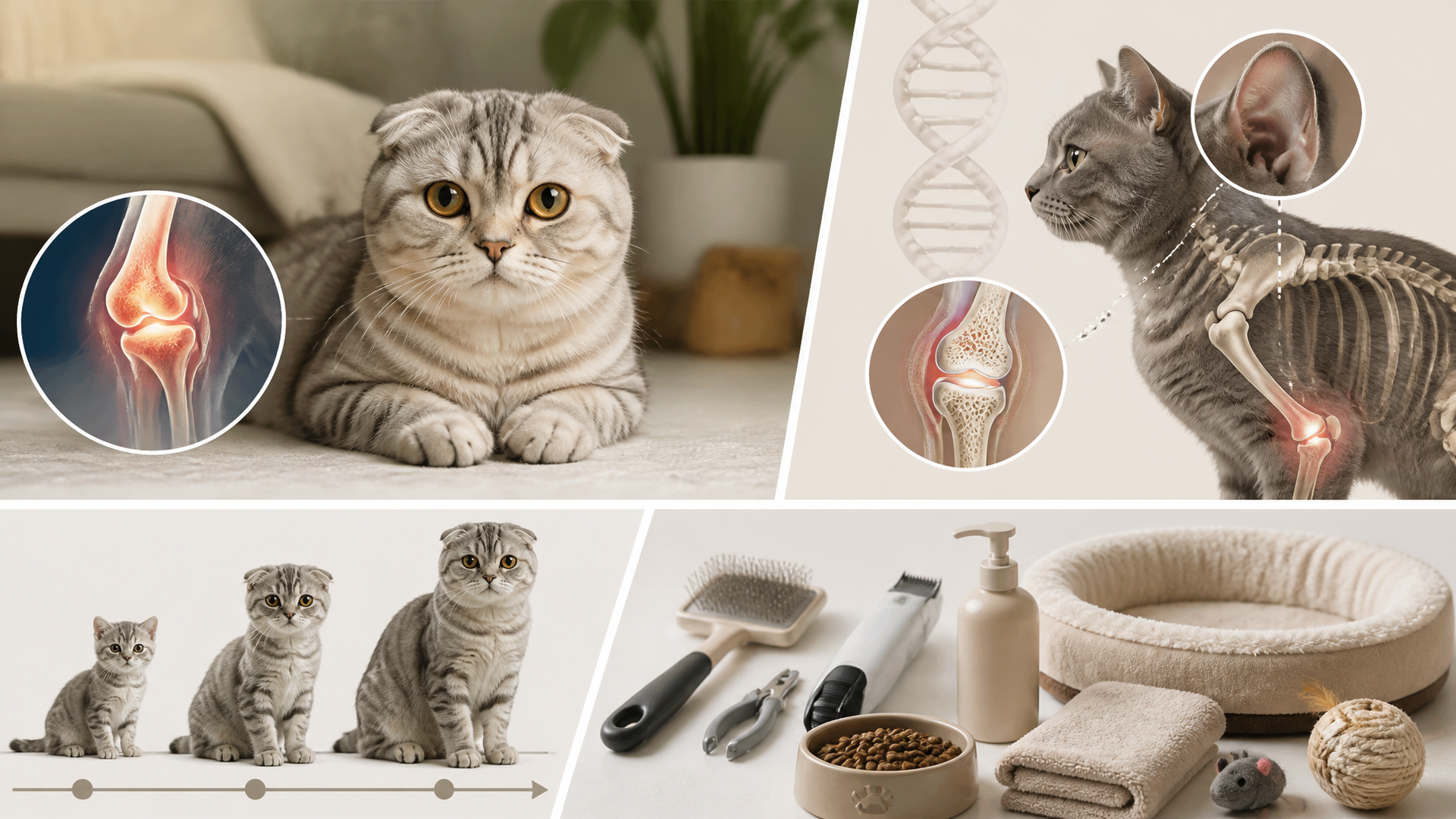
Yes, Scottish Fold cats suffer a lot from arthritis – and it’s not just because of their ears. The same dominant gene that creates the folded ear also causes abnormal cartilage growth throughout the body. By age two, most folded-eared cats already show arthritic changes on X-rays, even if they seem fine. But you can slow the progression and keep your cat comfortable. You just need to start early.

This guide gives you a step-by-step plan, breed-specific details, and clear signals so you know exactly what to do and when.
The Genetic Link: Why Arthritis Is Built Into the Breed
The folded-ear trait comes from a single dominant gene that disrupts cartilage formation everywhere. The ears are only the visible clue – the real damage happens in the tail, ankles, knees, and spine.
Counter-intuitive fact many articles skip: Even straight-eared Scottish Folds from a fold + straight breeding have a higher-than-average arthritis risk compared to non-affected breeds. They carry the gene in a milder form, but the risk is still real.
Severity depends on breeding:
- Fold-to-fold breeding (two folded parents) produces the worst cases – often crippling pain by age 1–2.
- Fold-to-straight breeding (one fold, one straight) leads to milder, slower-progressing disease.
- Straight-eared cats from fold parents still need monitoring.
Practical takeaway: If you don’t know your cat’s lineage, assume moderate risk and follow the full protocol.
When Does Arthritis Start? (The Timeline)
Arthritis doesn’t happen overnight. Here’s what to expect by age:
| Age | What’s Happening | What You May See (or Not) |
|---|---|---|
| 4–12 months | Cartilage deformities develop; X-rays show early changes | Usually nothing visible |
| 1–2 years | Joint inflammation begins; pain signals start | Subtle reluctance to jump on high surfaces |
| 3–5 years | Overt arthritis; stiffness after naps; decreased grooming | Limping, bunny-hopping gait, litter box accidents |
| 6+ years | Severe joint degeneration; muscle wasting | Constant discomfort, social withdrawal, aggression when touched |
Expert tip: Get a baseline X-ray at your cat’s first birthday, even without symptoms. A common mistake is waiting until you see limping – by then, joint damage is already advanced. Early X-rays let you track progression year over year.
How to Help Your Scottish Fold: A Step-by-Step Owner Flow
Follow this sequence in order. Each step builds on the last.
Step 1: Get a Vet-Led Diagnosis (Do Not Skip)
Your vet will:
- Perform a physical exam (checking range of motion and pain response)
- Take X-rays (often under mild sedation) to see joint changes
- Rule out other causes (injury, infection, neurological issues)
Verification checkpoint: Ask for a written report with specific measurements of joint angles and bone changes. Request a grade (mild, moderate, severe). This gives you a baseline to compare next year.
Step 2: Start Joint-Friendly Medications (When Needed)
Common vet-prescribed options:
- NSAIDs (e.g., Meloxicam) – for moderate-to-severe pain; short-term use only due to kidney risk.
- Gabapentin – for chronic nerve-related pain; safer for long-term use.
- Adequan (polysulfated glycosaminoglycan) – injectable drug that slows cartilage breakdown; requires a series of shots.
Trade-off to know: NSAIDs can damage kidneys if your cat gets dehydrated. Always pair with bloodwork every 6–12 months. Gabapentin may cause drowsiness – adjust timing so it doesn’t interfere with eating or litter box use.
Step 3: Add Joint Supplements (Start by 18 Months)
Supplements work best before severe arthritis sets in. They do not fix advanced joint damage.
| Supplement | Evidence | Best For |
|---|---|---|
| Glucosamine + chondroitin | Moderate support; reduces pain in some cats | Early-stage prevention |
| Omega-3 fish oil (EPA/DHA) | Strong anti-inflammatory effect | All stages; can reduce medication need |
| UC-II (undenatured type II collagen) | Emerging research shows reduced morning stiffness | Cats who still need extra support |
Expert tip: Start supplements by 18 months for best results. A common mistake is expecting them to reverse severe arthritis – they won’t. If you see no improvement after 8 weeks, discontinue and rely on medication and home changes. Also introduce supplements gradually over 7–10 days to avoid GI upset.
Step 4: Modify Your Home Environment (Most Immediate Relief)
Small changes remove daily pain triggers. Do these this week:
- Orthopedic bed (memory foam, egg-crate) in a warm, quiet spot – K&H Pet Products Orthopedic Cat Bed
- Ramps or steps next to sofas, beds, window perches – measure the height; ramp should be at least three times longer than the rise to keep the slope gentle
- Low-sided litter box (cut-front “senior” box) – Kitty Canyon Scut Buddy XL or cut a 3-inch opening in a plastic storage bin with a jigsaw
- Raised food and water bowls (2–4 inches off the ground) to reduce neck strain
- Heated cat bed (low-wattage, auto-off) – K&H Lectro-Soft provides deep warmth that soothes joints
Expert tip: Measure your furniture height before buying a ramp. A common mistake is buying a ramp that’s too short, creating a steep incline your cat will avoid. Aim for no steeper than 30 degrees. If your cat refuses it after two weeks, switch to pet steps with 4-inch risers instead of 6.
Step 5: Manage Weight – Non-Negotiable
Extra weight directly crushes arthritic joints. Target a lean body condition score of 4–5 out of 9.
- Stop free-feeding kibble – measured meals only
- Switch to high-protein, low-carb wet food (e.g., Wellness CORE or Tiki Cat)
- Use a digital kitchen scale to weigh food – aim for 150–200 calories per day for a 10-lb cat, adjusting based on activity
Common mistake: “Light” dry foods still contain carbs that promote fat storage. Wet food is almost always better for weight control. Also, weigh your cat weekly – changes happen fast.
Step 6: Gentle Physical Therapy
- Passive range-of-motion exercises – while your cat is relaxed (after a meal or nap), gently flex and extend each leg at the ankle, knee, and hip. Hold each position 5–10 seconds. Repeat 2–3 times per leg, 2× daily.
- Low-impact play – wand toys with feather or fleece that your cat can swat while lying down; no jumping required.
- Cold laser therapy – available at many vet clinics; a 10-minute session 1–2 times per week reduces pain for 24–48 hours per session.
Stop/escalation signal: If your cat flinches, pulls away, or hisses during any exercise, stop immediately. Pain should never increase. If you see swelling or heat in a joint, call your vet – it may indicate a flare-up needing medication adjustment.
Products That Help – And One Trade-Off to Know
| Product Type | Why It Works | Recommended Brand | Fit Check |
|---|---|---|---|
| Orthopedic cat bed | Cushions tender joints, retains body heat | K&H Orthopedic Cat Bed | Cat must step in/out easily; avoid beds with 6+ inch walls |
| Heated cat bed | Warmth reduces stiffness, improves circulation | K&H Lectro-Soft | Use only with supervision if cat has limited mobility (can’t move off if too hot) |
| Joint supplement chews | Slow cartilage breakdown; reduce inflammation | Cosequin for Cats | Check for chicken allergy; some cats refuse chews – try powder form |
| Ramp for furniture | Eliminates painful jumping | PetStep Original Folding Pet Ramp | Measure sofa height; ramp must be at least 36 inches for a 24-inch rise |
| Low-sided litter box | Easy entry, no step-over | Kitty Canyon Scut Buddy XL | Measure your cat’s shoulder height; entry cut-out should be 4–6 inches high |
Trade-off to know: Heated beds can cause burns if your cat cannot move away. Always choose a model with a chew-resistant cord and built-in thermostat. If your cat is weak or has severe arthritis, place the bed on the floor where they can easily exit.
Disclosure: Some links above are affiliate links. We may earn a small commission at no extra cost to you.
FAQ: Quick Answers for Owners
Do all Scottish Fold cats get arthritis?
Yes – every cat with folded ears develops some degree of osteochondrodysplasia, which leads to arthritis. Straight-eared Scottish Folds have a lower but still elevated risk.
At what age does arthritis become obvious?
Most owners notice mobility changes between 2 and 4 years old, but X-rays can show signs as early as 12 months.
Can joint supplements cure arthritis?
No – supplements can slow progression and reduce inflammation, but they cannot reverse existing joint damage. They work best when started before age 2 and combined with home modifications and weight management.
Save This Guide: Scottish Fold arthritis is unavoidable, but early action makes a real difference. Start with a baseline X-ray at 12 months, add supplements by 18 months, and modify your home immediately. The steps above give you a clear path to slow the disease and keep your cat comfortable for years.