Are Beagles Good Dogs For Farms Near
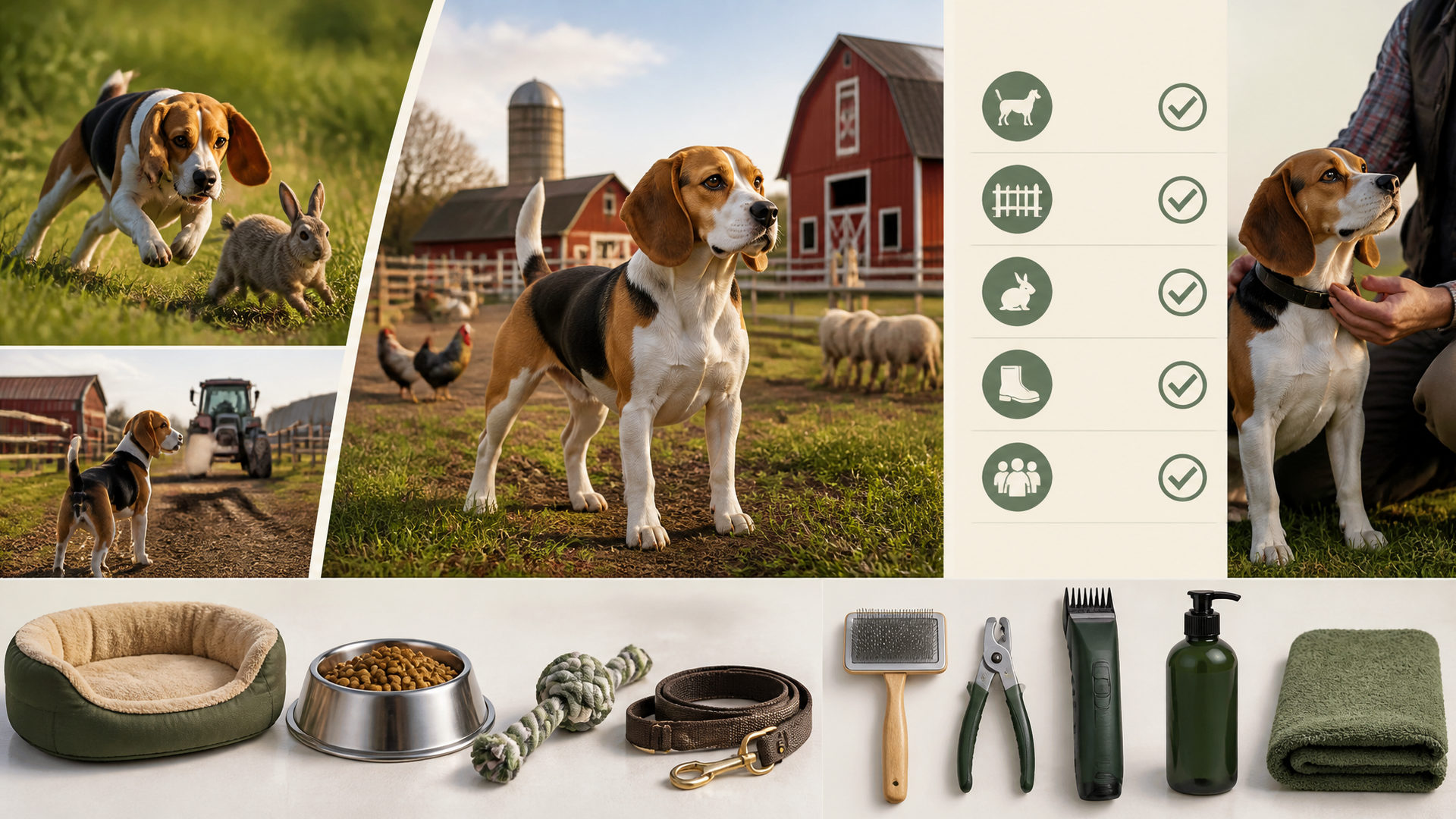
Beagles can work on farms, but not the way most people picture. Their hunting instincts make them excellent at flushing out rabbits and rodents, but their strong prey drive and tendency to wander mean they aren’t farm dogs you can leave unsupervised. If you’re considering a Beagle for a farm, the short answer is: yes, with careful management and secure fencing.

Before you bring one home, understand the trade-offs. This guide covers the real pros, the hidden challenges, and exactly how to set your Beagle (and your farm) up for success.
The Beagle Farm Fit: What Works and What Doesn’t
Beagles were bred to hunt in packs, not to guard livestock or stay close to a homestead. That background creates both strengths and weaknesses on a farm.
What Beagles Do Well on a Farm
- Pest control: Their keen nose and determination make them natural rodent hunters. Many owners report Beagles keeping barns free of mice and rats.
- Alarm barking: Beagles will alert you to unfamiliar sounds or animals. They’re not guard dogs, but they make effective watchdogs for unexpected activity.
- Good with children: Beagles are typically friendly and patient with kids, which matters if your farm is also a family home.
Where Beagles Struggle — and the Real Consequence
- Escape artistry: Beagles follow their nose, often for miles. Standard farm fencing (woven wire, electric) may not stop a determined Beagle. Concrete consequence: A Beagle that slips out will not return on its own. Lost Beagles on farms have been hit by cars, shot as trespassing dogs, or picked up by animal control miles away.
- Prey drive toward small animals: While they hunt rabbits and rodents, they may also chase chickens, ducks, or even young goats. Concrete consequence: In just two minutes, a Beagle can kill an entire flock if the coop door is left open — even if the dog seems gentle inside the house.
- Noise level: Beagles are vocal. Howling, baying, and barking can be constant if they’re bored or left outside alone for hours. Neighbors may not appreciate the soundtrack, and in some rural areas repeated noise complaints can lead to legal action.
Counter-intuitive angle: The very trait that makes Beagles bad “stay-in-the-yard” dogs — their intense scent drive — makes them excellent for specific farm tasks like clearing fields of groundhogs or flushing rabbits out of garden beds. But you can’t have one without the other. The same nose that finds a mouse also leads them over the fence.
Farm-Ready Beagle Checklist — With a Verification Step
Decide if your setup meets the minimum requirements before getting a Beagle. Then use the verification step to confirm.
| Requirement | Why It Matters | Actionable Step |
|---|---|---|
| 6-foot + secure fence | Beagles can climb or dig under short fences | Bury fencing 12 inches deep or add an electric wire at the bottom |
| Covered run or kennel | Safe containment when you can’t supervise | Use a heavy-duty dog run with a roof to prevent escape |
| Chicken/poultry housing | Protect birds until you’re sure your Beagle won’t chase them | Double-door system and raised coops with secure latches |
| Daily exercise | At least 45–60 minutes of off-leash exercise (in a fenced area) | Daily fetch, scent games, or structured walks |
| Mental stimulation | Prevents boredom barking and digging | Puzzle toys, hide-and-seek, or nose work training |
Concrete verification step for fence security: Walk your entire fence line at ground level. Look for gaps under gates, loose boards, or spots where a Beagle could dig. Then place a high-value scent (a piece of bacon or a rabbit-scented tennis ball) on the outside of the fence while your Beagle is inside. Leave him in the yard for 15 minutes. If he escapes, your fence needs immediate reinforcement — buried wire, a hot wire, or a stronger gate latch.
3 Expert Tips for Farm Beagles
Tip 1: Introduce Livestock Slowly — Never Let Him “Figure It Out”
Actionable step: Start with the Beagle on a leash 20 feet away from your chickens or goats. Reward calm behavior (sitting, looking at you) with high-value treats. Gradually decrease distance over several sessions. Call a professional trainer if you see stiff body language, fixating, or lunging.
Common mistake: Leaving a Beagle loose with livestock “to get used to it.” This often ends with injured birds or a chased goat. Controlled, positive exposure is the only safe path.
Tip 2: Invest in a GPS Tracker or Locator Collar
Actionable step: Attach a lightweight GPS collar (like Fi or Whistle) every time your Beagle goes outside. If he does slip out, you’ll know his exact location instead of spending hours searching.
Common mistake: Relying on a standard dog tag. Beagles can travel 5 miles in an hour, and tags alone won’t help you find them quickly. In one real case, a farm Beagle went missing for 3 days before the owner found him 7 miles away using a GPS collar.
Tip 3: Use a Barn Routine to Reduce Escape Attempts
Actionable step: Before letting your Beagle out each morning, do a quick perimeter check of your fence line. Loose boards, dug spots, or snowdrifts are escape routes he’ll notice before you do. Repair them immediately.
Common mistake: Assuming a Beagle will stay in the yard because he “knows it’s home.” Scent-driven dogs don’t reason that way — they follow a rabbit scent until they’re lost. One farm owner’s Beagle traveled 3 miles through a cornfield after a deer trail, and only a GPS collar brought him back.
Training Your Beagle for Farm Life: A Quick Operator Flow
Before You Start
Collect high-value treats (bits of cheese, hot dog, or freeze-dried liver). Have a 20-foot long line and a harness (no retractable leash). Ensure your fence is secure (see checklist above).
Step 1: Establish a Reliable Recall “Come” Command
Stay calm — Beagles resist if you chase or yell. Practice indoors in a low-distraction room. Say “Come” and reward when he reaches you. Progress to a fenced yard on a long line. Let him wander a short distance, then call. Reward generously. Add distractions: have a helper toss a tennis ball or squeak a toy while you call. Mark and reward only when he comes to you, not when he looks.
Step 2: Teach “Leave It” for Livestock and Wildlife
Hold a treat in your closed fist. Say “Leave it.” Wait until he stops sniffing or pawing at your hand. The second he pulls back, mark and reward with a different treat from your other hand. Once solid with treats, practice with a toy or a clump of grass. Then leash-walk near your chickens or goats, 30+ feet away. Say “Leave it” and reward for disengaging.
Step 3: Test and Proof
On a long line, allow your Beagle to explore near a fenced chicken run. If he ignores them, reward. If he fixates, shorten the distance and repeat Step 2.
Escalation signal: If your Beagle does not respond to “Come” or “Leave it” after 3–4 weeks of daily practice, consult a force-free trainer before allowing him off-leash near livestock. The first sign of trouble is a Beagle that freezes and stares at a chicken rather than glancing at you.
Success check: Your Beagle should be able to walk past a rabbit hutch or goat pen on a loose leash without barking, pulling, or staring intently.
What About Barking and Neighbors?
Beagles bark more than many breeds. On a quiet farm, that sound carries. If noise is a concern, provide enrichment — a bored Beagle is a noisy Beagle. Rotate toys, scatter feed in a snuffle mat, and play scent games daily. Don’t leave him outside alone for long stretches. A Beagle left in the yard for hours will bark at leaves, passing trucks, and birds. Bring him inside or into a covered kennel when you’re not interacting. Consider a bark-off collar as a last resort only with veterinary and trainer guidance. Never use a shock collar first; try vibration or spray collars if needed.
Product Recommendations That Actually Help
Affiliate disclosure: As an Amazon Associate, we may earn from qualifying purchases. These are products we recommend based on real farm Beagle owner feedback.
- GPS collar: Whistle Go Explore — waterproof, real-time tracking, and location alerts. Essential for a wandering Beagle.
- Heavy-duty dog run: Petsfit Heavy Duty Playpen 36-inch — can be configured as a secure kennel with metal panels and a locking gate.
- Scent work kit: Outward Hound Nina Ottosson Puzzle Toy — mental stimulation that wears out a Beagle’s brain faster than physical exercise.
- No-pull harness: Rabbitgoo No-Pull Dog Harness — gives you control without choking, useful for leash training near livestock.
FAQ
Can a Beagle be left alone on a farm all day?
Not safely. Beagles need companionship, supervision, and a secure environment. Alone outdoors, they’ll dig under fences, bark excessively, or chase wildlife. If you’re away for hours, provide a covered kennel or indoor crate.
Will a Beagle kill my chickens?
Some Beagles can learn to accept chickens, but many will chase and potentially kill them. Never assume your Beagle is safe around poultry until you’ve done controlled introductions and seen consistent calm behavior.
How much space does a Beagle need on a farm?
A Beagle doesn’t need hundreds of acres. A half-acre fenced yard with daily walks and sniffing opportunities is enough. More space actually increases escape risk if the fence isn’t escape-proof.
Are Beagles good with other farm dogs?
Generally yes. Beagles are pack animals and usually get along well with other dogs, especially similar-sized breeds. Introduce slowly, as with any new dog.
Save This Guide
Beagles can thrive on a farm, but they are not a low-maintenance choice. Strong fencing, structured training, and daily mental work are non-negotiable. If you’re ready for that, your Beagle will be a loyal, enthusiastic farm partner — especially chasing rabbits out of your garden. Print this checklist and keep it near your kennel.