Poodle Coat Type: Complete Guide for Poodle Owners
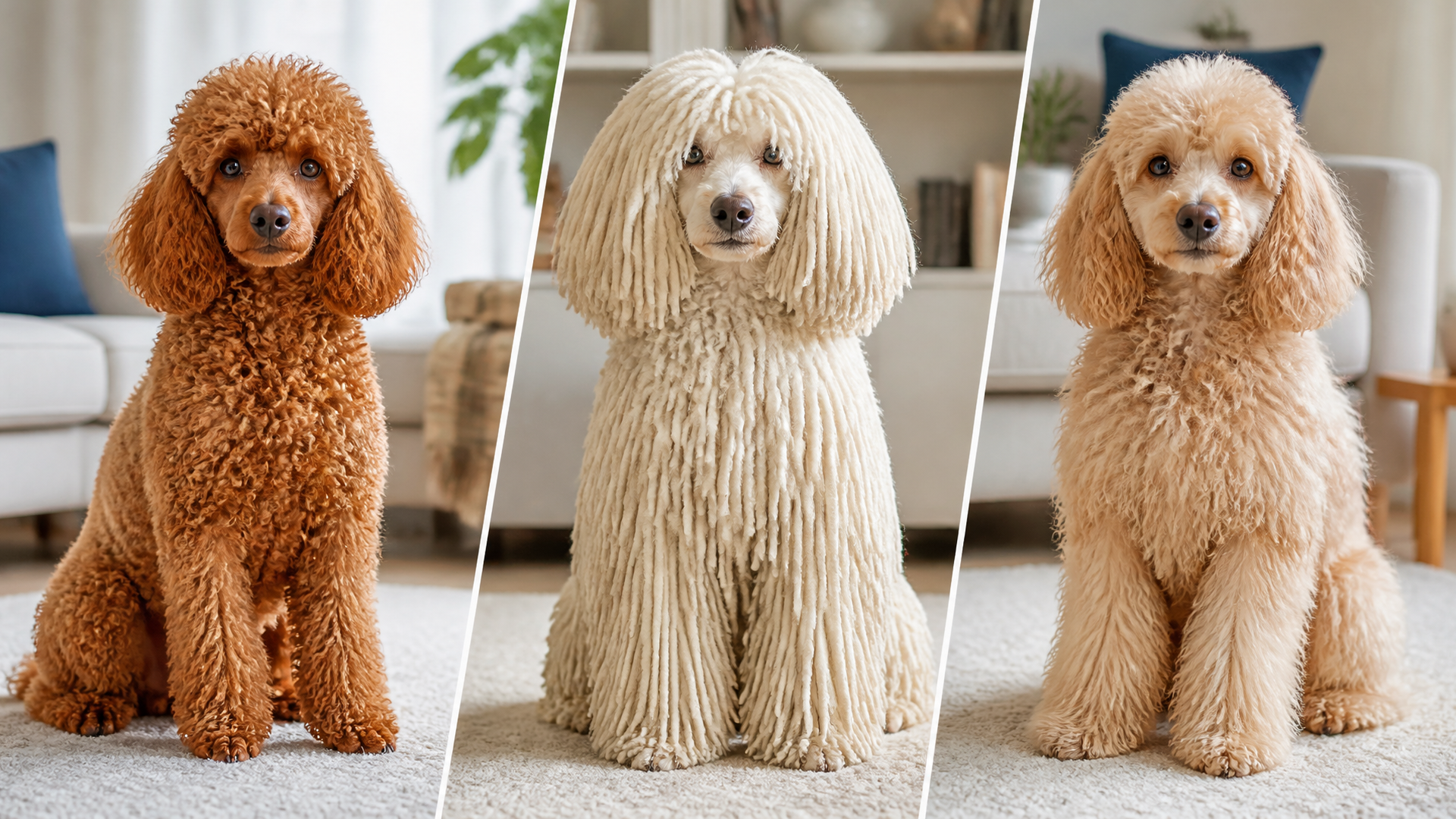
Your Poodle has one of three coat types: curly, corded, or wavy. Most owners assume every Poodle is born with tight curls, but that’s not always true. Using the wrong brush for even a week can lead to mats, frizz, or a coat that needs shaving. Identify your dog’s actual coat type first, then groom specifically for that type. Here’s how.

The 3 Poodle Coat Types (And Why Yours Matters)
Each coat type needs different tools, brushing frequency, and bath techniques. Your grooming routine only works if it matches the actual coat.
| Coat Type | Appearance | Grooming Frequency | Best Tools |
|---|---|---|---|
| Curly | Tight spiral curls, dense, wool-like texture | Daily brushing, professional groom every 4–6 weeks | Slicker brush, metal comb, detangling spray |
| Corded | Strands form rope-like cords, similar to a Komondor | Weekly cord separation, monthly bath with air-dry | Wide-tooth comb, mat splitter, hand-separating |
| Wavy/Irregular | Loose waves with a visible back part, softer texture | 2–3 times per week brushing, groom every 6–8 weeks | Pin brush, bristle brush, conditioning spray |
Why this matters: Curly coats mat fastest — skip two days of brushing and you’re dealing with mats that require shaving. Wavy coats are more forgiving but still need consistent care. Corded coats are a deliberate commitment that takes months to form and ongoing maintenance to prevent pelting.
Counter-intuitive truth most articles skip: Don’t treat a wavy Poodle coat like a curly one. Over-brushing wavy hair with a slicker brush breaks the hair shaft and creates frizz. Match your tools to the actual coat type.
Which Coat Does Your Poodle Have? A 6-Point ID Check
Run through these quick checks. Each is a simple observation or touch test. If you’re unsure after testing, ask your groomer — they can identify it instantly.
- Test 1: The curl check. Brush a small section of dry coat. Does it spring back into tight ringlets? Yes = curly. No = check next.
- Test 2: The strand pull. Can you gently separate individual curls into hanging rope-like strands that hold their shape? Yes = corded (or starting to cord). No = check next.
- Test 3: The back part. Does the coat naturally part along the spine and lie relatively flat on the sides? Yes = wavy/irregular. No = likely curly.
- Test 4: The texture feel. Run your fingers through the coat. Does it feel coarse and dense like wool? Yes = curly or corded. Does it feel softer with less density? Yes = wavy.
- Test 5: The mat test. Brush thoroughly, then check 12 hours later. Do you feel new matting starting? Yes = curly or corded (high matting risk). No = wavy (lower risk).
- Test 6: The groomer report. Ask your groomer what coat type they see. Professionals can identify this immediately.
Branch point: If Tests 1, 3, and 5 point to wavy, stop using your slicker brush today. Switch to a pin brush to prevent hair breakage. If they point to curly, daily slicker brushing is non-negotiable.
Groom Your Poodle’s Exact Coat Type
Pick the section that matches your dog from the ID check above.
For Curly Coats (Most Common)
Brushing a curly coat is non-negotiable. Miss one day and you’re playing catch-up.
Step 1: Pre-brush spray. Lightly mist the coat with detangling spray or water. Brushing a dry curly coat breaks hairs and causes static.
Step 2: Line brush. Part the hair in a straight line from head to tail. Brush one small section at a time from the skin outward. Do not skip any section — mats hide close to the skin.
Step 3: Follow with a metal comb. Run a fine-tooth metal comb through each brushed section. If it snags, you missed a mat. Go back and work it loose with your fingers or a mat splitter before brushing again.
Step 4: Check pressure points. Pay extra attention behind the ears, under the collar, between the legs, and under the tail. These are the first places mats form.
Step 5: Schedule professional grooms every 4–6 weeks. Curly coats grow fast and need a full clip regularly.
Likely cause of mats: You missed a day of brushing, or the coat was brushed dry without detangling spray. Fix by working mats loose with a mat splitter — never cut them out with scissors unless you’re certain the skin is clear.
Escalation signal: If mats are tight against the skin or you can’t get a comb through any section after 10 minutes, schedule a professional groom immediately. Shaving under mats is safer than cutting them yourself.
Success check: After brushing, run the metal comb through any section and feel zero snags. The coat should feel uniform and bouncy.
For Corded Coats
Corded coats are a commitment — they take 12–18 months to form properly and require ongoing maintenance.
Step 1: Separate cords by hand. Using your fingers or a wide-tooth comb, gently separate each cord from its neighbor. Work from the tips upward to avoid breaking the cords.
Step 2: Roll, don’t brush. Cords should be rolled between your palms to maintain their shape. Never brush a corded coat with a slicker brush — it destroys the cord structure.
Step 3: Bathe with care. Use a gentle shampoo and let the coat air-dry completely. Do not blow-dry on high heat, which can tighten cords too quickly and create mold or mildew at the skin.
Step 4: Check skin health. Lift cords to inspect the skin monthly. Trapped moisture under tight cords can cause hot spots or yeast infections.
Step 5: Professional maintenance. Find a groomer experienced with corded coats. Not all groomers know how to handle them.
For Wavy/Irregular Coats
Wavy coats are lower maintenance but still need consistent care.
Step 1: Brush 2–3 times per week with a pin brush. Pin brushes are gentler on wavy hair than slicker brushes and reduce frizz.
Step 2: Use a bristle brush for finishing. After pin brushing, go over the coat with a bristle brush to distribute natural oils and add shine.
Step 3: Bathe every 3–4 weeks. Wavy coats don’t trap dirt as quickly as curly coats but still benefit from regular baths.
Step 4: Professional groom every 6–8 weeks. Wavy coats grow slower than curly coats and hold a clip longer.
Branch point for wavy owners: If you’ve been using a slicker brush, switch to a pin brush now. Notice frizz or split ends? Those are signs of brush damage from the wrong tool. The coat will recover in 4–6 weeks once you switch.
3 Coat Problems That Look Like Grooming Issues (But Aren’t)
Sometimes your Poodle’s coat is trying to tell you something else. Watch for these signs:
- Excessive shedding or patchy hair loss. Poodles are low-shedding, so noticeable hair loss points to thyroid issues, allergies, or Cushing’s disease. See your vet.
- Dull, dry, or brittle coat. This often means a fatty acid deficiency. Adding fish oil (consult your vet for dosage) can restore shine within 4–6 weeks.
- Red, flaky skin under the coat. Environmental allergies or food sensitivities commonly show up as skin irritation in Poodles. A grain-free or limited-ingredient diet may help.
If the coat changes texture or appearance suddenly, always rule out health issues before adjusting your grooming routine.
Products That Actually Work for Poodle Coats
The right tools save time and prevent damage. Here are the product types worth investing in, matched to coat type:
- Curly coats: A high-quality slicker brush (medium-firm pins), a fine-tooth metal comb, and a conditioning det