Sphynx Cat Fat: Guide: What Every Owner Should Know
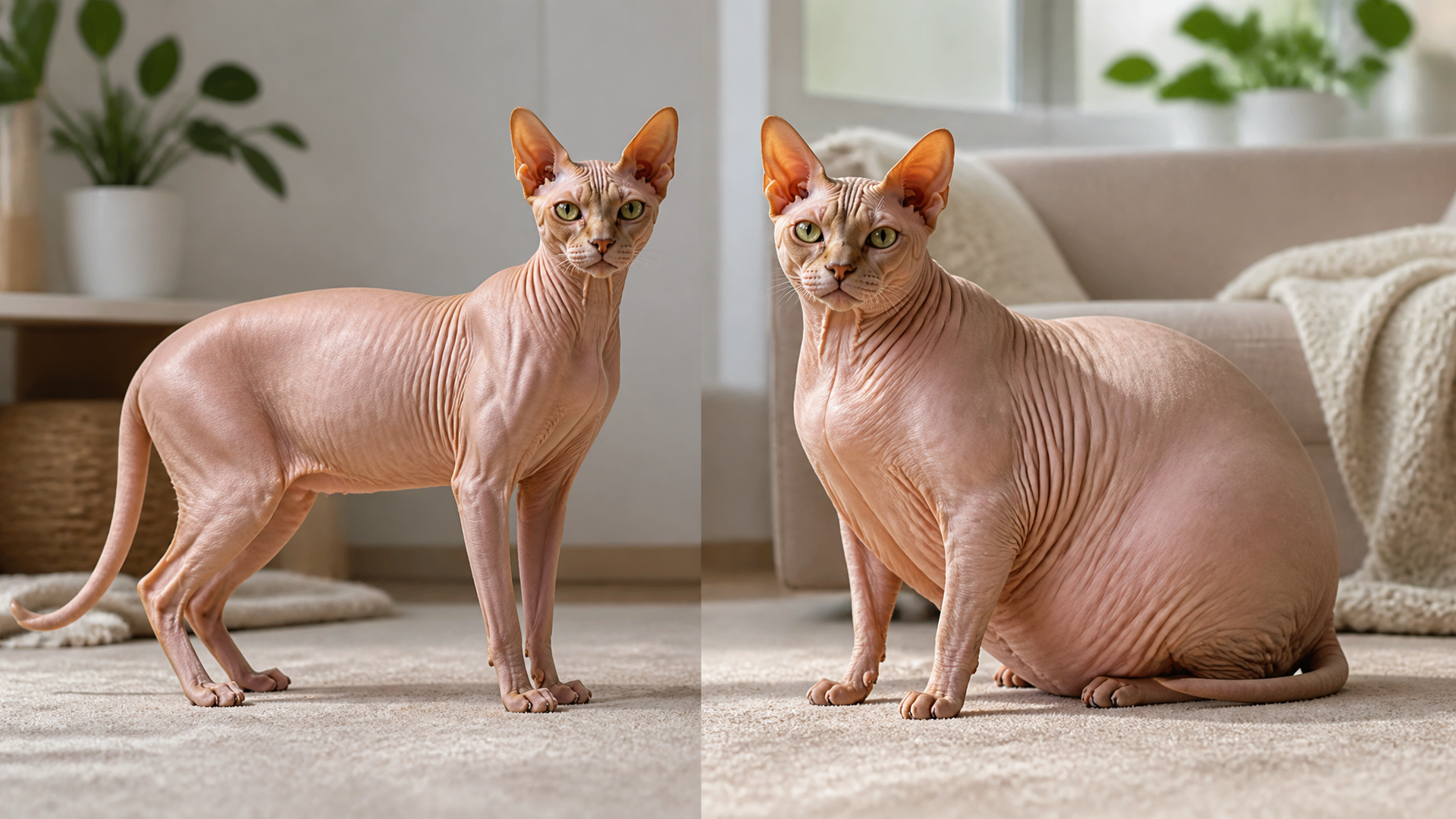
Your Sphynx’s round belly probably looks cute, but it’s almost always a sign of excess fat — not a normal breed feature. Unlike furry cats, a Sphynx’s body condition is completely visible, so you can catch weight gain early. Here’s the direct answer: a healthy Sphynx should have a visible waist when viewed from above, and you should feel (not see) their ribs with a light touch. If you can’t feel ribs, or there’s a sagging belly pouch that swings when they walk, your cat is carrying extra weight.

What “Sphynx Cat Fat” Really Means — and Why You Can’t Ignore It
Sphynx cats need a slightly higher body fat percentage than furry cats to stay warm — that’s normal. But the line between healthy insulation and obesity is thin. Because the breed has a naturally pot-bellied look even at a healthy weight, many owners mistake excess fat for normal anatomy.
For the owner, this means you must stop relying on “looks fine” and start doing a weekly body condition check. If you don’t, weight creeps up silently. Within a few months, your cat can go from lean to overweight, and that extra weight directly stresses their heart, joints, and skin folds. The practical takeaway: measure, don’t guess.
The Skinny vs. Fat Test (You Can See Everything)
With a hairy cat you’re guessing. With a Sphynx, the fat deposits are right there. Use this visual guide:
| What to Look For | Healthy Sphynx | Overweight Sphynx |
|---|---|---|
| Waist (viewed from above) | Clear hourglass shape behind ribs | Straight or bulging sides |
| Belly (side view) | Gentle upward tuck from ribs to hips | Sagging or rounded belly |
| Ribs | Not visible, but easily felt | Cannot feel without pressing hard |
| Fat pads | None visible | Visible fat pads on lower belly, armpits, or hips |
| Spine | Can feel each bump lightly | Buried under fat layer |
Expert tip #1: Run your hand along your Sphynx’s spine. In a healthy cat you’ll feel each vertebra bump without pressing. If you have to push down to find them, your cat is overweight. Common mistake: assuming the naturally round belly is normal — it isn’t. That belly should still have a subtle upward tuck.
Sphynx Cat Weight Ranges: What’s Normal for Your Cat
Weight alone isn’t enough — body frame matters. But these ranges give a starting point.
| Gender | Typical Healthy Range | Overweight Threshold |
|---|---|---|
| Female | 6 – 10 lbs | 11+ lbs |
| Male | 8 – 14 lbs | 15+ lbs |
| Neutered/spayed | Often 1–2 lbs heavier than intact | +2 lbs above breed norm |
Important caveat: A large-framed male at 14 lbs can be perfectly lean, while a small-boned female at 9 lbs might already be heavy. Use body condition scoring, not the scale alone.
The 5-Step Body Condition Check (30 Seconds, Do It Weekly)
- Rib check: Place both hands on the ribcage, thumbs on spine. You should feel ribs like the back of your hand — distinct but not poking. If you feel them like knuckles, too thin. If you can’t feel them, too fat.
- Waist check (top view): Stand over your cat while they’re standing. There should be a visible indent behind the ribs. No indent = overweight.
- Belly tuck (side view): The belly should curve upward from ribs to hind legs. A flat or sagging belly = too heavy.
- Fat pad check: Gently feel between the back legs and belly, under the chin, and behind the front armpits. Soft deposits there mean excess fat.
- Activity test: Can your Sphynx still jump onto a counter or chase a toy without panting? Winded after 30 seconds of play suggests weight is an issue.
Expert tip #2: Weigh your Sphynx weekly using a baby scale or a kitchen scale (place a bowl on it, zero it, then add your cat). Write it down. A jump of 0.5 lbs in two weeks is a red flag. Common mistake: using a regular bathroom scale — it’s not accurate for small changes, and your cat won’t stay still. A kitchen scale gives consistent, reliable numbers.
Expert tip #3: Take a weekly photo from above and from the side, on the same surface, at the same distance. Compare photos month to month. You’ll catch gradual weight gain that your daily eyes miss. Common mistake: relying on memory — “he looks the same” is almost always wrong because weight creeps up slowly.
Why Extra Fat Hits a Sphynx Harder Than Other Cats
Sphynx cats already have high metabolic demands because they burn energy staying warm. Excess fat makes things worse:
- Joint stress — Extra weight loads elbows and hips. Sphynx cats are prone to hip dysplasia; fat accelerates joint damage.
- Skin fold infections — Fat creates deeper folds that trap oil and debris. Sphynx cats already need regular baths; deeper folds mean more yeast and bacterial infections.
- Heart strain — The breed is predisposed to hypertrophic cardiomyopathy (HCM). Every extra pound forces the heart to work harder.
- Temperature regulation — Fat insulates, making overheating more likely. A fat Sphynx can’t cool down as efficiently — they’re less comfortable and more at risk for heat stress.
How to Help Your Sphynx Lose Weight (Breed-Specific Plan)
Step 1: Recalculate Their Food
Most Sphynx owners overfeed because the breed has a reputation for “needing more food.” That’s true for kittens and active adults, but once spayed/neutered and past age 2, calorie needs drop sharply.
Action: Feed a measured amount. Use a kitchen scale, not a scoop. A typical adult Sphynx needs 35–45 calories per pound of target body weight per day. For a 10‑lb cat aiming for 8.5 lbs, that’s about 300–380 calories daily.
Step 2: Switch to High-Protein, Low-Carb Wet Food
Dry food is calorie-dense and carb-heavy, which Sphynx cats don’t process well. Canned food (90%+ meat protein) keeps them full longer on fewer calories.
Step 3: Use Food Puzzles for Every Meal
Sphynx cats are smart and food-motivated. A puzzle feeder turns a 2‑minute bowl meal into 15–20 minutes of mental work. This alone can shave 0.25–0.5 lbs over a month.
Step 4: Increase Play Intensity
Target 15 minutes of active play twice daily. Wand toys with fast, erratic movement work best. Sphynx cats love to jump — use cat trees or wall shelves to get them leaping vertically.
Step 5: Adjust Your Thermostat
If your house is under 70°F, your Sphynx burns extra calories staying warm — a small advantage during weight loss. If your house is over 75°F, they burn fewer calories at rest. Keeping the thermostat at 68–72°F can help.
Concrete Verification Step: Check Your Portions
To confirm you’re feeding the right amount, here’s a simple one‑day test:
- Weigh out your cat’s daily food with a kitchen scale (not a cup or scoop).
- Pour that exact portion into a puzzle feeder or bowl for the day.
- The next morning, weigh your cat. If the scale shows no change, the portion is roughly maintenance. If your cat lost 0.1–0.2 lbs, you’re in the right range for weight loss. If they gained, reduce by 10%.
This feedback loop takes the guesswork out of feeding — you’ll know within a week whether the amount is working.
When to Call the Vet
- Your Sphynx gains more than 1 lb in a month without a diet change.
- They are panting after normal play.
- They stop jumping onto furniture they used to reach.
- You notice thickened skin folds that smell yeasty or look red.
- They eat more than usual but still lose weight (could indicate hyperthyroidism).
A vet can calculate exact daily calories and check for underlying conditions like HCM or thyroid issues before you start a weight loss plan.
A Realistic Limitation: The “Cute Belly” Trap
Even after you start the plan, that round belly may not disappear completely. Sphynx cats naturally have a slightly fuller abdomen than other breeds — it’s part of their build. The goal isn’t a flat stomach; it’s a visible waist, palpable ribs, and an upward belly tuck. If you aim for “no belly at all,” you risk underfeeding your cat. Stop when you can feel ribs easily and the waist is clear. Anything beyond that is too lean.
Save this guide — print the 5‑step body condition checklist and stick it on your fridge. Run through it every other Sunday. A healthy Sphynx is a lean, muscular cat with a visible waist and palpable ribs. That “cute round belly” is not normal — but with weekly checks and consistent feeding, you can keep your hairless friend at a healthy weight for life.
This article contains affiliate links. As an Amazon Associate, we earn from qualifying purchases.