American Bulldog Bite Force: Step-by-Step Training Guide
American Bulldogs have a bite force measured between 305 and 350 PSI – powerful enough to crack bones, but far less important than how you train that jaw. The real question isn’t how hard they bite, but how to teach your Bulldog to control their mouth from puppyhood through adulthood. Here’s exactly how to do that, step by step, so you get a confident dog that knows when to use pressure and when to be gentle.

What That Bite Force Means for Your Training Plan
A 350-PSI bite is serious equipment, but your Bulldog doesn’t come pre-programmed with bite inhibition. That skill has to be taught. The most common failure mode is this: owners let their 8-week-old puppy mouth hands and clothes because it’s “cute,” then wind up with a 90-pound adult who still thinks nibbling is play.
How to detect it early: If your American Bulldog puppy is still mouthing with noticeable pressure at 4–5 months old – and you haven’t actively redirected or stopped it – you’re already behind. That’s your earliest checkpoint. Puppy biting should be decreasing, not holding steady or increasing.
Training starts the day you bring them home. No exceptions.
The Three-Stage Training Plan
These stages follow your dog’s natural development. Follow them in order, and verify progress at each stage before moving forward.
Stage 1: Puppy Bite Inhibition (8–16 Weeks)
The goal here is not to stop all mouthing – it’s to teach soft mouth. When your puppy bites too hard, give a high-pitched yelp and immediately stop play. Turn away for 10–15 seconds. This mimics how littermates teach bite control.
- Product help: Keep a heavy-duty puppy chew toy in your pocket to redirect mouthing instantly. Look for rubber toys labeled for power chewers – American Bulldog puppies have strong jaws early.
- Warning: Never yank your hand away – that looks like prey. Go still, then yelp. Pulling away triggers their chase instinct and makes biting worse.
After the pause, offer the toy. If your puppy mouths it instead of your skin, reward with calm praise.
Verification checkpoint: At 12 weeks, your puppy should consistently soften their bite within 2–3 yelp-pause cycles. If they’re still biting hard after 10+ repetitions in a single play session, you’re not being consistent enough. Practice daily, every single time teeth touch skin.
Stage 2: Adolescent Impulse Control (4–12 Months)
Your Bulldog is gaining strength and confidence. Bite pressure may spike during teething (4–6 months) and again during adolescence (8–10 months). This is when structured play becomes critical.
- Step 1: Teach “leave it” – start with a treat in your closed fist. Wait for your dog to stop pawing or mouthing your hand, then open and give the treat. Once they reliably wait, drop a treat on the floor and cover it with your foot. Uncover only when they look at you instead of the treat.
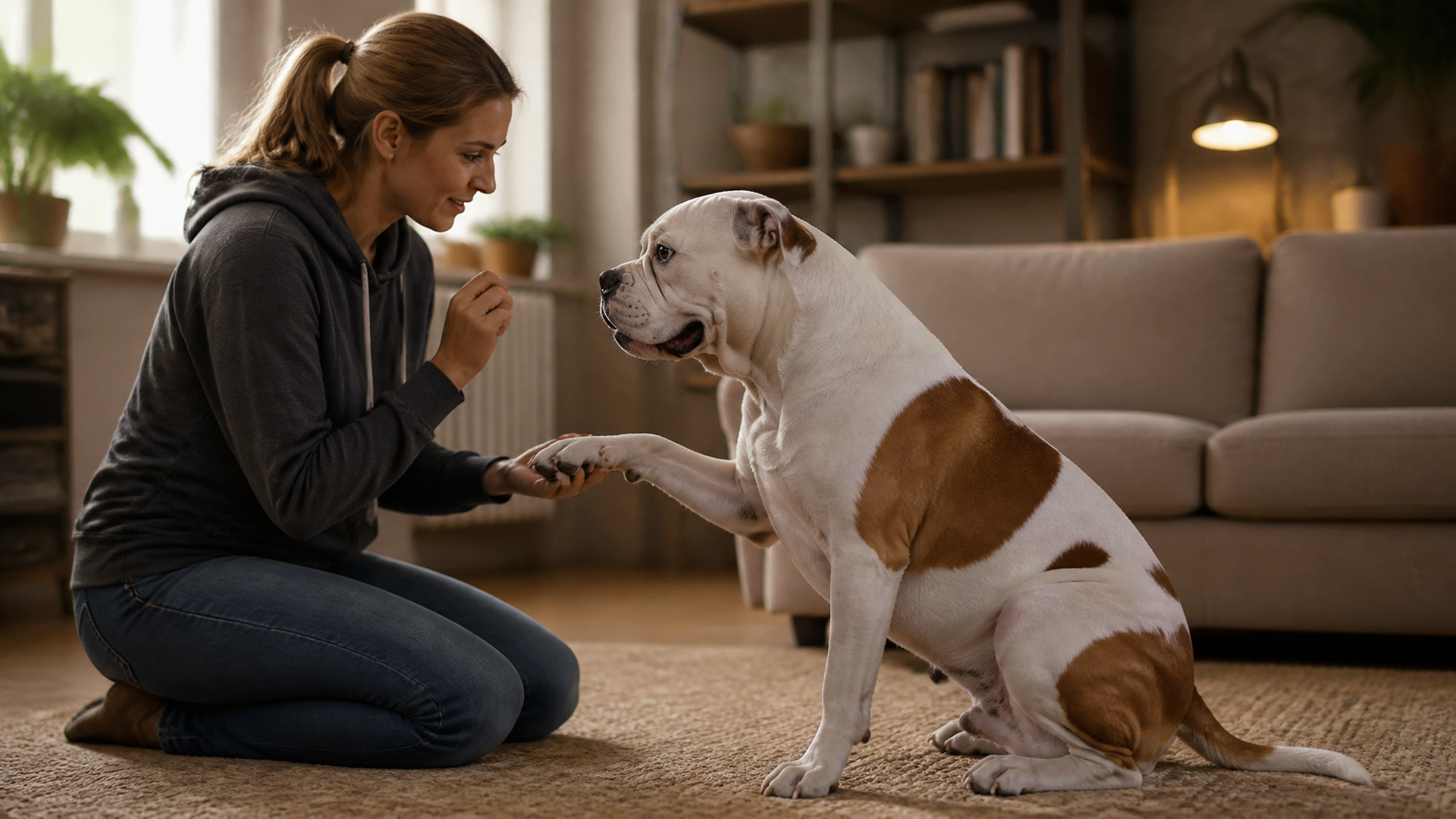
- Step 2: Use tug toys for controlled play. If teeth touch skin at all, say “uh-uh,” drop the toy, and end the game for 30 seconds. No exceptions. If you let it slide once, your Bulldog learns the rule is optional.
- Step 3: Practice “drop it” using a trade system. Offer a high-value treat in exchange for the toy. Never pry the mouth open – that teaches resource guarding.
Product help: A double-stitched tug toy with handles gives you control and keeps your hands away from the mouth. Rope toys with knots work, but check for loose threads weekly.
Verification checkpoint: By 6 months, your dog should stop mouthing immediately when you say “uh-uh” and should reliably “leave it” with low-distraction items like treats on the floor. If you’re still getting hard mouthing at 7 months, go back to Stage 1 basics for two weeks before retrying Stage 2.
Stage 3: Adult Reliability (12 Months+)
By now, your American Bulldog should understand the rules: no teeth on skin or clothing. But you still need to proof it in real-world situations.
- Practice “leave it” with higher-value items – a dropped steak, a squirrel outside the window, a guest entering the front door.
- Use bite sleeves or tug props only as a trained activity – never let your dog grab the sleeve and self-reward by tugging alone. That teaches them to initiate mouthing on their own.
- Test behavior around children and visitors. Have a helper walk past with a treat, then drop it. Your dog should look to you for permission, not grab.
Verification checkpoint: At 14 months, run this test: drop a piece of chicken on the floor while your dog is watching and say nothing. A reliably trained Bulldog will look at you first before reaching for the food. If they grab it without hesitation, you need more “leave it” practice with higher-value distractions.
When to Stop DIY Training and Get Professional Help
This is your concrete escalation threshold. Stop home training and call a certified professional dog trainer (CPDT or equivalent) if any of these happen:
- A bite that breaks the skin at any age after 4 months
- A bite that leaves a bruise after 6 months
- Your dog growls, stiffens, or shows teeth before biting – this indicates fear-based or resource-guarding behavior, not play
- Mouthing that gets worse after you start training, not better
What to do immediately: Stop all mouth-based games (tug, fetch, rough play). Use management instead – keep your dog on a leash or in a crate during triggering situations. Do not punish the behavior, as that can escalate fear responses. Get a certified trainer for an in-person assessment within 2 weeks. If you can’t find a CPDT in your area, ask your veterinarian for a referral.
Bite Training Success Checklist
Use this quick decision aid every week. Pass all items to stay on track.
- [ ] Puppy (under 5 months): Mouthing pressure has decreased compared to last week. If it’s increasing, you’re not being consistent enough.
- [ ] Adolescent (5–12 months): “Leave it” works reliably at home with low-distraction items (treats on floor, dropped kibble).
- [ ] All ages: Your dog responds to a yelp or “uh-uh” by stopping mouthing within 2 seconds.
- [ ] All ages: You rotate at least 3 appropriate chew toys daily and redirect mouthing to them every single time.
- [ ] All ages: No skin-puncturing bites ever occurred. If a hard bite happened, you initiated an immediate pause and assessed whether the situation warrants a trainer.
If you fail any item, go back to the previous stage’s steps for a week, then reassess.
Tools and Safety Gear That Actually Help
- Chew toys: Look for rubber toys labeled “extreme” or “power chewer” like Goughnuts or West Paw Zogoflex. Avoid rawhide – American Bulldogs can shred and swallow it, leading to blockages. Avoid nylon bones that splinter. Disclosure: As an Amazon Associate, we earn from qualifying purchases.
- Tug toys: Rope toys with heavy knots hold up longer than flat ropes. Inspect weekly for loose threads and replace when frayed. A double-handle tug gives you better control for training.
- Bite sleeves: Only use these if you’re training for a sport like protection work or bitework. For a family pet, they can blur the line between allowed and not-allowed mouthing. Stick to structured tug play with clear rules.
Frequently Asked Questions
How hard does an American Bulldog bite compared to other breeds?
American Bulldog bite force is roughly 305–350 PSI. That’s similar to a German Shepherd (around 290 PSI) but less than a Kangal (over 700 PSI). The number matters far less than training – a well-trained Bulldog never uses full force on a person.
Is my American Bulldog aggressive if they mouth during play?
No – mouthing is normal dog behavior. The problem is if it doesn’t decrease with training. If your dog is still mouthing hard past 6 months, it’s not necessarily aggression, but it signals you need to be more consistent with redirection and ending play.
Can I use punishment to stop biting?
No. Physical punishment like hitting or alpha rolls can trigger defense biting and erode trust. Positive interruption (yelp plus pause plus redirect) is faster, safer, and more effective for a strong breed like the American Bulldog.
Save This Guide
Your American Bulldog’s bite force is a tool, not a threat. Teach soft mouth early, stay consistent through adolescence, and use the weekly checklist to catch problems before they become habits. The payoff is a dog you trust with your family, your kids, and your furniture.