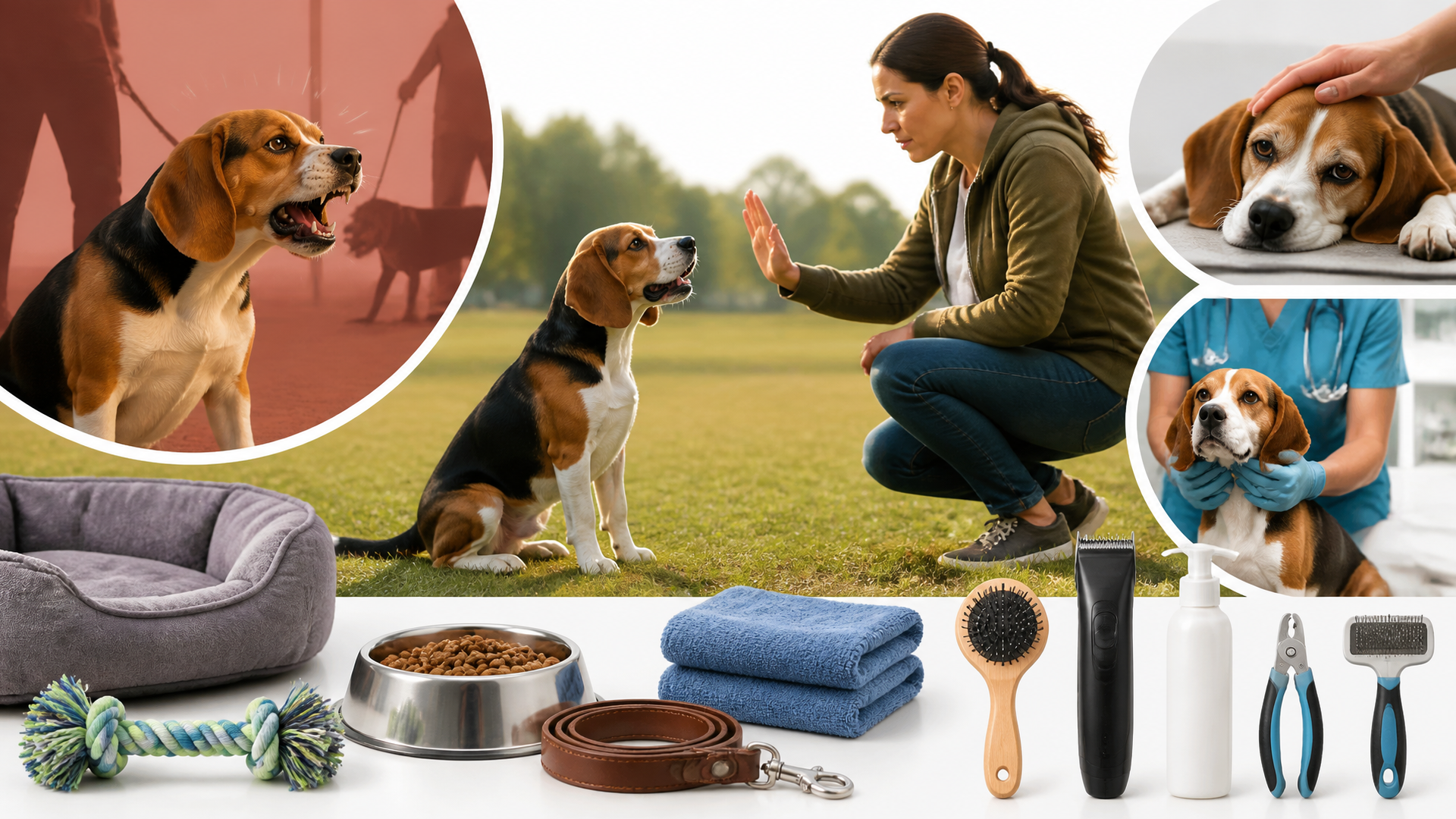
Beagle Aggressive Behavior: Step-by-Step Training Guide
Your Beagle isn’t being “bad” — he’s being a Beagle. And that’s the key to fixing the aggression.

Beagle aggression usually isn’t about dominance or malice. It’s almost always rooted in something specific to this breed: resource guarding, fear from harsh correction, or frustration when their nose overrides everything else. The fix starts with understanding what’s actually driving the behavior, not punishing the growl.
Here’s the step-by-step training plan that works for Beagles specifically — not generic advice you’d give to any dog.
The One Mistake That Triggers Beagle Aggression
Most Beagle owners accidentally teach their dog to be aggressive. Here’s how:
Your Beagle catches a scent and goes into “nose-lock.” He stops responding to his name. You call again — nothing. You raise your voice. You grab his collar. He startles, growls, or snaps.
You just punished a biological reflex he cannot control.
Early detection sign: Watch for the “scent freeze” — ears back, nose down, tail still, unresponsive to cues. That’s not defiance. That’s a Beagle’s brain overridden by olfactory processing. If you grab or scold in that moment, you’re teaching him that hands near his neck mean danger. Next time, he skips the growl and goes straight to a snap.
The fix isn’t more punishment. It’s management and a completely different communication system.
Before Training: Rule Out Pain and Medical Causes
Aggression that appears suddenly in an adult Beagle is often pain-related. Beagles are stoic by nature; they don’t limp or whine for minor discomfort. A Beagle who growls when you touch his head may have a chronic ear infection, not an attitude problem.
Have your vet check:
- Ear infections — Beagles’ floppy ears trap moisture and debris. Chronic ear pain is a common aggression trigger. Signs: head shaking, odor, scratching.
- Dental issues — Beagles are prone to periodontal disease. A sore tooth can make a dog snap when you reach for his muzzle or collar.
- Arthritis or hip dysplasia — Common in Beagles over 7. Watch for stiffness when rising, reluctance to jump, or growling when touched on the hips.
- Thyroid dysfunction — Hypothyroidism can cause irritable, unpredictable behavior. A simple blood test rules this out.
If your Beagle has never shown aggression before and is now growling when touched in a specific spot, book a vet visit before you book a trainer. Pain-related aggression rarely improves with training alone.
The 4-Step Training Plan for Beagle Aggression
Step 1: Manage the Environment (Don’t Test a Hungry Nose)
You cannot “train away” a Beagle’s nose. You can only manage it.
What to do:
- Use a front-clip harness (like the PetSafe Easy Walk) instead of a neck collar — it gives you steering control without pressure on the throat.
- Keep your Beagle on a long-line (15–30 feet) in unfenced areas so you never have to chase or grab.
- Block access to windows where he barrier-barks at passersby (use removable privacy film or frosted window decals).
- Feed meals in a separate room if you have multiple dogs — Beagles resource-guard food more than many breeds. The scent of another dog nearby can trigger guarding even without direct contact.
Product to consider: The SniffSpot app lets you rent private fenced yards by the hour. It’s a meaningful upgrade for Beagles who need decompression time without triggers.
Step 2: The Counter-Conditioning Protocol
This works for Beagles who growl or snap at specific triggers — other dogs, strangers, or people approaching their food bowl.
The method:
1. Identify your Beagle’s threshold distance (how close the trigger can be before he stiffens, freezes, or growls).
2. Start well outside that distance — you want him calm and aware of the trigger but not reacting.
3. Every time he sees the trigger, drop a high-value treat (freeze-dried liver, boiled chicken, string cheese — Beagles will work for stinky, soft treats).
4. The trigger appears → treat appears. Repeat 10–15 times per session.
5. Over days or weeks, slowly decrease the distance.
Why this works for Beagles: Their brains are wired for scent-food associations. You’re swapping “that person = threat” for “that person = chicken appears.” Beagles form these scent-based bonds faster than most breeds.
Friction point to watch: If your Beagle won’t take the treat, you’re too close. Back up 10 feet and try again. If he takes the treat but continues to stiffen or growl, you’re still too close — approach more slowly next session.
How to verify progress: After 3–5 sessions, your Beagle should begin looking at you when the trigger appears (a “check-in”) instead of staring at the trigger. That’s the first sign the new association is forming.
Step 3: Teach a Positive Interruption
Instead of grabbing your Beagle when he’s locked on a scent, teach him to choose to come back to you.
The setup:
1. Start indoors with no distractions.
2. Show your Beagle a high-value treat, say “Touch,” and present your open palm.
3. When his nose touches your palm, mark (“Yes”) and treat.
4. Practice until he does it instantly from across the room.
5. Move to the backyard, then to a quiet park with a long-line.
Why it works: A Beagle who knows “Touch” (nose to palm) can be redirected from a scent trail without you ever touching his collar. No grabbing = no defensive reaction.
Product to consider: A treat pouch with a magnetic closure (like the Kurgo Treat Pouch) lets you deliver treats one-handed while holding the leash.
Step 4: Teach “Calm Settle” on a Mat
Beagles who are overtired or overstimulated often redirect frustration into snapping.
The protocol:
1. Place a mat or bed in a low-traffic area.
2. Lure your Beagle onto the mat with a treat, say “Settle,” and reward.
3. Gradually increase the duration he stays on the mat (start with 5 seconds, work up to 2 minutes).
4. Use this when visitors arrive or when you see him starting to pace and whine.
When to use it: A Beagle who hasn’t napped in 4 hours and is now barking at the door has crossed into overtired territory. The mat gives him a structure to decompress. An adult Beagle needs about 12–14 hours of sleep per day — missing that threshold turns many Beagles into cranky, reactive dogs.
Quick Decision Aid: Is This Aggression or Beagle Drama?
Beagles are vocal. They bay, grumble, and “talk.” It’s easy to mistake breed-normal noise for aggression. Use this table to tell the difference.
| If your Beagle does this… | It’s likely… | What to do |
|---|---|---|
| Growls while chewing a bone but wags tail when you approach | Resource guarding — mild | Work on “trade” games (swap the bone for a treat) |
| Bay-growls at the door when someone knocks | Alert barking — normal Beagle behavior | Teach “Quiet” with a treat reward |
| Stiffens, freezes, shows whale eye (whites of eyes visible) when you reach for collar | Fear-based aggression risk | Stop reaching. Use “Touch” instead. Consult a trainer |
| Snaps when surprised from sleep | Startle reflex — not true aggression | Give a wide berth when he’s sleeping; warn guests |
| Growls at other dogs over a toy | Resource guarding | Remove the toy, trade for a treat, supervise all toy time |
| Bites when you try to take stolen food | Resource guarding of high-value items | Do NOT chase. |
Trade for a better treat. Manage access |
| Growls and shows teeth when you approach while eating | Food aggression | Feed in a crate or separate room. Consult a professional |
Red line — escalate to a vet behaviorist if:
- Your Beagle has bitten and broken skin (not just mouthing)
- The aggression appeared suddenly with no clear trigger
- You’ve tried counter-conditioning for 4 weeks with no improvement (no check-in behavior, no treat acceptance near triggers)
When to Stop DIY Training and Call a Professional
Counter-conditioning works for most Beagles, but some cases need expert help. Do not keep working on your own if you have any doubt about safety — a single bite can escalate quickly.
Call a certified trainer or veterinary behaviorist if:
- Your Beagle has bitten more than once with increasing intensity
- You cannot safely walk past him while he’s eating
- The aggression is directed at children or elderly family members
- You feel unsafe in your own home
Look for:
- Certified Professional Dog Trainer (CPDT-KA) with experience in aggressive behavior
- Veterinary Behaviorist (DACVB) — these are vets with specialized training in behavior medication
- Avoid trainers who use prong collars, e-collars, or “alpha rolls.” Beagles shut down under punishment, and a shut-down Beagle looks calm but is actually more likely to explode later.
Save This Guide
Beagle aggression almost always has a specific trigger: pain, resource guarding, or a defensive reaction to being grabbed during scent-lock. The fix is environment management, counter-conditioning, and a positive interruption system that works with your Beagle’s nose, not against it. Start with the vet visit, then use the 4-step plan in order. If you hit the red-line signs, skip the DIY and call a professional.
We may earn a small commission from products linked in this guide. It doesn’t affect your price.
Your Beagle isn’t aggressive by nature. He’s trying to tell you something. Now you know how to listen.