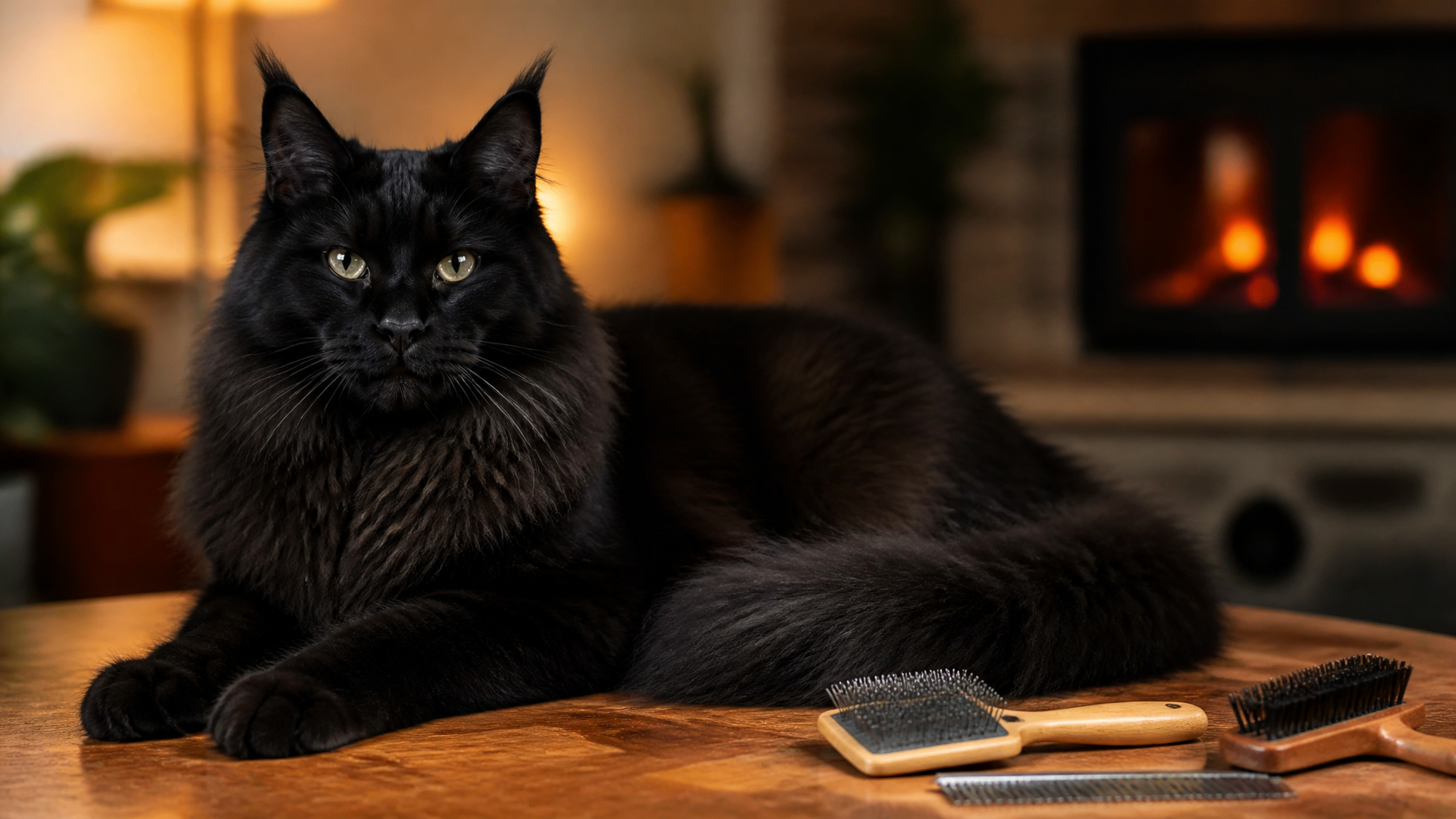
Black Norwegian Forest Cat
The Black Norwegian Forest Cat is a stunning color variation of the breed, featuring a solid jet-black coat, lynx-like ear tufts, and a thick fluffy tail. Despite their wild appearance, these cats are friendly, gentle, and make excellent family pets. Below you’ll find everything you need to know about their appearance, personality, grooming, health, and how to find one ethically.

What Sets the Solid Black Coat Apart
The black coat is a solid, even black from root to tip, with no pale patches or tabby markings. Eyes are typically amber, gold, or green, creating a dramatic contrast against the dark fur. Like all Norwegian Forest Cats, they have a triangular face, large almond-shaped eyes, and ear tufts that resemble a lynx.
Key physical traits:
- Coat length: Double-layer (water-repellent outer guard hairs + dense woolly undercoat)
- Coat color: Solid black (genetic designation: recessive non-agouti black)
- Size: Large: males 12–16 lbs, females 9–13 lbs
- Body: Long, sturdy, with powerful hind legs built for climbing
The black coat is less common than brown tabby or red tabby, but it is recognized by all major cat associations (CFA, TICA, FIFe). Some registries allow small freckles on the nose or paw pads — these are normal and do not disqualify the cat from showing.
How to Verify a True Black Norwegian Forest Cat
If you’re buying from a breeder, request to see the parents and registration papers. The black coat should be consistent with no tabby ghosting (faint stripes visible in bright light), though faint ghost marks on kittens can fade by adulthood. Ask for a DNA test confirming the non-agouti (aa) gene if you want certainty.
What this means for your purchase decision: If a breeder cannot show parent cats with clear breed traits or provide registration papers, the kitten may be a mixed breed with Norwegian Forest ancestry rather than a purebred. That’s not necessarily bad for a pet, but if you’re paying purebred prices ($1,000–$2,000), you should get documentation and health clearances.
Personality and Temperament
Black Norwegian Forest Cats share the breed’s hallmark personality: intelligent, playful, and affectionate without being demanding. They often follow their owners from room to room but are not clingy. They enjoy high perches, interactive toys, and learning tricks.
What to expect:
- Good with children and other pets (including dogs) when properly socialized
- Moderately vocal — they chirp and chatter, but are not as talkative as Siamese
- Adaptable to indoor or outdoor life (but safer indoors)
- Retain a love of climbing — provide cat trees or wall shelves
Grooming a Black Norwegian Forest Cat
Because the black coat shows dander, dust, and loose hair more visibly, regular grooming is essential. Here are three expert tips to keep your cat’s coat in top condition.
Tip 1: Use a Slicker Brush Before a Pin Brush
Actionable step: Start with a slicker brush to loosen undercoat tangles, then follow up with a pin brush to smooth and distribute natural oils.
Common mistake to avoid: Skipping the slicker and going straight to a comb — this misses hidden mats around the armpits and belly.
Tip 2: Bathe Only When Necessary (But Use a Black-Coat Shampoo)
Actionable step: Bathe once every 3–4 months (or less) with a blue-toned or color-enhancing shampoo designed for black coats to prevent a rusty or faded look.
Common mistake to avoid: Over-bathing strips the natural oils that keep the coat water-resistant and glossy. Frequent baths can also cause dry, flaky skin.
Tip 3: Trim Nails and Clean Ears Monthly
Actionable step: During grooming sessions, use a nail clipper or grinder and a gentle ear cleaner to prevent wax buildup.
Common mistake to avoid: Never use cotton swabs inside the ear canal — this can push debris deeper and damage the ear.
Recommended grooming tools:
- Slicker brush (e.g., Hertzko)
- Pin brush (e.g., JW Pet)
- Black-coat color-enhancing shampoo (e.g., Top Performance Black)
- Nail clippers or grinder (e.g., Dremel)
- Ear cleaning solution (e.g., Virbac Epi-Otic)
As an Amazon Associate, we earn from qualifying purchases.
Health and Lifespan
Norwegian Forest Cats are generally healthy, with a lifespan of 12–16 years. The black coat does not affect health, but the breed is prone to certain conditions:
- Hypertrophic Cardiomyopathy (HCM): A heart disease common in many large cat breeds. Annual vet checkups with a heart ultrasound (echocardiogram) are recommended.
- Hip Dysplasia: More common in Norwegian Forest Cats than in domestic cats — watch for limping or difficulty jumping.
- Glycogen Storage Disease Type IV (GSD IV): A rare genetic disorder; responsible breeders screen for it.
Quick health checklist for owners:
- Annual vet exam including heart screening (auscultation)
- Dental care: brush teeth weekly or use dental treats
- Weight monitoring: maintain lean body condition (ribs easily felt without pressing hard)
- Vaccination schedule current per vet advice
- Parasite prevention (flea/tick/heartworm) year-round
One Trade-Off to Know: Black Coat Visibility of Health Issues
The same black coat that makes this cat so striking also means that dandruff, flea dirt, and minor skin irritation are more visible than on a lighter cat. You’ll notice changes in coat condition sooner, which is an advantage for early health detection — but it also means you’ll be brushing more to keep the coat looking its best. If you prefer a low-maintenance grooming routine, consider a lighter-colored Norwegian Forest Cat or plan for 2–3 brushing sessions per week.
Are Black Norwegian Forest Cats Rare?
Yes, the solid black color is less common than the breed’s classic brown-tabby or red-tabby patterns, but it is not extremely rare. Responsible breeders occasionally produce black kittens. Price: $1,000–$2,000 from a reputable breeder (depending on location and pedigree). Expect a waiting list.
How to find an ethical breeder:
- Request health testing (HCM echocardiograms, GSD IV DNA tests)
- Visit the cattery or video-call to see the environment
- Ask for references from previous buyers
- Avoid breeders who advertise “rare black Norwegian Forest Cats” at a premium price — that’s a red flag
When to Consider a Different Breed Instead
If you’re drawn to the black Norwegian Forest Cat for its appearance but need a cat that sheds less, no cat is truly hypoallergenic, but the Siberian produces lower Fel d1 protein levels in many individuals. If you want a similarly large black cat with a lazier temperament, a black Maine Coon may suit you better. If you have limited space and grooming time, this breed’s size and coat demands may be more than expected for a small apartment.
Black Norwegian Forest Cat vs. Other Large Black Cat Breeds
| Feature | Black Norwegian Forest Cat | Black Maine Coon | Black Siberian |
|---|---|---|---|
| Coat texture | Double layer, water-repellent | Silky, heavy | Triple coat, semi-long |
| Ear tufts | Very prominent (lynx-like) | Long, tufted | Shorter tufts |
| Temperament | Social, adaptable | Laid-back, dog-like | Playful, affectionate |
| Grooming frequency | 2–3x per week | 2–3x per week | 1–2x per week |
| Average weight | 12–16 lbs | 15–25 lbs | 10–20 lbs |
Which one is right for you? If you want a large black cat with a wild look but a calm, family-friendly personality, the Norwegian Forest Cat is an excellent choice. If you prefer a very large, quiet cat, consider the Maine Coon. For an active, more hypoallergenic option, the Siberian is better.
Feeding Your Black Norwegian Forest Cat
Like all Norwegian Forest Cats, they need a high-protein diet with moderate fat to support their muscular bodies and thick coat. Choose a grain-free or limited-ingredient formula with real meat as the first ingredient.
Feeding tips:
- Kittens (up to 1 year): 3–4 meals per day of kitten food
- Adults (1–7 years): 2 meals per day, measured according to package weight guidelines
- Seniors (7+): 2 meals per day, possibly a senior formula with joint support
Recommended food types:
- Dry kibble: Orijen or Acana (high protein)
- Wet food: Weruva or Tiki Cat (for moisture and variety)
- Avoid: Fillers (corn, soy, wheat), artificial colors, and carrageenan
Save This Guide
The Black Norwegian Forest Cat combines the breed’s legendary beauty with a striking solid-black coat. Keep this guide handy for grooming routines, health checks, and choosing the right food and tools. A well-cared-for black Norwegian Forest Cat will be your loyal companion for 12–16 years.
Key takeaway: Regular grooming (slicker brush + pin brush), annual heart health screening, and a high-protein diet are the three pillars of care for your black Norwegian Forest Cat.