Burmese Cat First Appear
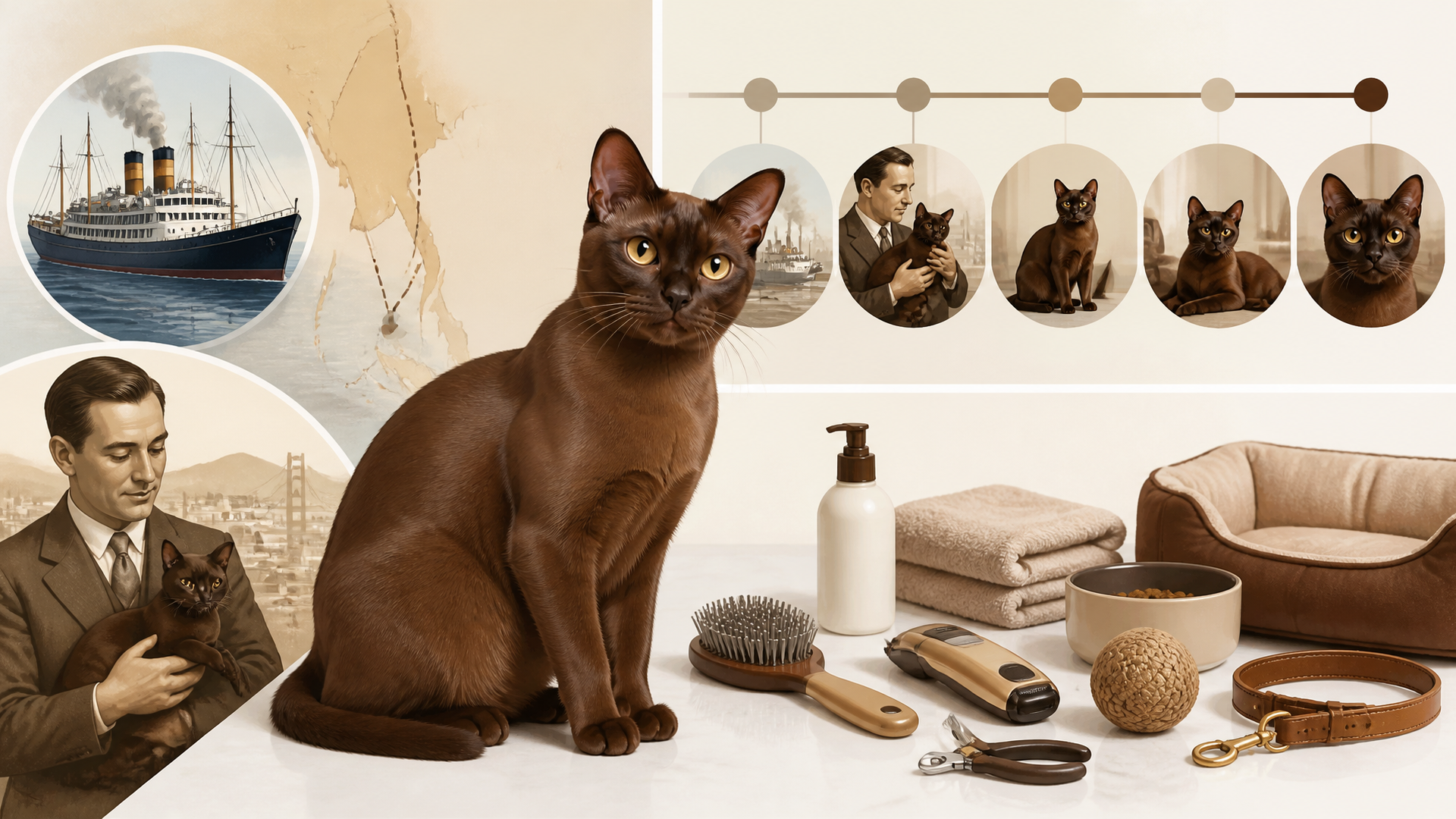
The Burmese cat first appeared in the United States in 1930, thanks to a single dark-brown cat named Wong Mau. Brought from Burma (now Myanmar) to San Francisco by Dr. Joseph Thompson, this small cat with a short, glossy coat became the foundation of an entire breed. The story involves a Navy psychiatrist, some careful breeding, and a long road to official recognition. Here’s exactly how it happened and what it means if you’re researching the breed today.

One Cat, One Breed: The Wong Mau Story
Dr. Joseph Thompson imported Wong Mau to California in 1930. At first glance, she looked like a Siamese with an unusually dark coat and a more muscular, compact body. But breeding experiments showed she wasn’t pure Siamese. By crossing her with a Siamese male and then breeding the offspring back, Thompson proved that Wong Mau carried genes from an unknown Burmese-type cat. That hybrid pairing created the foundation stock for modern Burmese.
Why this matters for owners today: Burmese cats still carry some Siamese genetics, which occasionally produces kittens with colorpoint patterns (darker face, ears, paws, tail). If your cat shows points, it may not be a purebred Burmese — or it could come from a line with recent outcrossing. Always verify pedigree papers and health records. This history also explains why some Burmese cats have a slightly different body type depending on the breeding line.
When It All Happened: A Quick Timeline
| Year | Event |
|---|---|
| 1930 | Wong Mau arrives in San Francisco |
| 1930–1934 | Thompson breeds her to a Siamese, then backcrosses to her offspring |
| 1936 | CFA accepts the Burmese as a breed |
| 1947 | CFA pulls recognition over inbreeding concerns |
| 1953 | CFA reinstates the breed after health improvements |
| 1958 | Final breed standard for American Burmese is set |
Practical implication: If you’re looking at a Burmese today, ask whether the breeder follows the original American standard or a European one. The divergence that started in the 1950s means not all “Burmese” cats are the same. Knowing which line your cat comes from affects health screening, show eligibility, and even temperament.
Old-Style vs Modern: Which Burmese Fits Your Goals?
This split creates a real decision point for owners. The first Burmese (like Wong Mau) were leaner and less extreme in the face — more like today’s European Burmese. Modern American Burmese are rounder, more compact, and have a very short muzzle.
American Burmese (CFA/TICA standard)
- Round, full face with a short nose
- Muscular, heavy-boned body
- Rich sable coat (dark brown with warm undertones)
- Predominant in US show rings
European Burmese (traditional or old-style)
- More moderate head shape, slightly longer muzzle
- Leaner, more athletic build
- Available in a wider range of colors (often from Siamese outcrossing)
- Less common in the US but closer to Wong Mau in appearance
Applicability boundary: This distinction matters most if you plan to show your cat or breed seriously. If you just want a loving, playful companion, both types share the same affectionate, people-oriented temperament — and health risks are similar. Choose based on breeder reputation and health testing, not just looks.
Mismatch risk: A European Burmese may not be eligible for CFA championship classes. If you import one, check with your local registry. Also, some traditional breeders have smaller breeding pools, so health testing (especially for GM1 gangliosidosis and hypokalemia) can vary. Always ask for documented test results.
How the Burmese Spread to Europe and Split into Two Lines
The breed reached Britain in the late 1940s, and by the 1950s, British breeders began crossing Burmese with Siamese to develop new colors like blue, chocolate, and lilac. That cross—along with different breeding goals—pushed the UK standard toward a more moderate, less round shape than the American standard.
- 1949: First Burmese imports to the UK from the US
- 1950s–1960s: British breeders add new colors and moderate the head shape
- 1970s onward: CFA and UK standards diverge completely
Trade-off to know: The European line offers more color variety but has a slightly higher risk of health issues linked to smaller genetic pools in certain countries. The American line has a larger, more established gene pool but fewer color options beyond the original sable. If you’re looking for a specific shade or show eligibility, verify the breeder’s registry before committing.
Three Practical Ways to Confirm Your Cat’s Lineage
Tip 1: Check the paperwork
- Actionable step: Look for registration papers from CFA or TICA for both parents.
- Common mistake: Believing a photo or description alone. Without papers, you may have a Tonkinese or a mix.
Tip 2: Examine eye color and coat
- Actionable step: Pure Burmese have gold to yellow eyes, not blue or aqua. The coat should be solid with subtle shading, not sharp points.
- Common mistake: A cat with blue eyes or distinct colorpoint markings is not a pure Burmese — it’s more likely a Tonkinese or a hybrid.
Tip 3: Verify health testing records
- Actionable step: Ask for results of GM1 gangliosidosis and hypokalemia screening before bringing a kitten home.
- Common mistake: Accepting verbal promises. Reputable breeders provide test documents from a lab.
Verification step you can do at home: Check the paw pads and nose leather — on a true sable Burmese, they should be a warm brownish-pink or dark brown, not black or vibrant pink. This is a quick visual clue.
Five Things to Verify When Researching Burmese History
Use these points to assess breed information or a cat’s background:
- [ ] Registry recognition: The breed is CFA-recognized (since 1936) and TICA-recognized (since 1979).
- [ ] Pedigree depth: A pure Burmese should have 3+ documented generations.
- [ ] Body type: Compact, muscular (American) vs moderately lean (European) — know which matches your goals.
- [ ] Coat color: Sable is the original; other colors (champagne, blue, platinum) appeared later through outcrossing.
- [ ] Health clearances: Ask for GM1 gangliosidosis and hypokalemia test results.
Common Questions About the Burmese Cat’s Origins
Q: Did the Burmese cat really start with just one cat?
A: Yes — Wong Mau, imported in 1930, is the documented foundation cat of the entire breed. Her offspring with a Siamese male created the gene pool.
Q: Why did the breed standard change over time?
A: Selective breeding in the US favored a rounder, more compact look for show purposes. British breeders preferred a moderate type and added new colors, leading to the split.
Q: How can I tell if my cat is a true Burmese?
A: Check eye color (gold to yellow), coat (solid with no sharp points), and body type (compact or moderately lean). Papers from CFA or TICA are the only reliable proof.
Q: Is the European Burmese healthier than the American one?
A: Neither is inherently healthier. Both lines are at risk for the same hereditary diseases. Health depends on the breeder’s testing, not the continent.
Save This Guide
The Burmese cat first appeared in the 1930s through one unexpected cat — and that history still shapes the breed today. Keep this timeline and checklist handy when evaluating breeders, verifying a cat’s lineage, or deciding between American and European lines. Always prioritize health testing over appearance, and ask for documentation. A well-researched owner finds the right Burmese.