Beagle Bite Force””””””””””'[;]: Step-by-Step Training Guide
Beagles don’t have the strongest bite among dogs — their bite force measures around 200–250 PSI (pounds per square inch), similar to other medium-sized breeds. But here’s what most guides skip: jaw strength isn’t the real issue with Beagles. Their stubbornness and high prey drive make them more likely to practice unwanted mouthing, and their strong bite inhibition as puppies means they need consistent training earlier than you might think.

The good news: you can train mouthing and biting out of your Beagle with the right sequence. Here’s exactly how.
What Normal Beagle Mouthing Looks Like vs. Problem Biting
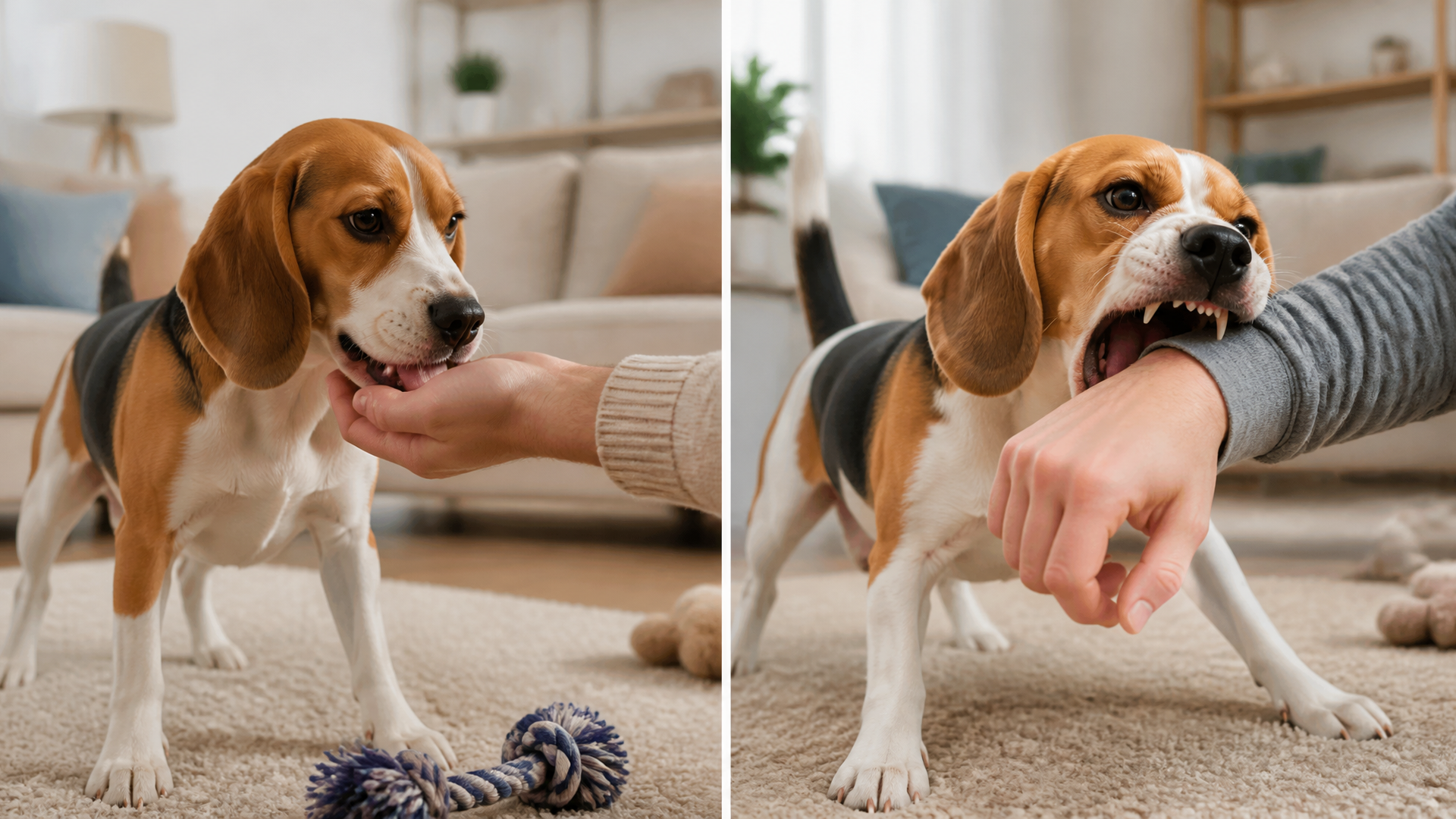
Beagles are mouthy dogs by nature. As scent hounds bred to work in packs, they use their mouths to explore, communicate, and carry objects. Normal puppy mouthing during teething (4–6 months) is expected. Problem biting includes:
- Hard pressure that breaks skin consistently
- Growling combined with biting (not just play sounds)
- Biting when handled (ears, paws, collar)
- Resource guarding with teeth — snapping when approached near food or toys
Understanding the difference tells you whether you need basic training or a veterinary behaviorist.
Step-by-Step Training Sequence
Step 1: Set Up Your Training Environment
Before any session, remove high-value distractions. Beagles are driven by scent, so pick a low-smell area:
- A room with no food crumbs or previous treat spills
- Remove other pets from the room
- Have a leash on inside for control (not punishment — just management)
- Keep treats in a sealed pouch, not loose in your pocket
What you’ll need:
- Soft, high-value training treats (freeze-dried liver or cheese bits work well)
- A chew toy that’s different from household items (avoid shoes, remotes, or anything you don’t want them to learn is okay)
- A harness (not a collar) for gentle control during handling exercises
Step 2: Teach Bite Inhibition (8–12 Weeks Old Critical Window)
This is the single most important step for Beagles specifically. Start the day your puppy comes home.
1. Let your Beagle mouth your hand gently — you want them to learn soft mouthing is okay
2. The moment you feel any pressure, yelp in a high-pitched “ow!” and stop all play immediately
3. Turn away and freeze for 10–15 seconds — don’t look at or touch your Beagle
4. Resume play only when they’re calm and not mouthing
Beagles respond to social signals from their pack. Your yelp mimics a littermate’s protest. If your Beagle is older (over 6 months), skip the yelp — it can excite them more. Instead, stand up and walk away every time they bite.
Verification step: After two weeks of daily practice, test by gently touching your Beagle’s lips while they’re calm. If they respond with a soft mouth (no pressure) or turn their head away, you’ve passed. If they clamp down hard or lunge, repeat Step 2 for another week before moving to Step 3.
Step 3: Redirect to Appropriate Chews
Beagles need to chew, especially during teething. Instead of stopping all mouthing, redirect:
1. Keep a chew toy within arm’s reach during every interaction
2. The instant your Beagle’s mouth touches your skin or clothes, say “gentle” (one word) and immediately offer the toy
3. Praise when they take the toy instead of your hand
4. If they drop the toy and come back to your hand, repeat — no scolding, just redirect again
Best chew options for Beagles:
- Rubber toys with treat compartments (Kong-type)
- Braided bully sticks (supervise to prevent swallowing large pieces)
- Nylabones for heavy chewers
Avoid rawhide — Beagles are gulpers and can choke on softened pieces.
Verification step: After one week of consistent redirecting, count the ratio. Your Beagle should take the offered toy instead of your hand at least 4 out of 5 times. If not, increase the value of the toy (stuff it with peanut butter or freeze-dried liver) and keep practicing.
Step 4: Teach “Leave It” for Impulse Control
Beagles follow their nose first and your commands second. “Leave it” is your most powerful tool against biting.
1. Close your fist around a treat and present it to your Beagle
2. Say “leave it” once — if they sniff, lick, or paw, just wait
3. The second they pull back even a centimeter, say “yes!” and give them a different treat from your other hand
4. Practice this 5 times per session, 3 sessions per day for one week
5. Move to an open palm — same command, same reward timing
6. Place treats on the floor under your foot, then without covering
Once “leave it” is solid, use it before any handling that might trigger biting (ear cleaning, nail trims).
Common Beagle-specific friction point: If your Beagle ignores “leave it” and goes straight for the treat, you’re moving too fast. Go back to the closed fist stage and wait them out — Beagles are persistent, but they eventually choose the reward from your other hand if you’re patient.
Verification step: Your Beagle should reliably leave a treat on the floor 3 feet away when you say “leave it,” and only take it when you release with “okay.” Test once per day for three days before considering this step complete.
Step 5: Handle Tolerance Exercises
Beagles can be touch-sensitive, especially around their paws and ears. Biting during handling is common and needs specific desensitization.
1. Start with one second of ear touch followed immediately by a treat — repeat 10 times
2. Work up to 3 seconds before the treat
3. Move to paw handling — touch one toe, treat, release
4. Add mild restraint — gently hold your Beagle still for 2 seconds, treat, release
Likely cause check: If your Beagle bites during handling, stop and go back two steps in difficulty. Rushing makes biting worse. Take a full week per level if needed.
Verification step: Your Beagle should allow you to touch both ears and all four paws without any growl, lip curl, or snap. If you can do that while they’re relaxed on your lap or on their bed, you’ve succeeded.
When Biting Gets Worse: Common Friction Points
| Behavior | Likely Cause | Fix |
|---|---|---|
| Biting when tired | Overtired puppy (Beagles hide fatigue) | Enforce nap time — 18–20 hours sleep for puppies |
| Biting only certain family members | Inconsistent rules | Everyone uses the exact same redirection and yelp |
| Biting during walks | Leash frustration + prey drive | Use a front-clip harness, practice “look at me” on walks |
| Biting after eating | Resource guarding immediate | Hand-feed meals for 2 weeks, trade for higher-value items |
One deeper example: If your Beagle bites during walks, it’s often because they see a squirrel or smell something irresistible and get frustrated that the leash holds them back. Instead of correcting the bite (which escalates frustration), train a strong “watch me” cue. Hold a treat at your eye level, say “watch me,” and reward eye contact. Practice in low-distraction areas first, then slowly add more exciting environments.
6-Item Training Check: Is Your Beagle Improving?
Print this or save it. Check at the end of each week.
1. Your Beagle releases when you say “drop it” within 3 seconds (test during play)
☐ Yes ☐ No
2. Mouthing no longer leaves red marks on your skin
☐ Yes ☐ No
3. You can touch both ears and all four paws without a growl or snap
☐ Yes ☐ No
4. Your Beagle takes a chew toy instead of your hand at least 4 out of 5 attempts
☐ Yes ☐ No
5. “Leave it” works with food on the floor 3 feet away
☐ Yes ☐ No
6. Biting happens less than once per day (not counting teething mouthing)
☐ Yes ☐ No
If you answered “No” to two or more, go back to Step 2 and repeat daily for another week before moving forward.
When to Escalate to a Professional
Take your Beagle to a veterinarian or certified behavior consultant if:
- Biting breaks skin consistently (more than twice)
- Your Beagle bites out of nowhere with no warning
- Growling accompanies biting in more than 50% of incidents
- Your Beagle is over 8 months old and still biting hard
- You’ve followed this guide for 4 weeks with no improvement — stop DIY training immediately if bites are increasing in frequency or intensity
- Your Beagle shows signs of pain during routine handling (flinching, yelping before biting)
These signs suggest pain, fear-based aggression, or a neurological issue — not a training gap. A veterinary behaviorist or certified applied animal behaviorist (CAAB) can create a customized plan that addresses the root cause, which may include medication, desensitization protocols, or management changes.
Products That Help (Used in This Guide)
- Soft training treats (freeze-dried liver, cheese, or moist training bits) — small, smelly, high-value
- Kong Classic (stuffed with peanut butter or kibble) — for redirection during teething
- Front-clip harness — reduces pulling and gives you control during walk training without choking
- Bully sticks in a holder — prevents gulping while giving your Beagle a safe outlet
Some links in this guide are affiliate links. We may earn a small commission at no extra cost to you.
Save This Guide
Beagle bite force isn’t about jaw strength — it’s about persistence. Training needs to be consistent, calm, and practiced daily for at least 4 weeks before you see real change. Focus on bite inhibition first, impulse control second, and handling tolerance third. Use the verification steps after each stage to confirm you’re ready to move on, and don’t hesitate to call a professional if you hit the escalation signs. Save this guide for the weeks ahead.