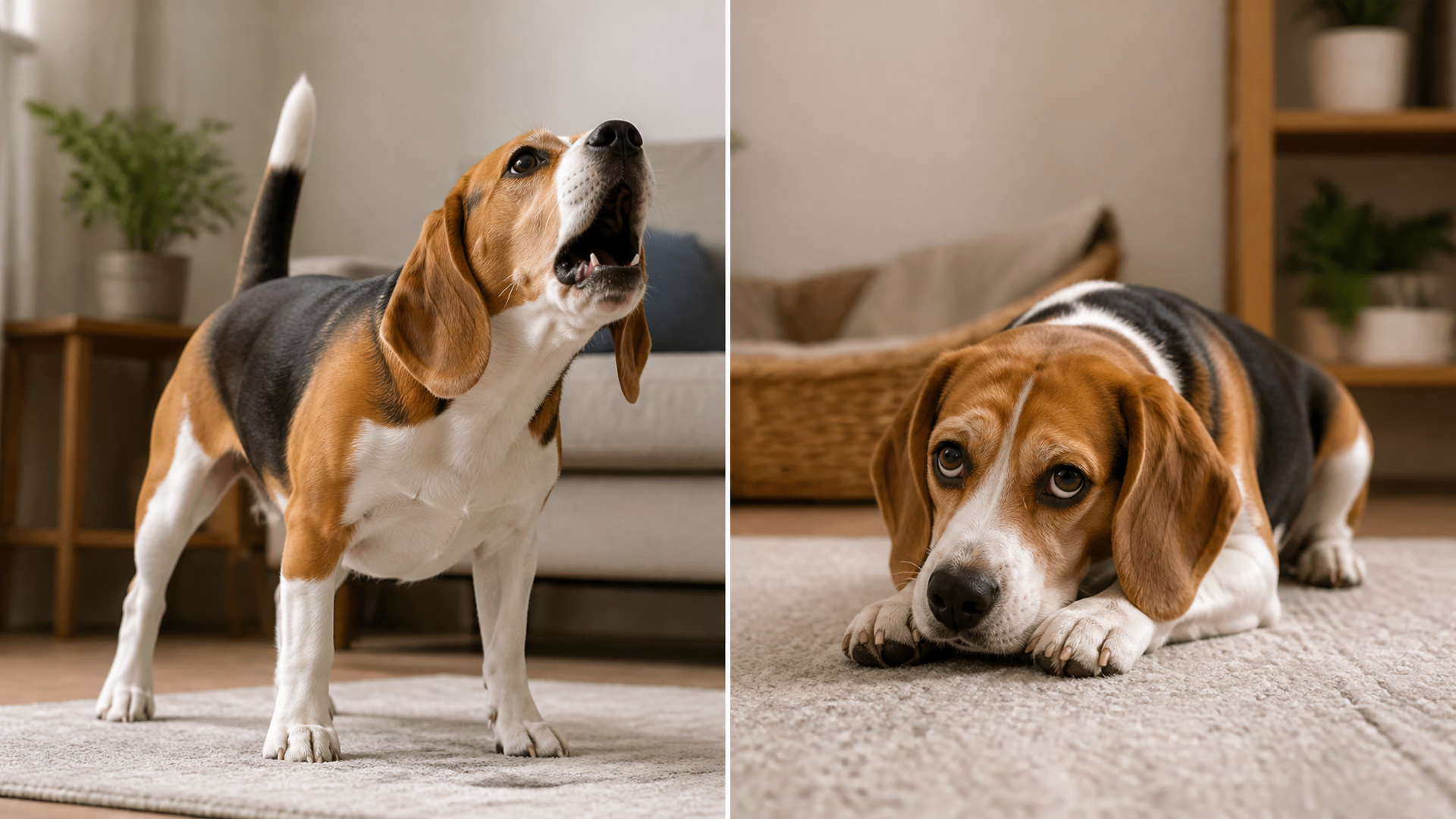
Beagle Sounds: Guide: What Every Owner Should Know
Beagles are one of the most vocal dog breeds, and every bark, bay, whine, or growl carries a direct message about what they need, feel, or sense. Learning to decode those sounds is the fastest way to reduce nuisance noise — without guesswork or punishment.

The short answer: A Beagle’s vocalizations are driven by instinct (hunting, pack communication) or need (boredom, discomfort, alert). Match the sound to the trigger, then choose the right response — or deliberate non-response. The counter-intuitive trick most articles skip: sometimes ignoring a sound trains your Beagle faster than rewarding or punishing it.
The Beagle Vocal Repertoire: Sound Types and What They Mean
Beagles produce three primary sound categories: barks, bays/howls, and whines. Each has distinct triggers and urgency levels. Use this table as a quick reference.
| Sound type | What it sounds like | Most common trigger | Action needed? |
|---|---|---|---|
| Alert bark | Sharp, repetitive, medium pitch | Doorbell, stranger, unfamiliar noise | Acknowledge once, then redirect |
| Playful bark | Higher pitch, short bursts, tail wagging | Favorite person, toy, or play invite | Join or ignore – your choice |
| Bay/howling | Long, drawn-out, rising then falling | Scent trail, siren, separation anxiety | Depends on context – see flow below |
| Whining | Soft, insistent, often with pacing | Need to go out, boredom, discomfort | Immediate check if pacing or pawing |
| Low growl | Low, rumbling | Resource guarding, fear, or play (watch body language) | Stop escalation if stiff body; play growls are loose |
Practical implication: If you hear a bay or howl, do not reach for an anti-bark collar. Beagles are driven by scent and pack instinct — suppressing the sound without addressing the trigger often increases anxiety and can make the behavior worse. Instead, ask yourself: Is he tracking a scent? Is he alone too long? Then fix the root cause, not the symptom.
Product recommendation: A snuffle mat (like the Trixie Mad Scientist or a simple DIY towel roll) gives your Beagle a legal outlet for scent-driven vocal energy. Expect about 15 minutes of sniffing to match the mental fatigue of a 45-minute walk.
How to Interpret and Respond to Beagle Sounds (Operator Flow)
Follow this five-step process when you hear a sound you don’t immediately recognize.
1. Stop and identify the sound class. Is it a bark, howl, whine, or growl? Use the table above as a cheat sheet.
2. Scan the environment. What changed in the last 30 seconds? Did a car pass? Did you pick up a treat? Is the Beagle staring at the door?
3. Check body language. A playful bark with a loose, wagging body is different from an alert bark with stiff legs and raised hackles.
4. Decide: act or ignore.
- Alert barks: say “Thanks, I see it” once, then redirect to a place command or toy.
- Howling from boredom: increase daily exercise and offer a puzzle toy like a frozen Kong or beef trachea.
- Whining with pacing: take outside immediately — that’s the bathroom signal.
5. Escalate to vet if the whining is accompanied by shaking, hiding, or refusal to eat — especially in older Beagles. Pain or cognitive decline can change vocal patterns.
Verification checkpoint
To confirm whether your Beagle’s howling is separation anxiety vs. boredom, set up a camera and leave for 30 minutes. If the howling starts within 5 minutes and persists, it’s likely separation anxiety. If it starts after 15–20 minutes of inactivity, it’s boredom. That distinction tells you whether to focus on gradual departures or on adding more mental stimulation before you leave.
Likely cause of sudden excessive barking
A deer, rabbit, or squirrel scent trail that entered your yard. Beagles were bred to track game by sound, so a fresh scent can trigger 15–20 minutes of nonstop baying. The fix is to block sight lines or use a white-noise machine inside (e.g., a LectroFan or a simple box fan).
Trade-off to watch for
Giving your Beagle a scent job (snuffle mat, scent work) can reduce barking, but some Beagles initially whine or bark at the mat in frustration. If that happens, switch to a simpler scatter feed on a clean floor for a few days, then reintroduce the mat slowly. Also, puzzle toys that require paw manipulation can frustrate Beagles — stick to nose-based puzzles instead.
The Counter-Intuitive Strategy: Sometimes Silence Is the Best Response
Most generic articles tell you to respond to every bark or whine with a command or reward. But Beagles are smart negotiators — if you reward attention-seeking barks, you train your dog to bark louder and longer.
What actually works: For low-stakes sounds (playful barks, attention whines when you’re busy), deliberately ignore them. Do not make eye contact, do not speak, do not move toward the dog. The moment the Beagle pauses and offers quiet, immediately mark that silence with a calm “yes” and a small treat.
Common mistake: Yelling “quiet” while the Beagle is still barking. The dog thinks you’re barking along with him, which reinforces the behavior. Silence must be trained in the absence of sound.
This approach works especially well for attention-seeking whining. Once your Beagle learns that silence earns attention while noise earns nothing, you’ll see the whining drop by 50-70% within a week.
3 Expert Tips for Managing Beagle Barking
These tips focus on prevention and positive redirection — not punishment.
Tip 1: Give the nose a job
- Actionable step: Feed meals using a scent-work mat (snuffle mat) or scatter kibble on a towel and roll it up. Fifteen minutes of sniffing equals a 45-minute walk in mental fatigue.
- Common mistake: Using a “quiet” command without rewarding the moment the Beagle stops barking. Mark the silence with a clicker or word (“yes”), then treat. Timing is everything.
Tip 2: Create a “settle” cue
- Actionable step: Train your Beagle to go to a designated bed or mat on command. Pair the cue with a high-value chewy (bully stick or frozen Kong), then gradually extend the duration of calm.
- Common mistake: Expecting instant quiet without first building duration. Start with 5 seconds of calm, reward, then slowly increase. Rushing leads to frustration on both ends.
Tip 3: Manage separation howling with gradual departures
- Actionable step: Practice leaving the house for 1–2 minutes, then return before the howling starts. Slowly increase time over days or weeks. A white-noise machine or calming pheromone diffuser (e.g., Adaptil) can help take the edge off.
- Common mistake: Leaving a Beagle alone for 8 hours without exercise — that’s a recipe for full-throated howling. Always do a 20-minute walk before any extended alone time.
Warning Signs: When Beagle Sounds Mean a Vet Visit
Most Beagle vocalizations are normal, but certain changes require a veterinary check:
- Sudden increase in whining with no obvious trigger (not food, bathroom, or boredom) – especially in an older Beagle, could indicate arthritis, ear infection, or cognitive decline.
- High-pitched yelp when touched in a specific spot – likely pain. Check for injury or tenderness.
- Nighttime howling that wasn’t happening before – could be separation anxiety or age-related confusion.
- Hoarse or weak bark after a period of loud barking – possible laryngitis; offer water and quiet rest. If it persists more than 48 hours, see the vet.
Product recommendation: A calming pheromone diffuser like Adaptil can reduce anxiety-driven vocalizations. Place it in the room where your Beagle spends the most alone time.
Save This Guide
This guide is worth saving for the next time your Beagle lets out a sound you don’t understand. The key takeaway: every vocalization is a message, not a malfunction. By matching the sound to the trigger and responding with the right action (or deliberate non-action), you’ll build a quieter, more trusting relationship with your Beagle.
This page may contain affiliate links. As an Amazon Associate I earn from qualifying purchases.