Burmese Cat Colors: Guide: What Every Owner Should Know
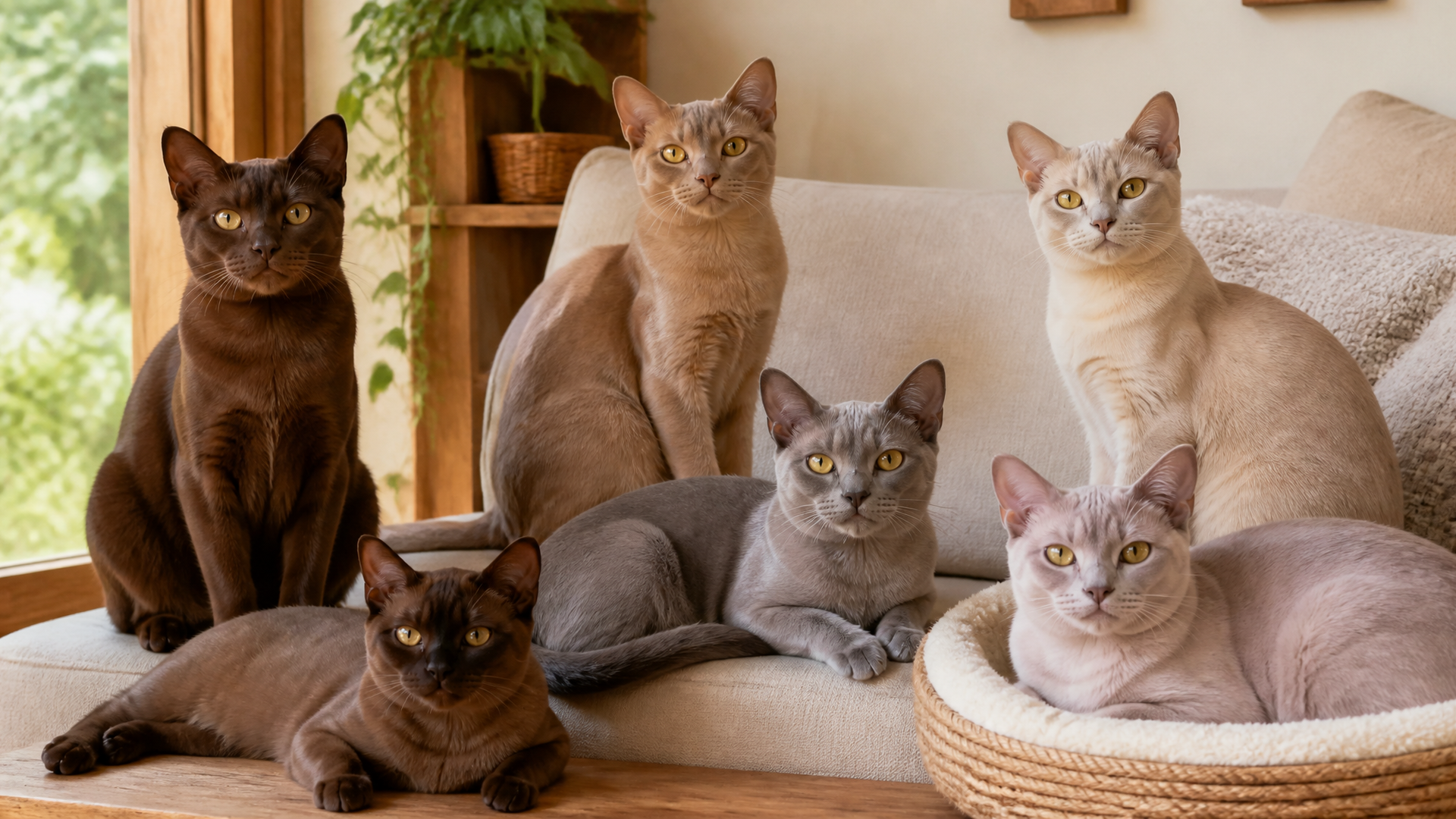
Burmese cats come in four standard colors — sable, champagne, blue, and platinum — plus two rarer shades (cinnamon and lilac) found in some breeding lines. All Burmese carry the same recessive sepia gene (cb), which gives their coat a warm, solid tone that darkens with age. If you’re picking a kitten or trying to ID your cat’s color, the short answer is this: compare in natural daylight, check the nose and paw pads, and wait until at least 12 months for the final shade.

These color descriptions apply to purebred Burmese registered with CFA or TICA. If your cat has any crossbreeding, the colors may not follow the standard pattern. Always verify lineage with your breeder.
Standard Colors
The Cat Fanciers’ Association (CFA) and The International Cat Association (TICA) recognize these four colors. All Burmese have gold to yellow eyes — blue or green eyes mean you’re looking at a mix or a different breed.
| Color | Appearance | Eye Color | Key Identifier |
|---|---|---|---|
| Sable | Rich warm brown like dark chocolate; the darkest standard shade | Gold to yellow | Darkens to near-black in older cats; most common color |
| Champagne | Warm beige with gold undertones; lighter than sable | Gold | Often mistaken for platinum; look for the golden cast |
| Blue | Soft gray-blue like a stormy sky; even tone across body | Gold to yellow | Looks silvery in bright light; more muted than Russian Blue |
| Platinum | Pale silvery gray with a faint warm tint; the lightest standard color | Gold to yellow | Cooler tone than champagne; described as “pale champagne” |
What this means for you: If you’re registering a cat or showing, these four are your only options in CFA/TICA. Any other color won’t be eligible for championship classes.
Rare Colors Worth Knowing
Cinnamon and lilac appear in some Burmese lines, especially from European and Australian breeders. They’re not accepted by CFA or TICA for showing, but you’ll still see them advertised.
Cinnamon
- Appearance: Warm reddish-brown, lighter than sable with a coppery tone
- Nose and paw pads: Pinkish
- Why it matters: If a US breeder advertises “cinnamon Burmese,” ask which registry they use — it may not be registerable for shows
Lilac
- Appearance: Pale dusty pinkish-gray, even lighter than platinum
- Nose and paw pads: Pinkish-gray with mauve tone
- Why it’s rare: Very few US breeders produce lilac; most come from imported lines
Practical takeaway: If you want a show cat, stick with the four standard colors. If you just want a healthy, unique-colored companion, cinnamon and lilac are fine — just verify the breeder’s health testing and parentage paperwork.
How to Track Color Changes from Kitten to Adult
Burmese kittens are born much lighter than their adult color — a sable kitten can look like a pale tan mouse at first. Here’s the exact progression and how to track it.
Step 1: Birth to 4 Weeks — Expect a Pale, Washed-Out Coat
All Burmese kittens start nearly cream or light tan. You cannot reliably identify the color at this stage. Even a sable kitten will look like a champagne.
Checkpoint: Don’t try to assign a color yet. Focus on health and temperament.
Step 2: 4 to 6 Months — The Darkening Begins
The sepia gene activates. Ear edges and tail tip develop pigment first. A sable kitten will show nearly black ear edges by 4 months. Champagne kittens develop warm brown ear edges, not gray.
Checkpoint: Compare ear edges in natural daylight. This is the earliest reliable indicator.
Step 3: 6 to 12 Months — Rapid Color Shift
This is where most of the change happens. Sable cats deepen to rich brown; champagne settles into warm beige; blue and platinum approach their final tone. Some cats darken dramatically in this window.
Checkpoint: Take a photo every 30 days in the same spot (near a window, on a white towel). You’ll see the progression clearly.
Step 4: 12 to 24 Months — Final Color Settles
Your cat’s color is now close to its adult shade. Minor seasonal shifts may still occur (darker in winter, lighter in summer) but the base tone is set.
Success check: Compare current photo to the 6-month photo. If you see a clear darkening, your cat is on track. If the color hasn’t changed much by 18 months, what you see is likely the final shade.
Likely cause of confusion: Assuming a kitten’s color at 8 weeks is its adult color. It’s not — wait until at least 12 months to judge.
When to escalate: If your cat’s color shifts dramatically after 2 years (especially yellowing or patchiness), schedule a vet check — it could signal a health issue like thyroid imbalance or nutritional deficiency.
Quick Tips for Identifying the Exact Shade
Tip 1: Use Natural Daylight — Not Indoor Bulbs
Actionable step: Place your cat on a white towel near a window on an overcast day. Take photos in morning light (10–11 AM). Indoors, sable can look black; platinum can look gray-blue.
Common mistake to avoid: Relying on incandescent bulbs. They add a yellow tint that makes champagne look like platinum and vice versa.
Tip 2: Check the Nose and Paw Pad Color
Actionable step: Look at the leather on the nose and the pads of all four paws. The color is stable from around 8 weeks and won’t shift much.
- Sable: Dark brown to almost black
- Champagne: Pinkish tan
- Blue: Slate gray
- Platinum: Pinkish gray with a soft mauve tone
Common mistake to avoid: Using only body fur color — it’s the least reliable part on a young cat. The nose and pads are more consistent.
Tip 3: Compare Ear Edges Rather Than the Whole Body
Actionable step: Gently part the fur at the outer edge of the ear. The pigment there develops first and gives the clearest early signal.
- Sable ear edges: Nearly black by 4 months
- Champagne ear edges: Warm brown, not gray
- Blue ear edges: Cool gray, not brown
- Platinum ear edges: Pale grayish-pink
Common mistake to avoid: Assuming a cat is sable because the tail tip is dark. Even platinum kittens have darker tails. Compare ear edges instead.
Verification Step for Registration
To confirm your cat’s color for official registration, compare nose and paw pad color against a breeder-provided color chart under natural daylight. Take a photo and send it to your breeder or a Burmese breed council for confirmation. Many breeders also offer free color verification for kittens they didn’t sell.
A Realistic Mismatch to Watch For
If you rely solely on body fur color, you may misidentify a champagne cat as platinum in dim light, or a dark sable as black (Burmese never produce true black). The safest approach is to use multiple identifiers: ear edges, nose pads, and monthly photos. Misidentification can lead to incorrect registration paperwork or disappointment if you expected a specific shade. When in doubt, ask a second breeder or a show judge for an opinion.
Frequently Asked Questions About Burmese Cat Colors
Do Burmese cats get lighter in summer?
Some do, but the change is subtle — think a shade or two at most, not a full color shift. It’s more noticeable in sable and blue cats. The base tone stays the same.
Can two champagne parents produce a sable kitten?
No. Sable is dominant over all other Burmese colors. Two champagne cats (both homozygous for the recessive champagne gene) can only produce champagne kittens. To get sable, at least one parent must carry the sable gene.
Are lighter-colored Burmese more prone to health issues?
No, unlike some breeds (white cats and deafness, for example), Burmese coat colors aren’t linked to known health problems. Platinum and lilac cats do show dirt and tear staining more easily — that’s a grooming consideration, not a health concern.
What color eyes do Burmese kittens have at birth?
All are born with blue eyes. The color shifts to gold or yellow around 6–8 weeks. If your cat keeps blue eyes past 12 weeks, it’s a mix or a different breed.
Save This Guide — Bookmark or pin this page for reference as your kitten’s coat develops. The biggest color shift happens between 4 and 12 months. Use the natural-light test, check the ear edges, and compare monthly photos to track the change. And if you’re transporting your cat to a breeder or show for color registration, a secure carrier like the GAPZER Pet Carrier for Large Cats keeps your Burmese calm and safe during travel.
Disclosure: This guide contains general breed information. Always verify specifics with your breeder or vet. Some product links are affiliate links.