Common Dog Grooming Blade For a Poodle
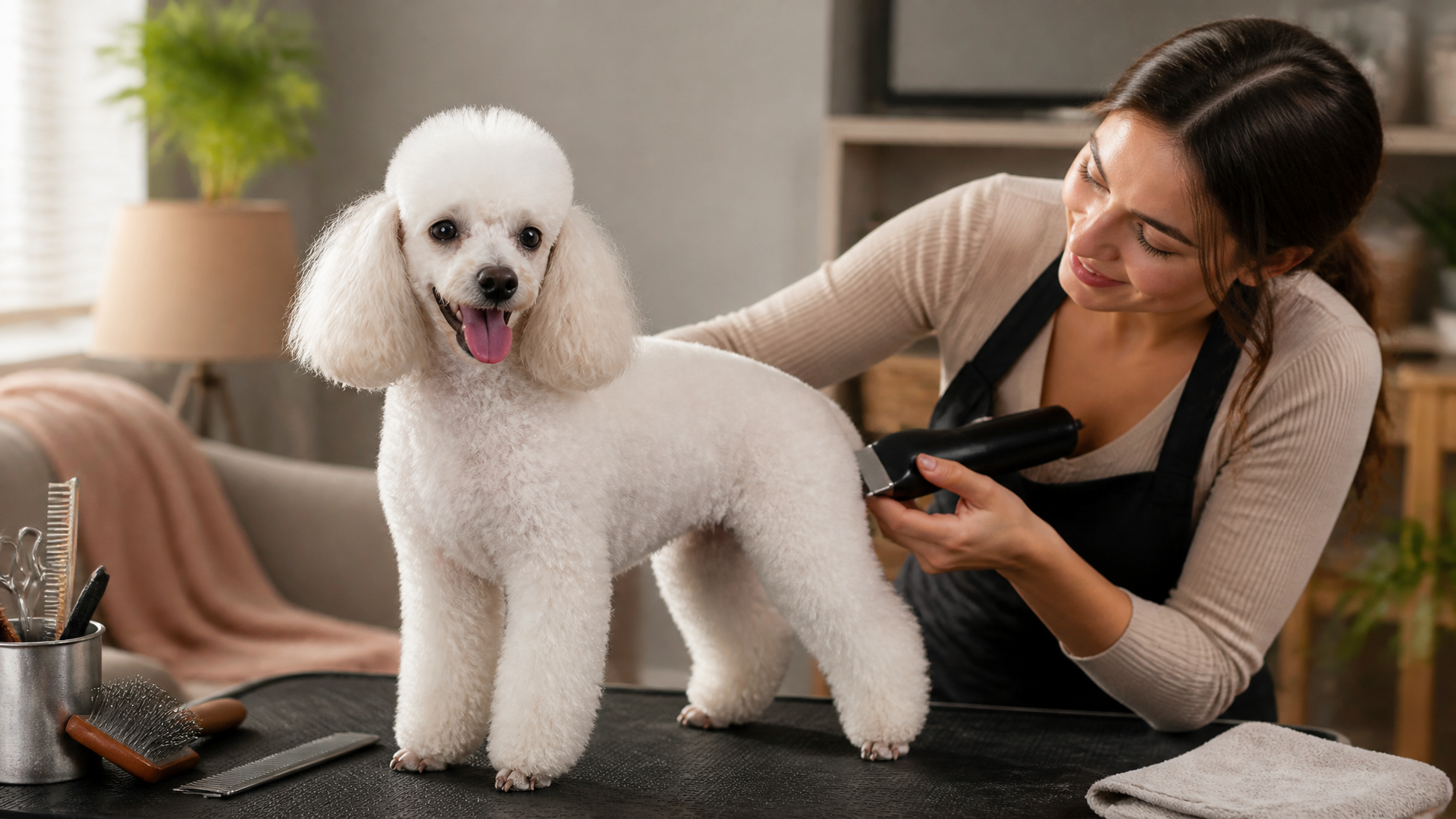
If you own a Poodle, you need a #10 blade. It’s the grooming industry standard for the face, feet, and sanitary areas on every Poodle size — toy, miniature, and standard. A #10 blade leaves roughly 1/16 inch of hair, giving you a clean, tight finish without risking nicks on sensitive skin.

But one blade won’t do everything. The right blade changes depending on whether you’re shaving the body, shaping the face, or cleaning the paws. Here’s exactly how to choose, use, and know when to stop.
What Makes a Poodle’s Coat Different
Poodle hair is dense, curly, and single-coated (no undercoat). This means:
- It mats fast if not brushed daily
- Blades dull more quickly than on double-coated breeds
- You need sharper, higher-quality stainless steel blades — cheap ones pull and snag
A dull blade on tight curls is miserable for your dog. Invest in professional-grade blades from Andis, Wahl, or Oster.
The #10 Blade: Your Poodle’s Best Friend
The #10 blade is the most versatile blade in any Poodle owner’s kit. Here’s what you’ll use it for:
| Blade # | Hair Length Left | Best For |
|---|---|---|
| #10 | 1/16 inch | Face, feet, sanitary areas, underbelly |
| #9 | 1/16 inch (closer) | Surgical prep, very sensitive skin |
| #7F | 1/8 inch | Summer body clip, close all-over trim |
| #5F | 1/4 inch | Body clip with more fluff left |
| #4F | 3/8 inch | Longer body clip, cold weather clip |
| #3F | 1/2 inch | Fluffy body clip, show-style trims |
Why #10 wins: It’s short enough to keep the face clean and paw pads clear, but not so short that it irritates a Poodle’s sensitive skin between the pads.
5-Step Check for Picking the Right Blade
Use this quick decision checklist before you start grooming:
1. Coat section — Is this the face, feet, or body? Face and feet get #10. Body depends on desired length.
2. Blade fit — Does the blade click securely onto your clipper? Loose blades cause uneven cuts and can pop off mid-groom.
3. Blade temperature — Is it cool to the touch? A hot blade burns Poodle skin. Always have a spare or blade coolant spray ready.
4. Coat prep — Is the Poodle freshly bathed, blow-dried, and brushed completely tangle-free? Blades skip and pull on dirty or matted hair.
5. Attachment combs — If you want longer hair than any blade leaves, do you have snap-on combs (#1, #3, #5, #7) that work with your clipper?
Blade Guidance by Body Part
Different parts need different blades. Here’s the breakdown:
Face and Muzzle
- Use: #10 blade
- Direction: Shave with the hair growth (from nose toward eyes)
- Avoid: Going against the grain — this causes razor burn on sensitive facial skin
Feet and Pads
- Use: #10 blade
- Direction: Between pads: one smooth pass, don’t dig. Top of foot: shave with hair growth.
- Watch for: Dewclaws and webbing between toes. Go slow.
Sanitary Area
- Use: #10 blade
- Direction: Shave in the direction of hair growth only
- Safety: Stretch the skin taut with your free hand. Never press hard.
Body
- Summer clip: #7F (1/8 inch) — keeps them cool
- Winter clip: #4F (3/8 inch) or #3F (1/2 inch) — more insulation
- Show trim: Leave longer on top, use #10 on face and feet
Tail
- Pom-pom tail: Leave a round puff. Use #10 on the shaved base, then hand-scissor the pom-pom.
- Full shave: #10 blade works here too, maintaining the same length as face and feet.
A Simple Body Clip Routine for Beginners
Follow this sequence for your first Poodle body clip:
1. Bathe and fully blow-dry — Blow the coat straight out from the skin. Any dampness will clog the blade.
2. Brush completely — Every mat must be removed before a blade touches the coat.
3. Start with a longer blade — Use a #5F or #4F. You can always go shorter, but you can’t put hair back.
4. Shave in the direction of hair growth — Going against the grain gives a closer cut but increases irritation risk.
5. Use a #10 for face, feet, and sanitary — Switch blades, don’t use the body blade on sensitive spots.
6. Check for missed patches — Run your hand over the coat. Any rough spots need another pass.
Verification step: After the full clip, run your palm flat over every shaved area. The coat should feel uniformly short and smooth — no wavy patches, no sticky spots where the blade skipped. If you feel a rough spot, that area needs a gentle second pass.
How Your Blade Can Still Fail — and What to Do
Even with the right blade, things can go wrong. Here’s the most common failure pattern for Poodle owners:
Symptom: The blade is pulling hair instead of cutting cleanly. You hear a tearing sound or see clumps of hair stuck between the teeth.
Likely cause: The blade is dull, or the coat wasn’t fully detangled. A single small mat you missed can jam the teeth and cause pulling across the whole section.
Safer next move: Stop immediately. Clean and re-oil the blade. If the pulling continues, swap to a spare blade. If you don’t have a spare, stop the groom — a dull blade will hurt your Poodle and leave an uneven mess. Brush the problem area again, then try a fresh blade.
One concrete stop threshold: If you’ve tried a clean, cool, oiled blade and the pulling persists after two passes over the same spot, stop grooming and switch to scissors for that area. Continuing will cause razor burn or a cut.
When to Stop DIY and Call a Professional
Some grooming jobs are best left to the pros. Hand off the clippers if:
- Your Poodle has severe matting close to the skin — shaving over mats can cut the skin
- You need a breed-standard show clip (Continental or English Saddle)
- Your Poodle is anxious and won’t hold still safely
- You’ve never clipped a Poodle and want a starting template from a groomer
Escalation signal: If your Poodle’s skin shows redness, bumps, or bleeding after any grooming session, stop all blade work and let the skin heal. That’s a sign the blade was too short, too hot, or used against the grain. Wait at least a week before your next groom.
The Big Mistake: Using a Skip-Tooth Blade on a Poodle
Skip-tooth blades (like #40 or #50) have wider gaps between teeth. They’re designed for heavy, thick coats on double-coated breeds — not Poodles.
Why it fails: The gaps let curly Poodle hair slip through uncut. You’ll get a choppy, uneven trim that requires multiple passes and irritates the skin. Stick with fine-tooth blades (marked “F” for fine) designed for single-coated, curly breeds.
Save This Guide: The #10 blade is your go-to for Poodle face, feet, and sanitary areas. For the body, choose #7F for summer, #4F for winter. Always swap blades when they dull or overheat. If you feel pulling after two passes, stop and use scissors. Run your hand over the finished coat to confirm it’s uniform. Keep your blades sharp, your Poodle dry, and your clipper well-oiled.
This article contains affiliate links. If you purchase through these links, we may earn a small commission at no extra cost to you.
FAQ: Common Dog Grooming Blade for a Poodle
What blade do professional Poodle groomers use for the face?
Professionals almost always reach for a #10 blade. It provides the clean, tight finish needed for Poodle faces without irritating sensitive skin around the eyes and muzzle.
Can I use a #10 blade on a Poodle’s entire body?
You can, but it leaves a very short coat (1/16 inch). This works for summer or medical shave-downs, but most owners prefer a #7F or longer for the body to keep some fluff.
How often should I replace my #10 blade?
Replace or sharpen it after every 3-4 full grooms on a single Poodle. If you groom multiple dogs, you’ll need to change blades more frequently.
What’s the difference between a #10 and a #7F blade?
A #10 leaves 1/16 inch of hair; a #7F leaves 1/8 inch. The #7F is better for body clips because it leaves a slightly longer, more forgiving finish while still keeping the coat short.
Do I need a different blade for a Toy Poodle versus a Standard Poodle?
No. The same blade numbers work across all Poodle sizes. The #10 blade is the standard for face, feet, and sanitary regardless of your Poodle’s size.