Maine Coon Growth Stage
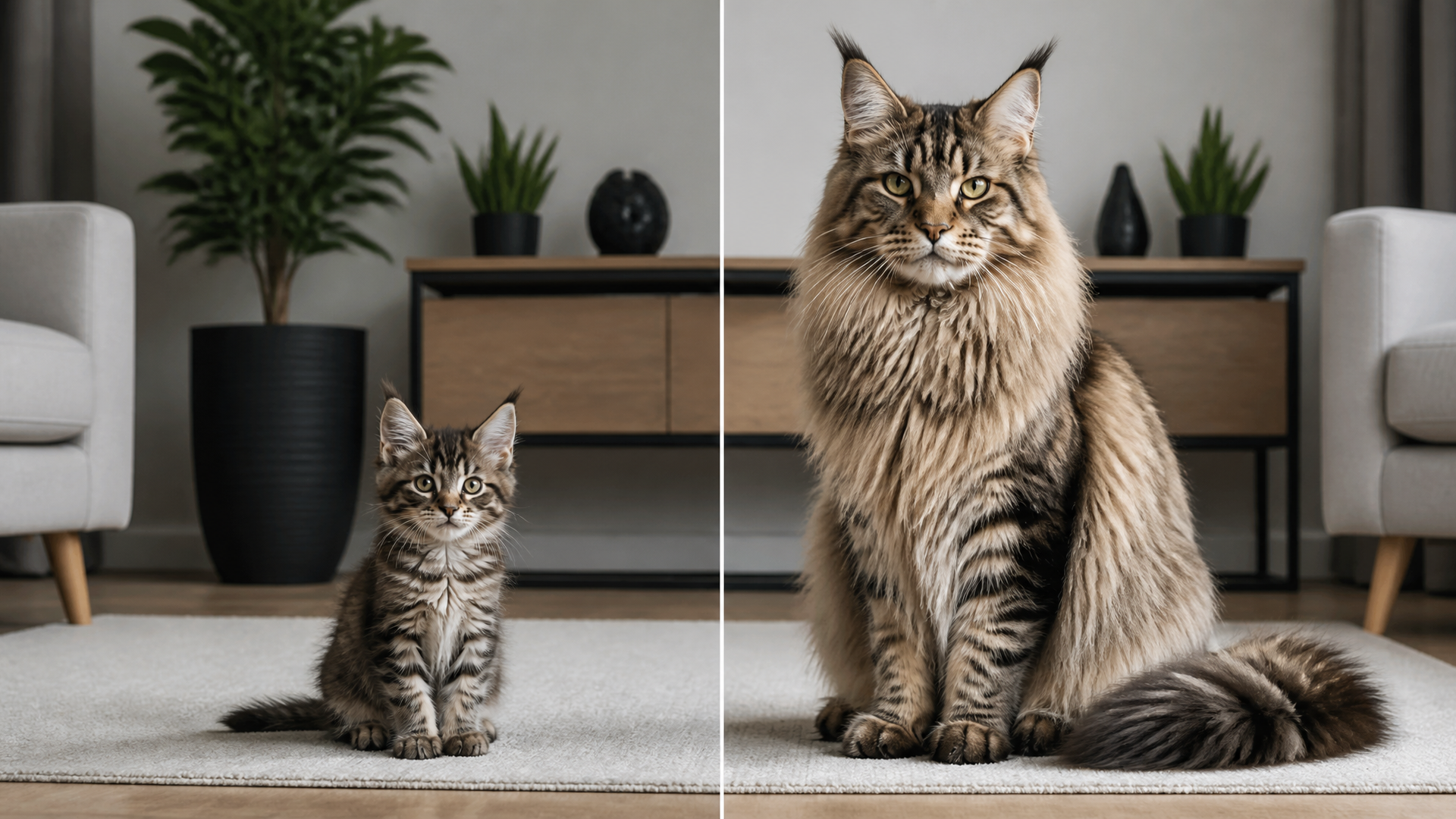
Maine Coons take 3 to 5 years to reach full size — far longer than most cat breeds that max out around 12 months. A male Maine Coon typically weighs 13–18 pounds, with some reaching 25 pounds or more. Females usually run 8–12 pounds. If you’re tracking your cat’s growth, the key number to watch isn’t weight alone — it’s whether they’re following a steady, gradual curve through their extended kitten-to-adult window.

These milestones apply to purebred Maine Coons from reputable breeders. If your cat is a mix or from uncertain lineage, growth may be smaller or follow a different pattern. Neutering before 12 months can also slow the growth window — talk to your vet about adjusting feeding for altered cats.
How Big at Each Age: Quick Reference Table
This table shows typical weight ranges by age. Every cat is different, but these are reliable benchmarks for a healthy Maine Coon.
| Age | Male Weight | Female Weight | What’s Happening |
|---|---|---|---|
| 8 weeks | 2–3 lbs | 1.5–2.5 lbs | Weaning to solid food |
| 4 months | 5–8 lbs | 4–6 lbs | Rapid bone growth |
| 8 months | 9–13 lbs | 7–10 lbs | Lean muscle development |
| 1 year | 12–16 lbs | 8–12 lbs | Slower growth, filling out |
| 2 years | 14–18 lbs | 9–13 lbs | Chest broadens, body matures |
| 3 years | 15–20 lbs | 10–14 lbs | Full height and length |
| 4–5 years | 16–25+ lbs | 11–15+ lbs | Full maturity, final weight |
Most cats reach 90% of their height by 12–18 months. Maine Coons keep thickening and lengthening through year three and sometimes beyond.
What this means for you: If your Maine Coon is under the listed ranges at a given age, don’t panic — but do adjust feeding and schedule a vet visit if the gap is large (e.g., a 4-month-old under 4 lbs). If your cat is on the high end, check body condition before reducing food; some large-framed cats are simply big, not overweight.
The #1 Mistake Owners Make: Thinking Growth Is Done at 1 Year
Here’s the failure mode that catches most first-time Maine Coon owners: treating a 1-year-old Maine Coon like a fully grown cat.
A typical domestic cat stops growing around 12 months. Maine Coons are still building bone and muscle at 18 months, and many males don’t reach their final chest depth until year three. If you switch to adult maintenance feeding at 12 months, you risk underfeeding during a critical growth window. The result: a cat that never reaches its genetic potential for size and frame.
How to detect this early: Track body condition, not just weight. Run your hands along your cat’s ribs. You should feel them without pressing hard, but they shouldn’t be visible. If ribs are visible or the backbone feels sharp, your cat needs more calories. If you can’t feel ribs at all, cut back.
Keep feeding a high-quality kitten or all-life-stages formula until at least 18–24 months for males, 12–18 months for females.
How to Monitor Your Maine Coon’s Growth: A Step-by-Step Flow
This operator flow gives you a clear routine to catch growth problems early and adjust feeding before your cat loses condition.
Preparation
- Tools: Digital kitchen scale (measures to 0.1 oz), notebook or phone log, body condition score chart (print one from WSAVA).
- Schedule: Same day and time each week (e.g., Saturday morning before first meal).
Early Checkpoints (First 12 Months)
- 8–12 weeks: Weight should increase 0.5–1 lb per week. If not, check for parasites or inadequate calorie intake.
- 4 months: Kitten should weigh 5+ lbs (male) or 4+ lbs (female). If below, increase meal frequency to 4 small meals daily.
- 8 months: Measure nose-to-tail length. Should be 70–80% of expected adult length (30–36 inches typical). Shortfalls may indicate genetic or nutritional issues.
Ordered Action Steps
1. Weigh your cat using the kitchen scale. Place a bowl on the scale, zero it, then set the cat in the bowl. Record to the nearest 0.1 lb.
2. Check body condition by feeling ribs, waist, and belly tuck. Use the WSAVA Body Condition Score chart: print it out, then palpate the ribs — you should feel them with slight pressure, not sharp. Check for a visible waist behind the ribs when viewed from above. Score 4–5 out of 9 confirms healthy growth.
3. Compare to the growth table above. Is your cat within the range for its age and sex?
4. Adjust feeding if needed: increase calories by 10–15% if underweight or if body condition is too thin; decrease by 10% if overweight.
5. Log the data in your notebook or app. Note any changes in appetite, energy, or stool.
Likely Causes of Slow Growth (Not Simple Variation)
- Caloric deficit: Kitten food switched too early or portion too small.
- Parasites: Roundworms or giardia are common in kittens. Fecal test every 3 months in the first year.
- Underlying illness: Thyroid issues, kidney disease, or malabsorption — more common in purebred lines.
- Genetics: Some Maine Coons are simply smaller. If body condition is ideal and vet checks are clear, accept a slower trajectory.
Friction Points Owners Run Into
- Cat won’t sit in the bowl. Use a cloth bag or a small pet carrier on the scale instead. Or weigh yourself holding the cat and subtract your weight.
- Coat hides weight loss. Maine Coons have dense, thick fur. You may not see ribs until the cat has already lost 10–15% of body mass. Trust your hands, not your eyes.
Escalation Signals: When to Call the Vet
- Weight loss or plateau for two consecutive weekly weigh-ins during the first year.
- Visible ribs or spine at any age despite eating normally.
- Bloated belly with a good appetite (possible worms or fluid buildup).
- Limping or stiffness during growth spurts (panosteitis or hip dysplasia is more common in large-breed cats).
- Not eating for more than 24 hours — kittens can decline fast from hepatic lipidosis.
Immediate vet visit: If your 6-month-old Maine Coon weighs under 5 pounds, schedule a vet appointment within the week.
Success Check
Your cat is on track if it follows the weight range in the table above, has a body condition score of 4–5, and shows steady gain during the first 18 months. Once your cat reaches 2 years, weight gain should slow to less than 1 lb per month. If weight stabilizes or drops slightly while body condition stays good, that’s normal.
What to Expect at Each Growth Phase
Kitten Stage: Birth to 4 Months
This is the fastest weight-gain period. A Maine Coon kitten should gain roughly 0.5–1 pound per week during the first 12 weeks.
- Feeding: Free-feed a high-quality kitten food (protein 40%+ dry matter, fat 20%+). Look for brands like Royal Canin Maine Coon Kitten or Orijen Cat & Kitten.
- Vet checkpoints: First vaccines at 8 weeks, second round at 12 weeks, fecal check for parasites at every visit.
- Socialization: Handle paws, ears, and tail daily. Maine Coons are naturally dog-like in temperament, but early handling makes grooming and vet visits easier later.
Junior Stage: 4 to 12 Months
Bones lengthen rapidly. Your cat will look gangly and awkward — this is normal. The chest and shoulders haven’t filled in yet.
- Feeding: Stay on kitten food. A 6-month-old Maine Coon needs about 350–450 calories per day, split into two meals. Increase to three meals if they’re not finishing portions.
- Growth signal: At 8 months, measure from nose to tail tip. Most Maine Coons reach 70–80% of their adult length by this age.
- Common mistake: Switching to adult food too early because the cat looks “big enough.” Don’t. Keep the calorie density high.
Adolescent Stage: 12 to 24 Months
Growth slows dramatically in height and length, but muscle mass and bone density increase. Males especially start broadening in the chest and shoulders.
- Feeding: Transition from kitten to all-life-stages or large-breed adult food around 18–24 months (sooner at 12 months for females). Royal Canin Maine Coon Adult and Hill’s Science Diet Adult Large Breed are solid options.
- Calorie range: 300–400 calories per day for most adults, adjusted up for active cats or those still filling out.
- Body condition check: Run your hands along the ribs weekly. If the waist isn’t visible from above, reduce portions slightly.
Trade-off to extended kitten feeding: The high calorie density of kitten food can cause rapid weight gain if your cat is less active. Monitor body condition monthly during this extended period. Some owners switch to all-life-stages food at 12 months to avoid over-conditioning; the right choice depends on your cat’s activity level and body score.
Young Adult Stage: 2 to 5 Years
Most Maine Coons reach their final height by 2 years, but weight can continue increasing slowly through year 4 or 5. This is normal if body condition stays healthy.
- Feeding: Adult maintenance food. Portion control becomes more important — Maine Coons are prone to obesity after maturity.
- Weight ceiling: A healthy 5-year-old male should stay under 22–25 pounds. Females under 15 pounds. Cats over these numbers without clear muscle definition likely need a diet adjustment.
- Vet check: Annual wellness bloodwork starting at age 2 to establish baselines for kidney and thyroid function.
- One limitation: These weight ranges are averages; some healthy Maine Coons may fall outside them without issue. The trade-off of strict weight tracking is that it can cause unnecessary worry if your cat is smaller but fit. Focus on body condition score first.
Feeding by Growth Stage: Practical Guide
| Stage | Food Type | Daily Calories | Meals Per Day |
|---|---|---|---|
| 8–16 weeks | High-protein kitten (wet + dry) | Free feed | 4 small meals |
| 4–12 months | Kitten formula | 350–450 | 2–3 meals |
| 12–24 months | Transition to adult/all-life | 300–400 | 2 meals |
| 2+ years | Adult large-breed formula | 250–350 | 2 meals |
Wet food advantage: Maine Coons are prone to urinary tract issues. Feeding at least one wet meal daily (3 oz per 5–7 pounds of body weight) increases water intake and reduces crystal formation risk.
Product note: Large, wide bowls matter. Maine Coons have broad heads and tall whiskers. A shallow, wide ceramic bowl (like the Necoichi Portion Bowl or Hepper Nom Nom) prevents whisker fatigue and makes eating more comfortable.
3 Essential Tips for Healthy Maine Coon Growth
Tip 1: Weigh Weekly During the First Year — Use a Kitchen Scale
Actionable step: Place your kitten in a bowl on a digital kitchen scale every Saturday morning. Log the number. You’ll spot plateaus or drops long before they look thin.
Common mistake: Guessing by feel. A thick Maine Coon coat hides weight loss for weeks. By the time ribs feel sharp, your cat has already lost meaningful mass.