The Incredible Sense of Smell of Beagles
Have you ever wondered just how strong a beagle’s sense of smell really is? These lovable dogs are renowned for their incredible olfactory abilities, making them exceptional companions and workers. You’ll be amazed to learn about the intricate anatomy of their noses and the unique ways they process scents. In this article, you’ll discover the various roles beagles play in search and rescue operations, hunting, and even medical detection. Get ready to dive into the fascinating world of beagles and their extraordinary sense of smell!
Get your dog to listen to you
Learn how service dogs are trained to ALWAYS come when called. Watch the free workshop now.
k9ti.org
Key Takeaways
Beagles have approximately 300 million olfactory receptors, making their sense of smell about 40 times more powerful than that of humans.
The unique anatomical features of a beagle’s nose, including long droopy nostrils and a moist surface, enhance scent capture and processing.
Environmental factors such as humidity, temperature, and terrain significantly influence a beagle’s ability to track scents effectively.
Beagles play crucial roles in search and rescue, hunting, and medical detection due to their exceptional olfactory capabilities and friendly disposition.
Understanding the Anatomy of a Beagle’s Nose
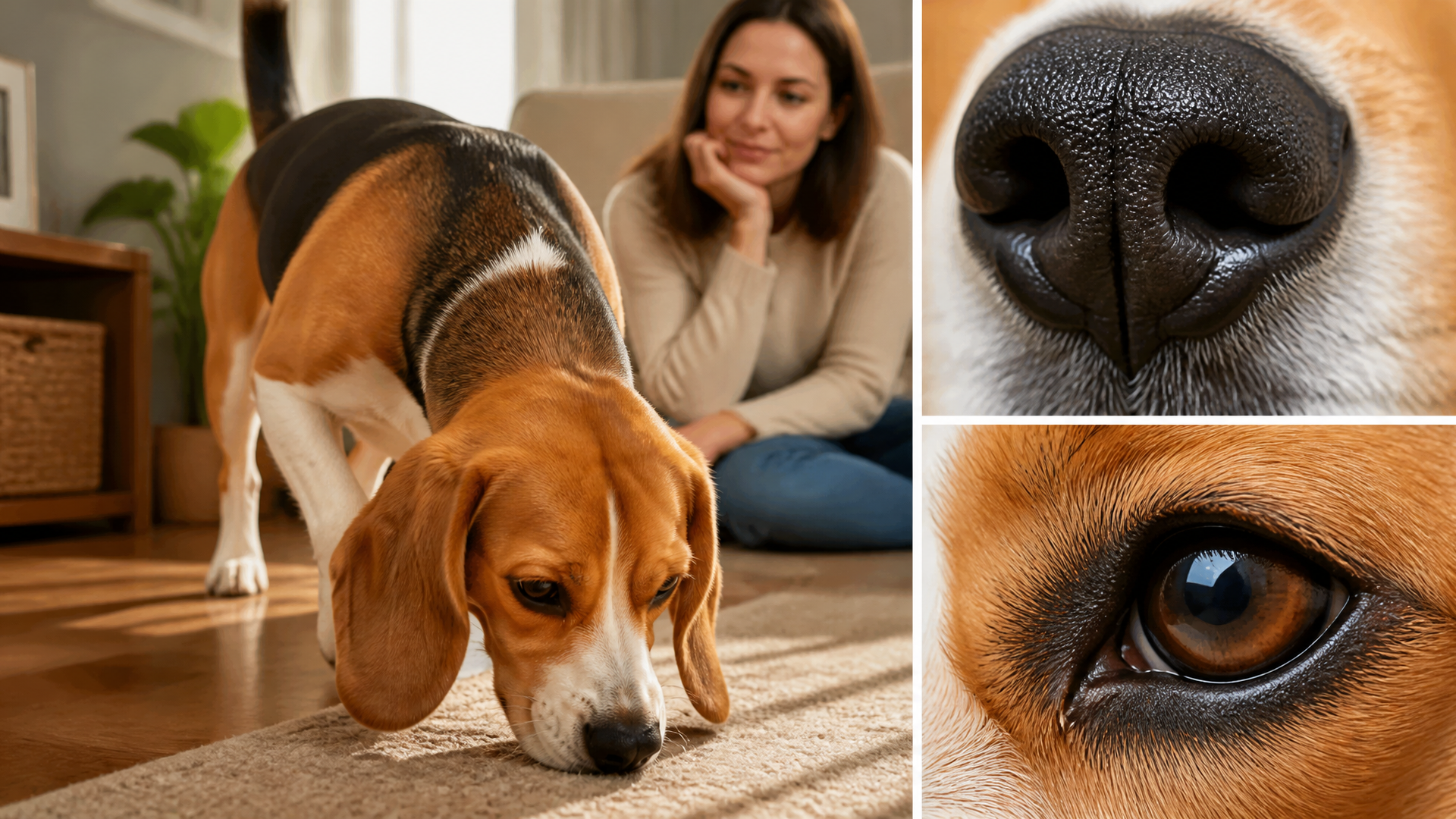
Understanding a beagle’s nose anatomy helps you appreciate how they can detect scents so effectively. Their long, droopy nostrils allow for increased airflow, capturing more scent particles. The moist surface of their nose helps to absorb these particles, enhancing their ability to smell. A beagle’s nasal cavity is extensive, with many folds that create more surface area for scent detection. These features contribute to their incredible olfactory capabilities, making them excellent scent hounds. Additionally, their unique facial structure aids in directing scents toward their olfactory receptors. Next, you’ll discover the role of olfactory receptors in a beagle’s remarkable sense of smell.
The Role of Olfactory Receptors
Beagles’ olfactory receptors play a crucial role in their remarkable ability to detect scents. Each receptor is finely tuned to pick up specific odor molecules. When you watch a beagle sniffing around, you’re seeing its receptors at work. These receptors send signals to the brain, which processes the information rapidly. You might notice that beagles can differentiate between various smells with ease. Their keen sense of smell allows them to track scents over long distances. It’s no wonder they’re often used in search and rescue missions!
How Beagles Process Scents
When it comes to processing scents, you’re witnessing an extraordinary ability that allows them to distinguish between different odors with incredible precision. Their brains are wired to analyze scent molecules, making them experts in detecting even the faintest traces. You’ll find that each sniff provides a wealth of information, as they can pick up on layers of scents that you might overlook. Their keen sense of smell is complemented by a specialized structure in their nasal cavity, which enhances their ability to process these aromas. You may notice how they seem to "taste" the air, using their highly developed olfactory senses to gather data about their surroundings. This incredible skill is what makes them invaluable in search and rescue operations. Ultimately, you’re observing a remarkable process that highlights the beagle’s unique connection to the world of scents.
Comparing Beagle Smell to Human Smell
Beagles’ sense of smell is about 40 times more powerful than yours. While you rely on your sight and hearing, they depend on their olfactory abilities to interpret the world. Their noses contain approximately 220 million scent receptors, compared to your mere 5 million. This heightened sense allows them to detect odors at incredibly low concentrations. You might struggle to identify a scent in a crowded room, but a beagle can pinpoint a specific smell from miles away. Their ability to track scents is unmatched, making them invaluable in various roles. Understanding this incredible capability sets the stage for exploring effective training techniques for scent detection.
Training Techniques for Scent Detection
When you’re looking to enhance a beagle’s incredible sense of smell, you’ll find that effective training techniques are essential. You’ll want to incorporate positive reinforcement strategies to keep your beagle motivated and engaged. Additionally, scent discrimination exercises can help sharpen their skills, ensuring they can distinguish between various odors with precision.
Effective Scent Training Methods
Effective scent training methods can significantly improve your beagle’s ability to track and locate scents accurately. You’ll want to start with simple scent games that encourage exploration and curiosity. As your beagle becomes more confident, you can gradually increase the difficulty of the tasks. Consistency is key, so practicing regularly will help reinforce their learning. Remember to celebrate their successes to keep the training experience enjoyable and rewarding.
Positive Reinforcement Strategies
Positive reinforcement strategies can significantly improve your beagle’s training experience and help them learn more effectively. By rewarding your beagle with treats, praise, or playtime, you’ll encourage them to repeat desired behaviors. Consistency in your rewards will help your beagle understand what actions you expect from them. It’s important to start with simple tasks and gradually increase the difficulty as your beagle becomes more confident. Once you’ve established a solid foundation, you can move on to scent discrimination exercises to further enhance their skills.
Scent Discrimination Exercises
Scent discrimination exercises can really boost your dog’s ability to identify specific smells. By using various scents and rewards, you’ll keep your beagle engaged and eager to learn. As you practice regularly, you’ll notice improvements in their ability to differentiate between similar odors. Incorporating fun challenges can make the training sessions even more enjoyable. This skill is particularly valuable when it comes to beagles in search and rescue operations.
Beagles in Search and Rescue Operations
You might be surprised at how crucial these dogs are in search and rescue operations. Their incredible sense of smell allows them to track scents over long distances. Beagles can pick up on human scents that are days or even weeks old. When deployed in disaster areas, they can locate survivors trapped under debris. Their friendly disposition makes them great companions for victims, providing comfort during stressful situations. You’ll often see them working alongside trained handlers, who rely on their instincts and skills. With their keen noses and determination, beagles play an essential role in saving lives.
The Use of Beagles in Hunting
Beagles are often your best companions in hunting, thanks to their remarkable sense of smell. Their keen olfactory abilities allow ’em to track scents over great distances. You’ll find that they can effortlessly follow trails left by game animals. With their friendly demeanor, they make the hunting experience enjoyable for everyone involved. As you navigate through the woods, their enthusiasm keeps your spirits high. You can’t help but appreciate their persistence when they pick up a scent. In the end, their tireless efforts lead to successful hunts and cherished memories.
Medical Detection with Beagle Scent Skills
Medical detection benefits greatly from their incredible scent skills, and it’s fascinating how they can identify diseases like cancer. You might be surprised to learn that beagles can detect certain biomarkers in a person’s breath or urine. Their noses are so sensitive that they can pick up on changes that humans can’t even perceive. You’ll find that researchers are increasingly relying on these dogs for non-invasive testing methods. In clinical settings, beagles are trained to alert medical staff to specific diseases. It’s amazing how a simple wagging tail can lead to early diagnoses and better patient outcomes. With ongoing studies, you can expect even more breakthroughs in medical detection using these remarkable animals.
The Impact of Environment on Scent Tracking
Your surroundings play a crucial role in how effectively a beagle can track scents. Factors like weather, terrain, and vegetation can either enhance or hinder their impressive olfactory abilities. Understanding these environmental influences is key to optimizing scent tracking.
Environmental Factors Affecting Tracking
Weather conditions, such as humidity and temperature, can significantly influence how effectively a beagle tracks scents. If it’s too dry, scents might dissipate quickly, making it harder for your beagle to follow. Conversely, high humidity can enhance scent retention, giving your beagle an advantage. The type of terrain also matters; soft, moist ground can hold scents better than hard, dry surfaces. Lastly, dense vegetation can either help by trapping scents or hinder them by masking important signals.
Scent Dispersal in Nature
Scent dispersal in nature can significantly affect how well a dog can track a particular odor. Wind direction can carry scents away, making it harder for your beagle to hone in on a target. Humidity levels can also change how scents linger in the air, sometimes amplifying or diffusing them. Different terrains, like rocky or grassy areas, can affect the way scents settle and disperse as well. These factors highlight the importance of training in varied conditions to enhance your beagle’s tracking skills.
Training in Varied Conditions
Training in varied conditions helps ensure that your dog can adapt to different environments while tracking scents effectively. You’ll notice how changes in terrain can challenge your beagle’s focus and determination. Incorporating diverse weather patterns during training can enhance their ability to navigate through distractions. By exposing your dog to different scents in various settings, you’ll strengthen their tracking skills. Ultimately, this versatility will make your beagle an even more proficient scent tracker.
Fascinating Facts About Beagle Smell Abilities
You won’t believe just how incredible a beagle’s sense of smell really is. With their unique olfactory anatomy and unmatched scent discrimination skills, these dogs are truly remarkable in their ability to sniff out scents. Let’s dive into some fascinating facts about their abilities, including how they’re trained for scent work and the real-world applications of their skills.
Unique Olfactory Anatomy
A beagle’s unique olfactory anatomy allows it to detect scents that are far beyond human capability. Their noses contain up to 300 million scent receptors, compared to a human’s mere 5 million. You might not know that the structure of their nasal cavity is specially designed to trap and analyze odors. This incredible anatomy enables beagles to distinguish between different smells with astonishing accuracy. It’s no wonder they’re often used in search and rescue missions or to detect contraband.
Scent Discrimination Skills
Beagle’s scent discrimination skills are so advanced that they can differentiate between a vast array of odors, making them invaluable in search and rescue missions. You’ll find that their noses contain up to 300 million scent receptors, far surpassing the mere 5 million found in humans. When trained, they can identify specific scents even in complex environments filled with distractions. With a keen ability to remember scents, they can also track scents over long distances. Their talent in scent work makes them ideal partners for various roles, from detecting drugs to locating missing persons.
Training for Scent Work
Success in scent work relies heavily on consistent and positive reinforcement methods that encourage a beagle’s natural instincts. You’ll find that using treats and praise can significantly motivate your beagle during training sessions. It’s essential to start with simple scent tasks before gradually increasing the difficulty. Beagles thrive on variety, so incorporating different scents will keep their interest alive. Remember, patience and persistence are key to developing their remarkable scent abilities.
Real-World Applications
Real-world applications of beagle scent work can significantly enhance search and rescue operations, making it easier to locate missing persons. You’ll find that their keen sense of smell allows them to detect human scents even in challenging environments. Many agencies utilize beagles for tracking lost individuals in forests, urban areas, and disaster sites. Their ability to differentiate between various scents helps them pinpoint specific locations. It’s impressive how these dogs contribute to saving lives with their extraordinary olfactory skills.
Frequently Asked Questions
How does a beagle’s sense of smell compare to other dog breeds?
When you think about how a dog’s sense of smell compares across breeds, beagles often rank at the top. Their olfactory capabilities are exceptional, allowing them to detect scents that other breeds might miss. While many dogs have a strong sense of smell, beagles possess a unique combination of scent receptors and tracking instincts. So, if you’re looking for a breed with an extraordinary nose, beagles definitely stand out among the rest.
What are some common misconceptions about beagles and their scent abilities?
You might think that all dogs have similar scent abilities, but that’s not true when it comes to beagles. Many people underestimate their impressive tracking skills, assuming they’re just cute and friendly pets. Some also believe that beagles can only track a limited number of scents, when in reality, they can differentiate between thousands. It’s easy to overlook how specialized and refined their noses really are!
How do beagles communicate their findings during scent detection tasks?
When you’re observing beagles during scent detection tasks, you’ll notice they have unique ways of communicating their findings. They often use body language, like sitting or staying still, to indicate they’ve identified a scent. Additionally, they may bark or make other vocalizations to draw attention to the source of the scent. It’s fascinating how these signals help their handlers understand what they’ve discovered.
Conclusion
In summary, beagles truly stand out with their extraordinary sense of smell, making them invaluable in various roles. Their unique anatomical features and specialized olfactory receptors allow them to detect scents far beyond human capabilities. Effective training techniques ensure that they develop and refine these remarkable skills, enabling them to excel in challenging situations. Moreover, understanding environmental factors can further enhance their tracking efficiency. Overall, the incredible olfactory abilities of beagles highlight their importance in search and rescue missions, law enforcement, and beyond.
If you’re fascinated by unique animal traits, you might also be interested in understanding the symptoms of Sphynx cat allergies. This insightful article provides valuable information that can help you navigate the challenges of caring for these hypoallergenic felines. Check it out here: sphynx cat allergies.