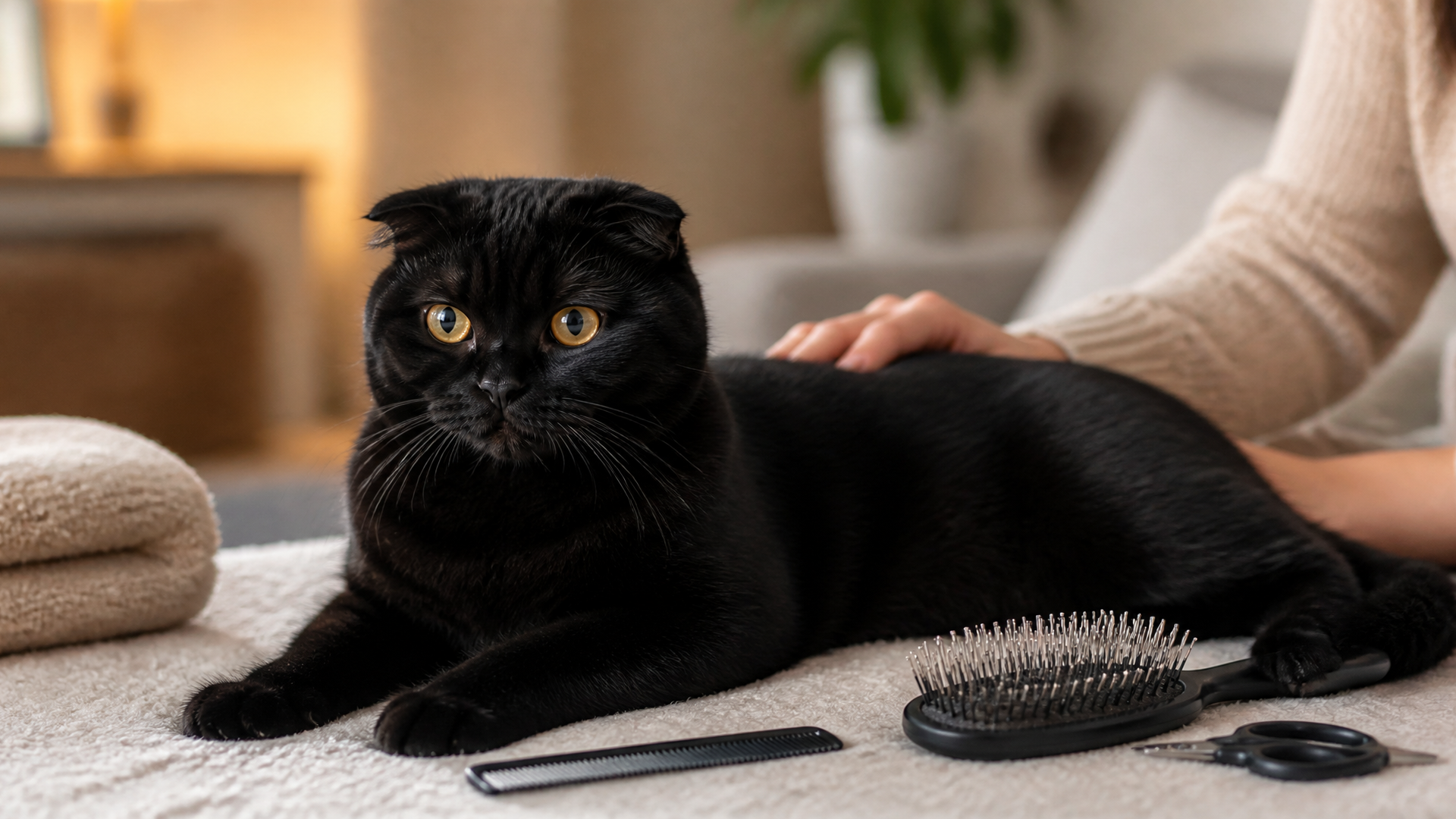
Black Scottish Fold: Guide: What Every Owner Should Know
The black Scottish Fold is one of the rarer color variations of this already distinctive breed — a solid black coat paired with those signature folded ears creates a cat that looks like living shadow. But that striking appearance comes with a health reality you need to understand before bringing one home.

The black Scottish Fold isn’t a separate breed. It’s a Scottish Fold with a solid black coat. The breed’s defining feature is a dominant gene mutation that folds the ear cartilage forward, giving the head a round, owl-like appearance. When the gene pairs with a black coat, the effect is dramatic — but that same gene carries unavoidable health trade-offs.
What Makes a True Solid Black Scottish Fold
A true solid black Scottish Fold has no white patches, no tabby striping, and no brown undertones. The coat should be deep, uniform black from nose to tail tip. Eye color is typically copper, gold, or green — blue eyes are extremely rare and usually indicate mixed ancestry.
How to verify a true solid black:
- Check the nose and paw pads — they should be black or very dark gray
- Look at the coat in natural sunlight — any ghost tabby markings (faint stripes) mean the cat isn’t a true solid
- Ask the breeder for photos of both parents showing their coat color
The mismatch most owners don’t expect: Many black Scottish Fold kittens develop faint ghost tabby markings in bright light during their first year. This usually fades by age two, but some cats retain faint markings for life. If you’re looking for a show-quality solid black, verify that both parents carry the solid black gene. Otherwise, you may end up with a cat that looks solid black in dim light but shows stripes in sunshine.
The Health Reality Behind the Folded Ears
This is the most important section in this guide. The gene that gives Scottish Folds their folded ears — called osteochondrodysplasia (OCD) — causes a cartilage abnormality that doesn’t stop at the ears. It affects joint development throughout the entire body.
What this means in practice:
- All Scottish Folds with folded ears have some degree of OCD
- Symptoms range from mild stiffness to severe arthritis
- The condition is progressive — it gets worse with age
- Not all cats show obvious symptoms early on
The trade-off you need to accept: Every fold-eared cat has OCD. There is no such thing as a healthy fold-eared cat with zero joint issues. The severity varies, but the condition is present. If you want a Scottish Fold without OCD risk, you need a straight-eared Scottish Fold (called a Scottish Straight), which doesn’t have the folded ears but still carries the breed’s temperament and appearance.
Early Warning Signs to Watch For
| Symptom | What to Look For | When to Act |
|---|---|---|
| Stiff gait | Short, choppy steps in hind legs | Schedule vet visit within 2 weeks |
| Reluctance to jump | Avoiding counters, beds, or cat trees | Try ramps; consult vet |
| Swollen paw joints | Paws look knobby or thick from above | Vet visit within 1 week |
| Tail stiffness | Tail doesn’t bend or swish normally | Vet visit — early intervention helps |
| Decreased activity | Sleeping more, playing less in a previously active cat | Monitor; vet visit if sustained for 2+ weeks |
Expert tip #1: Request x-rays of the hind legs and tail from any breeder you’re considering. Reputable breeders screen for OCD severity. Avoid any breeder who says their cats “don’t have the disease” — all fold-eared cats have it to some degree. You’re managing severity, not avoiding it entirely. Common mistake: Assuming your cat is fine because it jumps normally at age one. OCD often doesn’t show visible symptoms until age 2-5. Early management (joint supplements, weight control, low-impact exercise) makes a real difference.
How to verify a breeder’s claims: Ask for veterinary records showing x-ray results for both parents. A responsible breeder will have documentation from a licensed veterinarian, not just their own word. If they can’t or won’t provide this, consider it a red flag.
Weekly Grooming Routine for a Black Coat
The black coat shows every speck of dander, dust, and loose hair. A solid black Scottish Fold that’s not groomed regularly will look dull and dusty within days.
What you need:
- Slicker brush (fine wire bristles) — for removing loose undercoat
- Pin brush — for smoothing the topcoat
- Detangling spray — helps reduce static and makes brushing easier
- Grooming glove — good for daily quick passes and bonding
Step-by-Step Weekly Grooming Flow
Step 1: Pre-brush (2-3 minutes) — Use the grooming glove in circular motions to lift loose hair and dander. This loosens debris before you go in with a brush.
Step 2: Slicker brush the body (5-7 minutes) — Work section by section: back, sides, chest, belly. Use short, gentle strokes. Scottish Folds have a dense double coat — don’t press hard or you’ll scratch the skin.
Step 3: Pin brush for finish (3-4 minutes) — Smooth the topcoat in the direction of hair growth. This distributes natural oils and gives the coat its gloss.
Step 4: Check ears (1 minute) — The folded ears trap moisture and debris. Gently lift the ear flap and inspect for redness, dark wax, or odor. Clean with a vet-recommended ear cleaner and cotton ball only — never use Q-tips.
Step 5: Wipe down with a damp cloth — A quick once-over with a soft, slightly damp cloth removes surface dust and dander. This is especially important for a black cat if you plan to let them on light-colored furniture.
Frequency: Full grooming session once per week. Quick pass with grooming glove every 2-3 days.
Expert tip #2: Many black cats develop dandruff that’s invisible on lighter cats but obvious on a black coat. If you see white flakes, add a high-quality omega-3 supplement to their diet. Look for fish oil specifically formulated for cats (dosage depends on weight). Common mistake: Bathing too often. Black cats show water spots and can develop a dull, chalky residue if bathed more than once every 6-8 weeks. Stick to dry grooming for maintenance.
Success check: After grooming, run your hand over the coat. It should feel smooth, not gritty or dusty. The coat should have a natural sheen, not a dull or chalky appearance. If you still see white flakes, increase the omega-3 dosage (within vet guidelines) or check for underlying skin issues.
Feeding to Protect Joints and Weight
Scottish Folds are prone to weight gain because their joint discomfort makes them less active. A heavy cat puts more stress on already-compromised joints, creating a downward spiral.
Feeding Guidelines
| Cat Weight | Daily Calorie Range | Notes |
|---|---|---|
| 6-8 lbs | 180-220 kcal | Ideal for most adult females |
| 8-10 lbs | 220-260 kcal | Average for adult males |
| 10-12 lbs | 260-300 kcal | Only for large-boned, active cats |
| Over 12 lbs | Consult vet | Risk zone for joint stress |
Key diet choices:
- High-protein, moderate-fat wet food as the primary diet
- Joint-support ingredients: Look for foods with glucosamine, chondroitin, and EPA/DHA (omega-3s)
- Avoid all-grain, low-protein dry foods — they promote weight gain without nutritional value
- Measured portions, not free-feeding — Scottish Folds will overeat if given the chance
Expert tip #3: Add 1-2 teaspoons of canned pumpkin (plain, not pie filling) to one meal per day. The fiber helps with digestion and the extra moisture supports kidney health. Many cats love the taste, and it helps them feel full without extra calories. Common mistake: Feeding a “senior” diet too early. Some owners switch to senior food at age 5-6 because their cat is slowing down. But most senior formulas are lower in protein and higher in filler. Stick with a high-quality adult formula until your vet recommends a change.
The trade-off with dry food: Dry food is convenient and helps with dental health, but it’s lower in moisture and often higher in carbohydrates. For a Scottish Fold with joint issues, wet food is generally better because the extra moisture supports kidney function and helps maintain a healthy weight. If you must feed dry food, choose a high-protein, low-carb formula and ensure your cat drinks plenty of water.
Daily Temperament and Lifestyle Fit
Black Scottish Folds are known for being:
- Quiet and observant (they watch before acting)
- Affectionate but not demanding (they’ll sit near you, not on you)
- Adaptable to apartment living (low prey drive, moderate energy)
- Bonded to their primary person (one-person cats)
What this means for your routine:
- They need 15-20 minutes of interactive play daily (wand toys, laser pointers, puzzle feeders)
- They prefer low-height cat furniture (avoid tall cat trees) — jumping down from heights aggravates joints
- They do well with calm households; loud environments cause stress
- They will follow you from room to room but won’t demand constant attention
One thing that surprises new owners: Scottish Folds can be surprisingly vocal. Not loud, but they use quiet, chirping meows to communicate. A black Scottish Fold sitting silently in a shadowed corner is easy to miss. They’ll develop a specific sound for “I want food” versus “pet me now.”
The limitation to know: Scottish Folds aren’t great candidates for homes with very young children or other pets that are rough players. Their joint sensitivity means they can’t escape quickly if bothered, and they may become defensive or stressed. If you have a busy, loud household, a Scottish Fold may not be the best fit.
Monthly Health Checklist for Early Action
Monthly checks:
- [ ] Run hands over back and legs — any flinching or stiffness?
- [ ] Inspect ears for redness, dark wax, smell
- [ ] Feel paw pads for swelling or warmth
- [ ] Check for any changes in grooming behavior (stopped grooming = pain signal)
Every 6 months:
- [ ] Vet wellness exam with joint assessment
- [ ] Weight check and diet adjustment if needed
- [ ] Dental check (Scottish Folds are prone to gum disease)
- [ ] Blood work if over age 5
Signals to escalate to the vet immediately:
- Sudden lameness or refusal to put weight on a leg
- Crying or hissing when touched
- Reluctance to eat or use the litter box
- Rapid breathing or open-mouth breathing
- Any swelling in the face, mouth, or paws
Save This Guide
The black Scottish Fold is a beautiful, quiet, affectionate cat with specific health needs you can’t ignore. The folded ears are charming, but they’re a visible sign of a genetic condition that affects the entire skeleton.
Here’s what you can do now:
- Find a breeder who screens for OCD severity and can show you x-rays
- Start joint supplements (glucosamine + chondroitin + omega-3s) at age 1
- Keep your cat lean — every pound matters for joint health
- Groom weekly to maintain that stunning black coat
- Watch for early stiffness and act before symptoms worsen
Key takeaway: With proper care, a black Scottish Fold can live 12-15 years. Without it, joint pain and reduced quality of life start as early as age 3-4. The choices you make determine how well your cat ages.
This guide contains affiliate product recommendations. As an Amazon Associate, we may earn from qualifying purchases at no extra cost to you.