at What Age Does a Miniature Schnauzers Hair Color Start to Change
Most Miniature Schnauzers start showing coat color changes around 6 months old, when the puppy coat begins transitioning to adult hair. But the color you see at 1 year is rarely the final color. The breed’s signature “clearing” process — where black fades to silver or gray — continues for years. A dog that looks black at 12 months can appear distinctly silver by age 3.

One critical boundary: This timeline applies primarily to salt‑and‑pepper, black‑and‑silver, and solid black Miniature Schnauzers. White and parti‑color dogs follow a different path — their white base coat stays stable from puppyhood, while any colored patches will clear on the same 2‑to‑4‑year schedule.
The Biggest Color Shift Happens Between 2 and 4 Years
Here’s what most guides skip: the most dramatic color change in Miniature Schnauzers happens between 2 and 4 years old, not during the puppy‑to‑adult coat transition. Puppy coats fade predictably, but the adult coat keeps shifting long after most owners think it’s settled.
| Age Range | What Happens to the Coat |
|---|---|
| 0–6 months | Puppy coat — color is usually dark and uniform |
| 6–12 months | First transition phase — puppy coat sheds, adult coat starts coming in |
| 1–2 years | Intermediate coat — some lightening, but still darker than final color |
| 2–4 years | Primary clearing phase — black areas fade to silver or gray |
| 4+ years | Color largely stable, though gradual lightening can continue |
Practical implication for owners: If you’re choosing a puppy based on coat color, expect significant shifts by age 3–4. The puppy will not grow into the exact color you see at 8 weeks. And if you already have a 1‑year‑old Schnauzer, don’t assume the current shade is permanent — the real change is still ahead.
How to verify your dog’s expected color path: Ask the breeder about the parents’ adult coats and whether your puppy carries one or two copies of the clearing gene. A DNA test (available through Embark or Paw Print Genetics) can confirm the gene status and give you a reliable forecast — but even without it, the breed’s pattern is predictable enough to know that clearing will happen.
Color‑by‑Color Breakdown
Salt & Pepper
Puppies are born dark gray or nearly black. By 6–12 months, lighter banding on each hair starts showing. The full salt‑and‑pepper pattern settles between 18 months and 3 years. This color changes the least dramatically overall.
Black and Silver
Expect the most visible change. Puppies are born solid black or black with faint silver markings. Between 6–18 months, the silver eyebrows, muzzle, and leg markings emerge clearly. The real surprise: the body coat lightens significantly between 2–4 years, often turning from jet black to a softer charcoal or dark silver.
Solid Black
Solid black Schnauzers can either stay black or gradually fade to charcoal gray. If the dog carries the recessive clearing gene, you’ll see lightening starting around 2 years old. Dogs that stay jet black past 4 years will likely remain black for life.
White or Parti‑Color
White Miniature Schnauzers don’t clear the way dark‑coated dogs do. Their color is stable from puppyhood, though cream or biscuit shading on the ears or back can appear during the adult coat transition (12–24 months). Parti‑color dogs (white with patches of black, silver, or salt‑and‑pepper) follow the dark‑patch clearing timeline — the white stays, but the colored patches lighten over 2–4 years.
What Controls the Speed and Amount of Color Change
Genetics
The clearing gene controls how much and how fast black pigment fades. Dogs with one copy lighten modestly. Dogs with two copies can shift dramatically — a nearly black puppy turning into a silver adult. There’s no reliable way to predict the final color from a puppy’s birth coat alone. If you bought a black‑and‑silver puppy expecting a lifelong black dog, you may be disappointed by year 3.
Grooming Method: Clipping vs. Hand‑Stripping
This is where owners have real control — and a real trade‑off.
- Clipped coats change color faster. Regular clipping removes the harsh, pigmented outer guard hairs. The softer undercoat grows back lighter. Clipped Schnauzers often look significantly lighter by age 2 than hand‑stripped dogs of the same lineage.
- Hand‑stripped coats retain color longer. Stripping preserves the guard hairs, which carry the darkest pigment. Dogs on a stripping schedule keep their richer color well into adulthood.
The trade‑off: Clipping is cheaper, faster, and easier to do at home, but it accelerates color lightening. Hand‑stripping preserves darker color but requires professional skill, more time, and higher cost. If your goal is to maintain a dark adult coat, hand‑stripping is the only reliable method. If you’re fine with a lighter silver or gray dog, clipping is fine — just don’t expect the puppy black to stay.
Expert Tips for Managing Coat Color
Expert Tip 1: If you want to slow the color lightening, switch to hand‑stripping (or have a certified groomer do it) instead of clipping. Stripping every 8–12 weeks keeps the darker guard hairs in the coat. Common mistake: Clipping a show‑line Schnauzer expecting the coat to stay dark — clipped coats always lighten faster, and show judges penalize clipped coats.
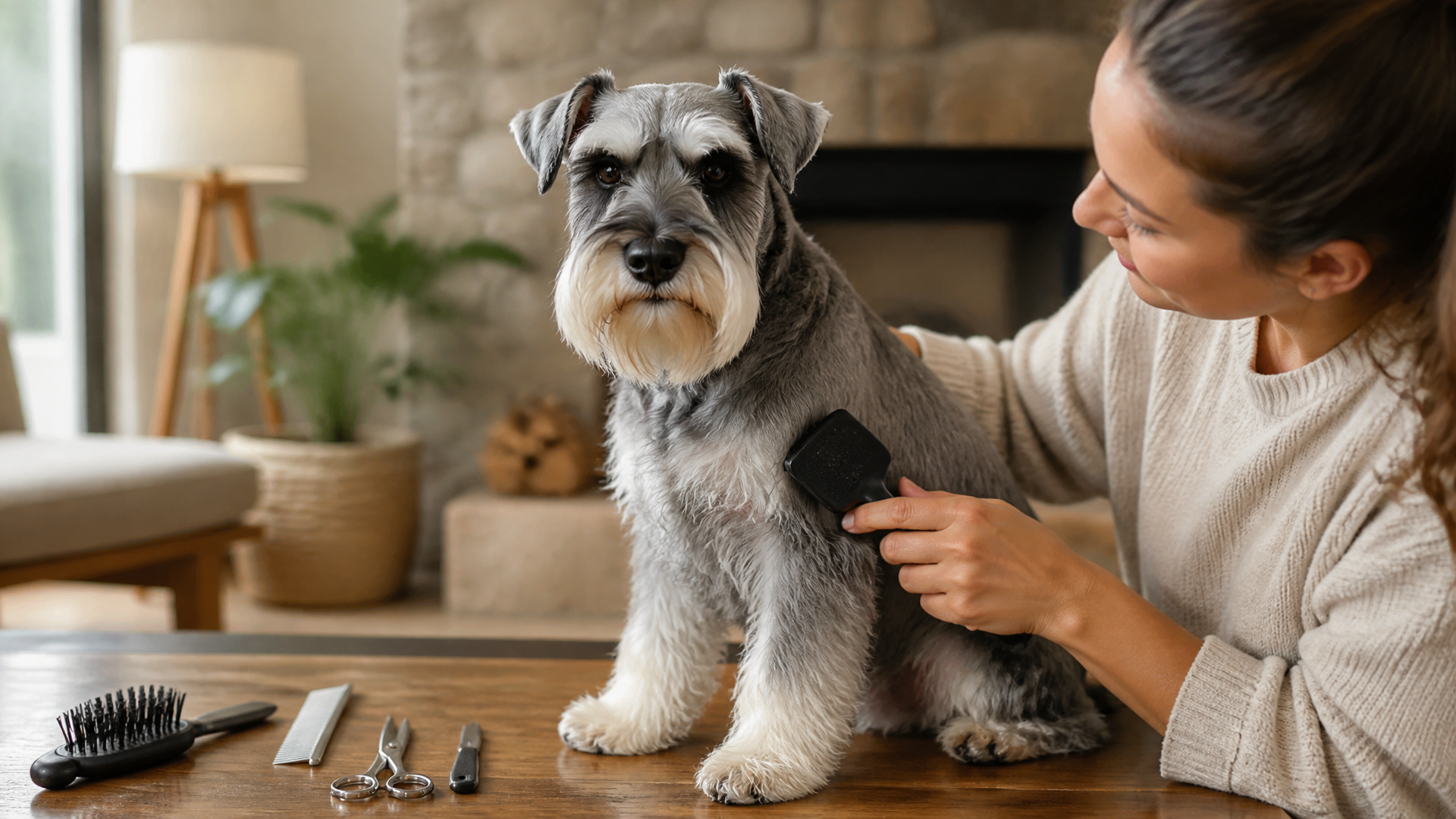
Expert Tip 2: Use a high‑quality slicker brush (like the Chris Christensen Big G or a similar medium‑stiffness brush) 3–4 times per week to remove loose undercoat without stripping the guard hairs. This keeps the coat healthy and slows premature lightening. Common mistake: Using a fur rake too aggressively — it pulls out guard hairs and accelerates color fading. Stick to a slicker brush for regular maintenance.
Expert Tip 3: Add a fish oil supplement (check with your vet for dosage) during the coat transition phase (6–18 months). Omega‑3 fatty acids support healthy hair growth and can help maintain coat pigment density. Common mistake: Over‑supplementing — more than the recommended dose won’t darken the coat and can cause digestive upset. Start at the lowest vet‑recommended dose.
We may earn a commission if you purchase through links on this page, at no extra cost to you.
Health Factors
A dull, patchy coat that’s changing unevenly could signal:
- Thyroid issues (common in Miniature Schnauzers)
- Cushing’s disease
- Poor nutrition or low‑quality protein
- Allergies causing coat damage
If your dog’s coat changes suddenly — especially if it’s patchy, thin, or accompanied by hair loss — see a vet. Gradual overall lightening over 2–4 years is normal. Sudden changes are not.
Is Your Schnauzer’s Color Change Normal? Run These Checks
Use these six checks to decide whether the color shift is routine or requires a vet visit:
1. Is the change gradual (over months/years) or sudden (over weeks)? Gradual = normal. Sudden = vet visit.
2. Is the coat still full and healthy, just lighter? Normal clearing.
3. Are there bald patches, flaking, or irritated skin? Not normal — check with your vet.
4. Is your dog between 6 months and 4 years old? Expected timing for color change.
5. Has the grooming method changed recently (switched from stripping to clipping)? Expect faster lightening — this is normal.
6. Did you just get the dog as an adult and the breeder didn’t share the puppy coat color? If the dog is over 4–5 years old, the current color is likely the final version — don’t expect further change.
If all checks point to “normal,” you can relax. The color shift is part of the breed. If any check flags a problem, schedule a vet appointment.
When to Talk to Your Vet
Call your vet if you see:
- Patchy or asymmetrical lightening — one side lighter than the other
- Coat thinning or hair loss alongside color change
- Skin changes — redness, flaking, bumps, or odor
- Sudden color change in an adult dog over 5 years old
Normal color change in a Miniature Schnauzer is uniform, gradual, and healthy‑looking. The coat stays thick, the skin stays clear, and the dog acts normal the whole time. Anything outside that pattern deserves a professional opinion.
Frequently Asked Questions
Will my Miniature Schnauzer’s coat keep changing after 4 years?
After 4 years, the coat is largely stable, though very gradual lightening can continue into senior years. A dog that has stayed dark through age 4 will likely remain that shade for life.
Can I predict what color my puppy will be as an adult?
Not from the puppy coat alone. The clearest predictor is the parents’ adult coats. A DNA test for the clearing gene provides the most reliable forecast, but even then, the exact shade can vary.
Does clipping or hand‑stripping affect the final color?
Yes. Clipping removes dark guard hairs, so the coat lightens faster and more overall. Hand‑stripping preserves those hairs, keeping the coat darker longer. The grooming method doesn’t change the underlying genetics, but it changes how fast the color appears.
Is it normal for a white Miniature Schnauzer to get cream patches?
Yes. White Schnauzers often develop light cream or biscuit shading on the ears or back during the adult coat transition (12–24 months). This is normal and doesn’t mean the dog is turning a different color.
When should I worry about coat color change?
Worry when the change is sudden, patchy, or accompanied by skin issues or hair loss. Gradual, even lightening over years is normal for the breed.
Save This Guide — Miniature Schnauzer coat color changes are predictable. The biggest shift happens between 2–4 years, not at puppyhood. Use hand‑stripping to preserve darker color, and watch for sudden changes that warrant a vet visit. Keep this guide for your grooming and health routine.