Are Scottish Terriers Good With Children
Scottish Terriers can work in homes with children, but the honest answer is that most Scotties are not naturally good with kids. This breed is independent, stubborn, and easily overwhelmed by chaotic households. If you already own a Scottie and have children, or if you are considering getting one, the next 60 seconds will tell you whether your situation fits.

For families with children ages 8 and up who can respect boundaries, a well-socialized Scottie can be a loyal and protective companion. For toddlers or homes with constant noise and unpredictability, the mismatch often leads to stress for the dog and risk for the child. The practical implication is clear: if you have children under 6, or if your household is loud and busy, this breed is likely not the right choice no matter how much you like the look.
What to Expect From a Scottish Terrier Around Kids
Scotties were bred to hunt vermin and guard property — not to be gentle family dogs. That background explains both their best and worst traits with children.
What works well
- Loyalty: A Scottie often bonds strongly with “their” children and will watch over them.
- Moderate energy: Not as hyper as many terriers. They match a calm household well.
- Manageable size: At 18–22 pounds, a child can walk them on leash once both are trained.
What creates friction
- Stubborn independence: Scotties often ignore commands from children. Adults must be the clear leaders.
- Strong prey drive: Sudden movements, squeals, or running can trigger chase instincts. This is hardwired, not a training flaw.
- Noise sensitivity: Scotties dislike loud, chaotic environments. They may growl, snap, or hide.
- Resource guarding: Many guard food, toys, or favorite people. Children need to learn not to approach during these moments.
Quick comparison with other terriers
| Trait | Scottish Terrier | West Highland White Terrier | Cairn Terrier |
|---|---|---|---|
| Child tolerance | Selective, best with ages 8+ | Usually more patient | Generally good with training |
| Trainability | Low (stubborn) | Moderate | Moderate |
| Energy level | Medium | Medium-high | High |
| Prey drive | High | High | High |
| Recommended child age | 8+ years | 6+ years | 6+ years |
Why this matters for your decision: If you are comparing breeds, notice that Scotties score lowest on trainability and child tolerance among these three popular terriers. The difference is not small — it means the Scottie needs more adult management and fewer child mistakes to succeed.
How to Set Up Your Home: A Step-by-Step Plan
This is not a breed you can bring home and hope for the best. Use this operator flow to create a safe environment from day one.
Before the dog arrives: Preparation check
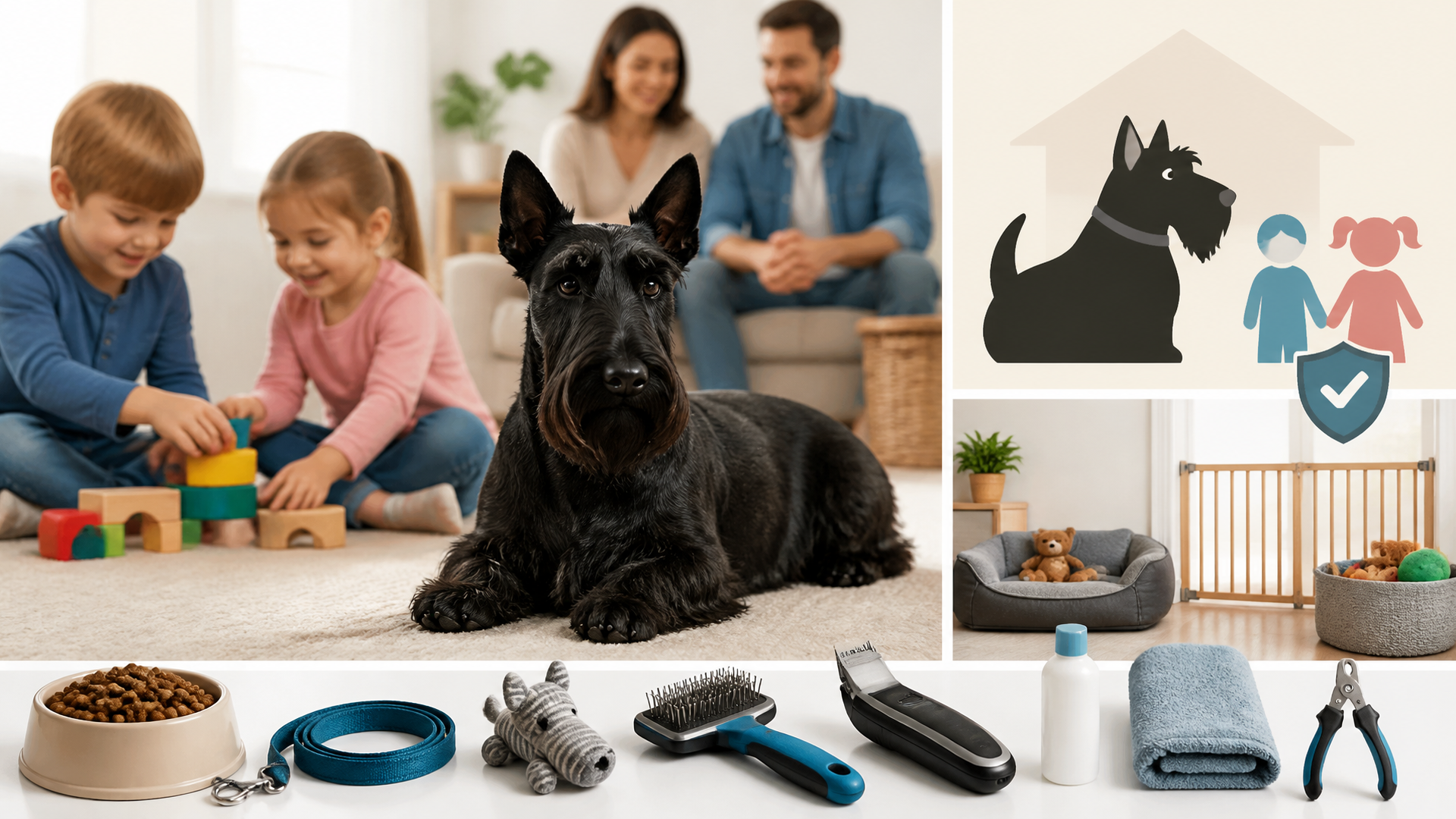
- [ ] Set up a child-free zone (crate, gated room, or elevated bed the dog can access freely)
- [ ] Purchase a baby gate rated for dogs (at least 30 inches tall — Scotties can jump lower gates)
- [ ] Buy high-value treats (freeze-dried liver, chicken) for training
- [ ] Choose a force-free trainer who has worked with terriers before
- [ ] Talk with children about rules (listed below)
Step 1: Teach the dog first, then the kids
Your Scottie must reliably respond to three commands before children have free access:
1. “Leave it” — for dropped food, toys, or anything the dog should not touch
2. “Drop it” — to release items from their mouth safely
3. “Go to mat” — to send the dog to a calm spot on cue
Checkpoint: Can your Scottie hold “go to mat” for 30 seconds with a distraction (dropped toy, clapping)? If not, continue practicing before introducing children.
Step 2: Controlled introductions
Keep the dog on a leash during the first several interactions. Let the dog approach the child at its own pace. Never force proximity. Reward calm behavior with treats.
Likely cause of failure: Moving too fast. Most problems happen because owners let children run up to the dog within the first week.
Step 3: Establish ground rules for children
- No hugging, chasing, or climbing on the dog
- Do not approach the dog while eating or holding a toy
- Always ask an adult before interacting with the Scottie
- If the dog goes to its crate or mat, leave it alone
Step 4: Supervised play sessions
Keep play short (5–10 minutes) and end while everyone is calm. Use a flirt pole or tug toy to channel prey drive safely away from children. Stop immediately if the dog’s ears go back, body stiffens, or they growl.
Friction point to watch: Scotties enjoy chase games but can escalate to nipping when excited. Do not allow running games in tight spaces.
Expert Tips
Tip 1: Practice the “off” command with a baby gate. Set up a gate so your Scottie can choose to leave the room when overwhelmed. Reward the dog for retreating. Common mistake: Letting the dog stay in a corner where it feels trapped and may snap. A trapped Scottie is a bite risk.
Tip 2: Use a mat as a calm spot during active play. Train your Scottie to stay on a designated bed during kid play sessions. This gives the dog a safe zone and teaches children not to approach. Common mistake: Assuming the dog will naturally find a quiet spot — many Scotties prefer to stay near the action and get overstimulated. You must enforce the boundary.
Tip 3: Involve children in care tasks under adult supervision. Older kids can hand-feed treats or brush the Scottie’s wiry coat with a slicker brush. This builds trust and teaches respect. Common mistake: Allowing children to chase the dog with grooming tools or grab at the beard. Always have an adult holding the dog calmly during grooming.
Quick safety checklist for daily life
- [ ] Scottie has access to a child-free zone at all times
- [ ] Children know to drop food or toys if the dog stiffens or growls
- [ ] Nail trims and ear cleanings are done by an adult only
- [ ] The dog is never left alone with children under 6, even if “friendly”
- [ ] High-value treats are only given in the dog’s crate to prevent guarding
How to Verify Fit Before You Commit
If you are still deciding whether a Scottish Terrier is right for your family, use this verification step before buying.
Visit the breeder or rescue with your children. Ask to see how the puppy or adult Scottie reacts to your kids in a controlled space. Look for:
- Does the dog approach willingly or avoid?
- Does the dog stiffen, lip-lick, or yawn (stress signals)?
- Does the breeder or rescue allow a trial period?
If the breeder refuses a visit with children, or if the rescue cannot confirm the dog’s history with kids, consider that a red flag. Reputable breeders who raise puppies around children will encourage this visit.
When a Scottish Terrier Isn’t the Right Fit
No amount of training can fully override the breed’s hardwired sensitivity and prey drive. Choose a different breed if:
- You have children under 6 years old
- Your home is consistently loud or chaotic
- You are not willing to commit to daily training and supervised interactions
- Your child has a strong fear of dogs or cannot follow safety rules
Realistic alternatives for families with young children: Cavalier King Charles Spaniel, Golden Retriever, or Beagle (with similar training). These breeds tolerate more handling and noise than a Scottie.
What can go wrong if you ignore this mismatch: A stressed Scottie may snap or bite when surprised. The breed’s strong jaws and determined nature mean even a warning bite can break skin. Many Scotties end up rehomed or kept in crates because owners did not anticipate the breed’s limits with children.
Frequently Asked Questions
Do Scottish Terriers get along with babies?
Most do not. The breed’s sensitivity to sudden noises and flailing movements makes a newborn’s crying and squirming stressful. Many breeders advise waiting until children are older.
Can Scottish Terriers be trained to be gentle with kids?
Yes, but only with early socialization and consistent positive reinforcement. The key is teaching both the dog and the child appropriate boundaries. Scotties respond best to reward-based methods, not harsh corrections.
Are female Scotties better with kids than males?
Temperament varies more by individual than by sex. Females can be more independent, males more affectionate. The breeder’s evaluation of each puppy’s temperament is the most reliable guide.
What is the best age to introduce a Scottish Terrier to children?
Puppies raised with children from 8 weeks will adapt best. For an adult Scottie, a slow introduction over several weeks is essential. Rescue organizations often test adult dogs for child tolerance before adoption.
Save This Guide
Scottish Terriers can be wonderful companions for older, respectful children when paired with early socialization, firm boundaries, and consistent supervision. For families with toddlers, loud households, or limited training time, this breed carries real risk. Use the checklist and verification steps above to decide whether your home is the right match.
We may earn a commission if you purchase products through links on this page. Product recommendations are based on quality and value, not commission rate.