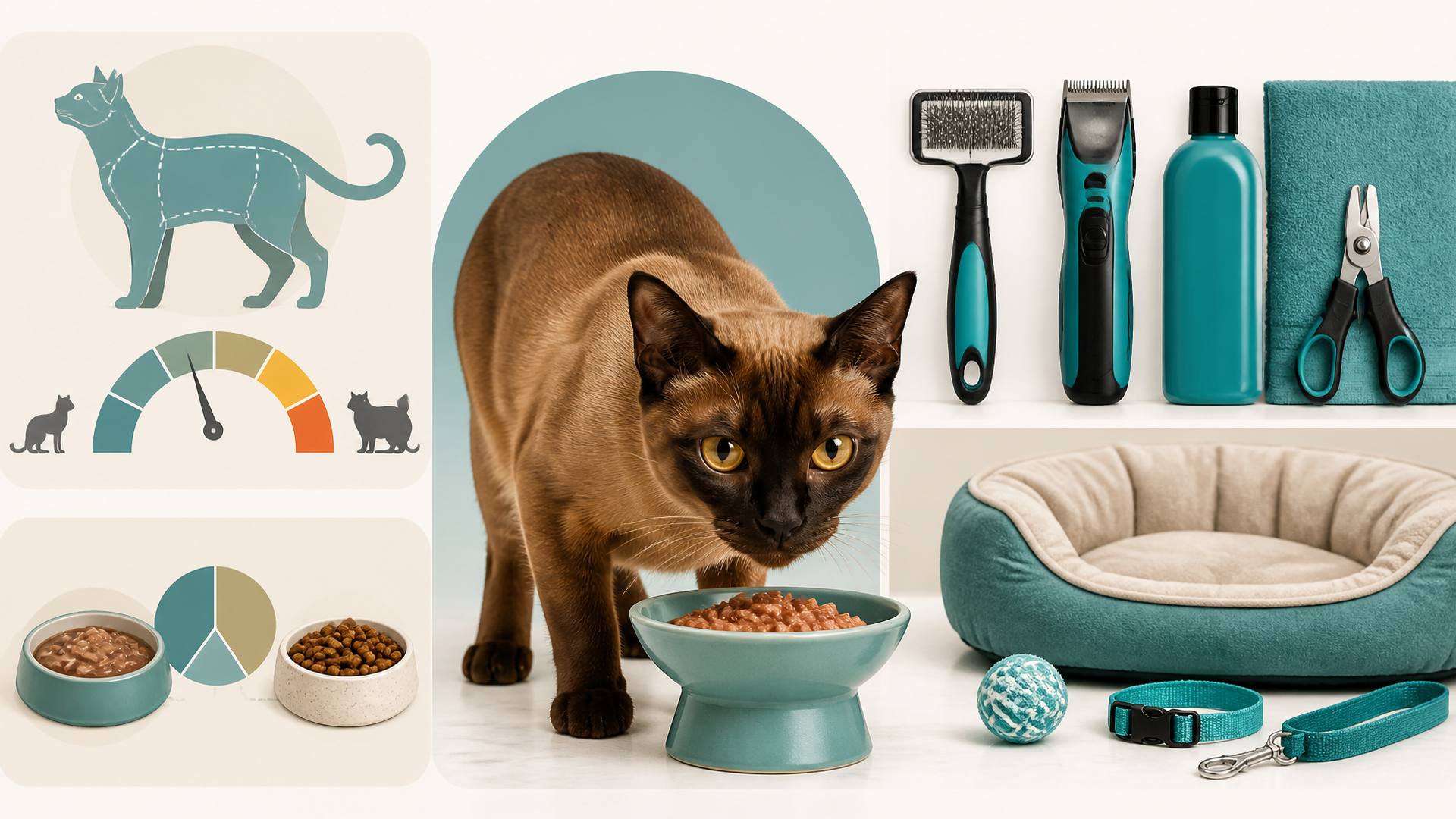
Burmese Cat Diet: Daily Routine & Expert Tips
Burmese cats look muscular and athletic, but that sleek frame hides a fast-track to obesity. Most owners don’t realize that this breed needs fewer calories per pound than many other active cats because their metabolism slows down after age two. Here’s how to build a feeding routine that keeps your Burmese lean and healthy — starting with the numbers that matter.

Calculate Your Baseline Calories
Use this chart as your starting point, then adjust based on your cat’s body condition (not their begging). Calorie density varies by brand, so always check the bag.
| Life Stage | Daily Calories | Wet Food (3 oz cans) | Dry Food (cups) |
|---|---|---|---|
| Kitten (4–12 months) | 250–350 | 1.5–2 cans + free-feed dry | ¼–⅓ cup dry + wet |
| Adult (1–7 years) | 200–280 | 1–1.5 cans | ¼–⅓ cup |
| Senior (8+ years) | 180–240 | 1–1.5 cans | ¼ cup |
Counter-intuitive tip: A 5-year-old Burmese that still acts kittenish may need fewer calories than a 2-year-old. Muscle mass doesn’t burn energy the same way after maturity. Start at the low end of the range if your cat is indoors-only. Burmese have a lower resting metabolic rate than breeds like the Abyssinian or Bengal, so activity level alone isn’t a reliable guide — you need to adjust based on body condition, not energy level.
Why this matters for Burmese specifically
Burmese are prone to obesity-related issues like diabetes and arthritis. Unlike some breeds that self-regulate, Burmese will eat whatever you put in front of them. That eager appetite is charming, but it also means you have to be the one setting firm boundaries. A Burmese that’s just 1–2 pounds overweight is already at higher risk for health problems down the road.
Choose Your Wet-to-Dry Split
Burmese cats are prone to urinary crystals and dehydration. Their kidneys need steady moisture to flush properly. Wet food should make up at least 50% of daily intake — ideally more.
Best wet options for Burmese:
- Wellness CORE Grain-Free Pâté — high protein, low carb, and smooth texture that Burmese tend to prefer over chunky styles
- Royal Canin Burmese Adult — breed-specific kibble shape fits their shorter jaw and the formula includes tailored nutrient ratios for muscle maintenance
- Tiki Cat After Dark — high moisture content with muscle meat as the first ingredient; good for urinary health support
- Weruva Paw Lickin’ Chicken — another high-moisture option with simple ingredients if your Burmese has a sensitive stomach
Dry food is fine for the rest, but pick a high-protein (40%+ dry matter), low-carb formula. Burmese don’t process carbs efficiently — excess converts straight to belly fat. Look for products where meat or fish is the first ingredient and avoid brands that list corn, wheat, or soy in the top three ingredients.
Prep check
Buy a kitchen scale. Measuring by weight (grams) is more accurate than by volume (cups) because kibble density varies wildly between brands. A ¼ cup of one dry food can be 20–30% more calories than ¼ cup of another. A $15 digital kitchen scale eliminates that guesswork entirely.
Lock in a Two-Meal Schedule
Free-feeding is the #1 cause of weight gain in Burmese. They eat out of boredom, not hunger. Unlike some breeds that graze lightly throughout the day, Burmese will clean the bowl every time and then stare at you for more.
Set two fixed meals:
- Morning (within 1 hour of waking)
- Evening (at least 1 hour before bed)
Divide the daily calorie target equally between meals. Use a timer or auto-feeder for consistency if your schedule is unpredictable. Burmese thrive on routine — a predictable feeding schedule also reduces anxiety-based begging because they learn exactly when food will arrive.
Early checkpoint: the rib test
After 1 week, run your hands along their ribs. You should feel ribs with a light fat covering — like the back of your hand. If you feel a solid meaty wall, reduce portions by 10% immediately. If you can feel ribs easily without any fat covering (like your knuckles), increase portions by 10%. This is your first branch — adjust up or down based on what you feel.
If you’re not sure, err on the lower side for the first two weeks. It’s easier to add calories than to take them off after weight gain has already started.
Verify Your Portions: Body Condition Test Every Two Weeks
This is how you confirm your feeding plan is working. Do the test every two weeks so small drifts don’t become big problems.
- Rib feel: Can you easily count ribs without pressing hard? If no, reduce food. If yes and ribs feel very sharp, increase food.
- Waist view: From above, do you see an hourglass shape? If the waist is straight or bulging, reduce portions.
- Belly pad: A small primordial pouch is normal. If it feels thick or sags low, cut back.
- Activity check: Has your cat slowed down noticeably? Lower energy levels sometimes mean they’re carrying extra weight, even if the scale hasn’t moved much yet.
Success check: Ribs are felt but not seen, waist is visible from above, and belly pad is soft — your cat is at ideal weight. Continue the same portions and recheck in two weeks.
If you see changes in the wrong direction, adjust portions by 10% and recheck again in two weeks. This slow, steady adjustment is safer than drastic cuts that can trigger hepatic lipidosis (fatty liver disease) in cats that go too long without enough food.
Why Your Burmese Begs Constantly
Burmese are vocal, food-motivated, and brilliant at training owners. Persistent begging after meals usually means boredom, not hunger. An unstimulated Burmese will default to food because it’s the most reliable source of entertainment they’ve found.
Fix it without adding food:
- Use a puzzle feeder (like the Nina Ottosson Cat Puzzle or a treat ball) to make mealtime last longer
- Add a second play session before meals to burn energy and shift focus
- Offer a few freeze-dried chicken treats (limit to 10% of daily calories)
- Rotate toys weekly — Burmese get bored with the same play routine fast
If begging stops after a week of puzzles, the issue is behavioral. If it continues, check whether your meal portions are too small (refer back to the chart) or the food is low-quality and leaving them nutrient-deficient. A Burmese on a high-carb, low-protein diet will feel hungry even after eating enough calories because their body isn’t getting the nutrients it needs.
When to Call the Vet
Stop DIY adjustments and call your veterinarian if you see any of these:
- Sudden weight loss or gain >0.5 lb in two weeks
- Increased thirst + increased urination (diabetes risk in Burmese)
- Coat turning dull or greasy on the same diet
- Vomiting or diarrhea after eating (could signal food intolerance or a dental issue)
- Visible ribs or spine — this means underfeeding has gone too far
- Refusal to eat for more than 24 hours — cats can develop serious liver issues quickly
Burmese are at elevated risk for diabetes and pancreatitis compared to mixed-breed cats. Any persistent change in appetite, thirst, or bathroom habits warrants a vet visit, not a DIY diet tweak.
Burmese Cat Diet Checklist
Save or print this for quick reference:
- [ ] Measure food by weight (kitchen scale), not volume
- [ ] Feed 2 set meals per day, no free-feeding
- [ ] Wet food makes up at least 50% of diet
- [ ] Fresh water changed daily (not just topped off)
- [ ] Treats ≤ 10% of daily calories (3–4 small treats max)
- [ ] Weigh cat every 2 weeks on a baby scale
- [ ] Transition new food over 7–10 days
- [ ] No human food — onions, garlic, grapes, chocolate, xylitol are toxic
- [ ] Puzzle feeder or slow-feeder for at least one meal per day
- [ ] Body condition check every 2 weeks using rib feel + waist view
FAQ: Burmese Cat Diet
How much should a Burmese kitten eat?
Kittens need 3–4 small meals daily until 6 months, then 2–3 meals until 1 year. Use kitten formula (higher protein/fat). Expect 1.5–2 times the adult portion during growth spurts. Switch to adult food at 12 months.
Can Burmese cats eat a raw diet?
Yes, but only with a veterinary nutritionist. Burmese short digestive tracts handle raw well, but unbalanced raw food can cause taurine, calcium, or phosphorus deficiencies. Do not wing it — use a board-certified veterinary nutritionist, not internet recipes.
Do Burmese cats need grain-free food?
Not unless they have a proven grain allergy. What matters is high protein (40%+ dry matter) and moderate fat (20–25%). Many Burmese thrive on grain-inclusive formulas with whole grains like brown rice or oats.
Why does my Burmese act hungry all the time?
It’s likely learned behavior. Burmese are smart and will train you if you let them. Try puzzle feeders and more playtime. If they are at a healthy weight and still begging, ignore the drama — feeding extra will start the obesity cycle. A healthy Burmese that is getting enough calories will not starve from waiting until the next meal.
What foods are toxic to Burmese cats?
Onions, garlic, chives, grapes, raisins, chocolate, xylitol (in sugar-free gum and peanut butter), raw eggs, raw fish, and alcohol. Also avoid dairy — most adult cats are lactose intolerant and Burmese digestive systems are no exception. Stick to cat-safe treats only.
Save This Guide: Burmese cats need measured meals twice a day with wet food as the backbone of their diet. Start with the calorie chart, use a kitchen scale, and check body condition every two weeks. The biggest mistake is overfeeding because this breed looks muscular — but their real calorie needs are lower than you expect and their appetite will not self-regulate. Following a consistent routine with portion control is the single most effective way to keep your Burmese healthy and lean for its full lifespan.
This article contains affiliate links. We may earn a small commission if you purchase products through these links, at no extra cost to you.