Beagle Common Eye Problems: Warning Signs & What To Do
Beagles are prone to several inherited and breed-related eye conditions, including cherry eye, glaucoma, dry eye (KCS), progressive retinal atrophy (PRA), and ectropion. The most critical rule: if your Beagle’s eye looks different, they’re squinting, or the third eyelid is showing, see a vet within 24 hours — eye problems can worsen fast and vision loss may be permanent if delayed.

Here’s what every Beagle owner needs to watch for and what to do at each stage.
8 Warning Signs You Should Never Ignore
Check your Beagle’s eyes weekly. These signs mean it’s time for a veterinary exam:
| Warning Sign | What It Looks Like | Urgency |
|---|---|---|
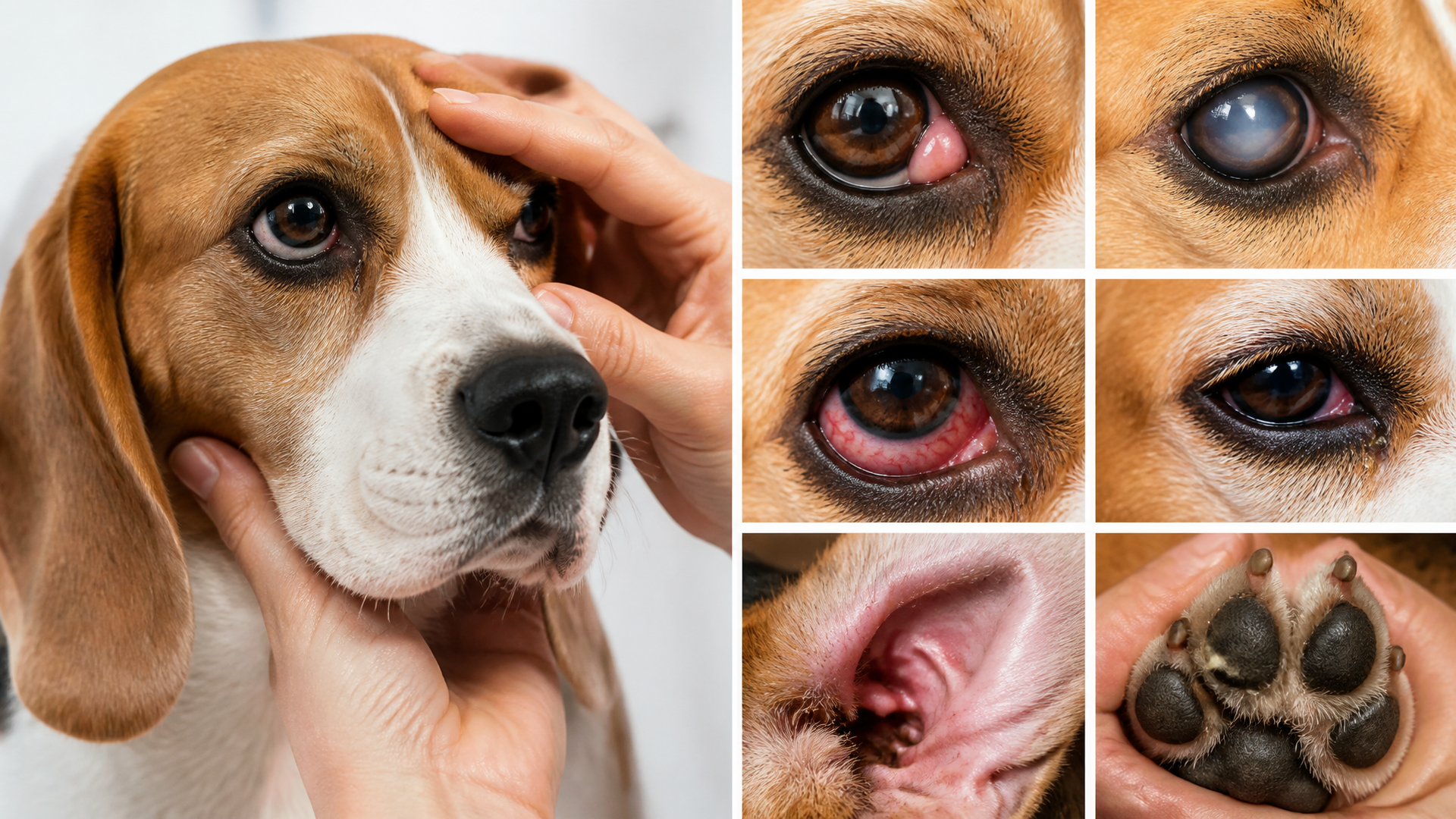
| Squinting or blinking excessively | One eye partially closed, avoiding bright light | Same-day vet |
| Redness or bloodshot sclera | Pink/red whites of the eye | Same-day vet |
| Cloudy or bluish cornea | Haze over the eye surface | Same-day vet |
| Third eyelid raised | Pink fleshy tissue covering part of the eye | Within 24 hours |
| Excessive tearing or discharge | Wet streaks down the face, colored gunk | Within 24–48 hours |
| Pawing at the eye | Rubbing face on furniture or using paws | Same-day (pain signal) |
| Bulging eye or asymmetry | One eye appears larger or pushed forward | Emergency vet |
| Bumping into furniture | New clumsiness, especially on one side | Within 24 hours |
BLOCKQUOTE_0
Condition-Specific Warning Signs & What To Do
Cherry Eye (Prolapsed Third Eyelid Gland)
This is the most visible Beagle eye problem. A red, round mass appears at the inner corner of the eye, looking like a small cherry.
Why Beagles get it: The connective tissue that holds the third eyelid gland in place is naturally weaker in Beagles. It’s a genetic predisposition.
What to do:
- This is not an emergency, but needs treatment within a week
- The gland produces 30–50% of your dog’s tear film — leaving it out risks dry eye later
- Treatment is surgical replacement (not removal). Removal was common years ago, but vets now know it causes dry eye long-term
- Cost range: $300–$800 per eye depending on your location and vet
Can it fix itself? Rarely. Massage may work in puppies under 6 months (gentle upward stroke over the closed eye), but in adult Beagles, surgery is almost always needed.
Decision criterion: If your Beagle is under 6 months with a cherry eye appearing for the first time, try gentle massage for 5–7 days. If it persists beyond that window or your Beagle is older, schedule surgery.
Dry Eye (Keratoconjunctivitis Sicca / KCS)
The tear glands don’t produce enough moisture, leading to thick, gooey discharge and corneal damage.
Why Beagles get it: Beagles are overrepresented in KCS cases. It’s often immune-mediated — the body attacks its own tear glands.
Symptoms you’ll notice:
- Thick yellow or green discharge
- Dull, lackluster cornea
- Frequent blinking or squinting
- Redness along the eyelid margins
Treatment:
- Lifelong cyclosporine or tacrolimus eye drops (once or twice daily)
- Artificial tears for comfort
- Most dogs improve within 2–4 weeks of starting medication
- Without treatment: corneal ulcers, scarring, and blindness
BLOCKQUOTE_1
Glaucoma — The Silent Vision Thief
Pressure builds up inside the eye, damaging the optic nerve. In Beagles, it’s often primary glaucoma — genetic and eventually affects both eyes.
Two stages:
| Stage | Signs | Action |
|---|---|---|
| Early | Mild redness, subtle squint, dilated pupil | Vet visit within 24 hours |
| Advanced | Cloudy cornea, bulging eye, vision loss, pain | Emergency — hours matter |
What Beagle owners must know:
- Primary glaucoma in Beagles often starts in one eye, then affects the other within 6–18 months
- Once vision is lost from glaucoma, it cannot be restored
- Emergency treatment lowers pressure with IV medications and eye drops
- Long-term management requires daily pressure-lowering drops
- Decision criterion: If your Beagle is diagnosed with glaucoma in one eye, discuss prophylactic treatment for the other eye — it delays or prevents onset in 70–80% of cases
Common failure mode: Stopping glaucoma drops early because the eye looks better. Without drops, pressure rebounds within 24–48 hours. Continue indefinitely as directed by your vet.
Progressive Retinal Atrophy (PRA)
The retina slowly degenerates, causing night blindness first, then total blindness. There is no treatment or cure.
Warning signs:
- Hesitation in dim light or at night
- Bumping into furniture in low-light rooms
- Reluctance to go down stairs in the evening
- Eyes may look normal until late stages
Breeds note: Beagles have a specific form called beagle PRA that typically starts between 2–5 years of age. A DNA test (PRA-prcd test) can identify carriers before breeding.
What you can do:
- No medical treatment exists
- Most blind Beagles adapt well — keep furniture in the same places, use scent markers near doorways
- Antioxidant supplements (lutein, vitamin E) may slow progression marginally — discuss with your vet
Ectropion (Eyelid Drooping)
The lower eyelid sags outward, exposing the inner eyelid. Beagles with loose facial skin are more prone.
What you’ll see:
- Lower eyelid droops away from the eye
- Reddish inner eyelid visible
- Chronic tear staining below the eye
Risks: Exposed tissue gets dry and irritated. Secondary conjunctivitis is common.
Treatment: Mild cases need only lubricating drops. Severe cases require surgical eyelid tightening (blepharoplasty).
What To Do: A Step-by-Step Owner Flow
Step 1: Initial Assessment (at home)
Check your Beagle in good lighting:
1. Look for squinting, redness, cloudiness, or discharge
2. Check both eyes — compare symmetry
3. Note if your dog is pawing or rubbing the eye
4. Test vision: drop a cotton ball near each eye — normal dogs track it
Step 2: Make the Urgency Call
Use the table above. If any same-day sign is present, call your vet immediately. If they can’t see you, go to an emergency vet.
Step 3: What to Do Before the Vet (if you can’t get there right away)
- Do NOT put any human eye drops, ointments, or home remedies in your dog’s eye
- Do NOT try to “pop” a cherry eye back in yourself — you can damage the gland
- Do keep your Beagle from rubbing the eye (use a cone or inflatable collar if needed)
- Do rinse with sterile saline (contact lens solution works) if there’s obvious debris — only for dirt, not for medical conditions
Step 4: At the Vet — What to Expect
Your vet will likely perform:
- Schirmer tear test — checks tear production
- Fluorescein stain — finds corneal ulcers or scratches
- Tonometry — measures eye pressure (glaucoma check)
- Ophthalmoscope exam — examines the retina and lens
If the problem is complex, your vet may refer you to a veterinary ophthalmologist. Beagles with multiple eye issues often need specialist care.
Step 5: At-Home Care After Diagnosis
- Medication routine: Give eye drops at the same times daily. Set phone alarms. Missing doses for dry eye or glaucoma can undo weeks of progress.
- Cleaning: Gently wipe discharge with a warm, damp cloth — use a separate cloth corner for each eye
- Protection: Use a harness instead of a collar to avoid neck pressure that can raise eye pressure in glaucoma-prone Beagles
- Tracking: Keep a log of symptoms and medication times — share it at follow-up visits
Step 6: Confirm the Fix Worked
What normal looks like after treatment:
- Eye is fully open with no squinting
- Whites of the eye are clear, not red or bloodshot
- No discharge or only a small amount of clear tears
- Your Beagle is not pawing or rubbing the eye
- Vision test: your dog tracks movement with both eyes equally
Check these signs daily for the first week, then weekly. If any warning signs return, call your vet within 24 hours.
Common failure mode: Medication works for a few weeks, then symptoms return. This often means the underlying condition is progressing or the dose needs adjustment. Don’t wait — call your vet the same day.
Expert Tips for Beagle Eye Health
Tip 1: Weekly Photo Check
Take a photo of your Beagle’s eyes in natural light every Sunday. Compare week to week. Subtle changes are easy to miss day-to-day, but side-by-side photos reveal them. Common mistake: Relying on memory instead of visual records.
Tip 2: Know Your Beagle’s Baseline
Most Beagles have some tear staining (the reddish-brown marks below the eyes). Know what’s normal for your dog. A sudden increase in staining or a change from brown to green/yellow means infection may be present. Common mistake: Assuming all discharge is just normal staining.
Tip 3: Groom Around the Eyes
Trim the hair around your Beagle’s eyes every 2–3 weeks using rounded-tip scissors. Long hairs can scratch the cornea or trap debris. Common mistake: Using regular scissors that can accidentally poke the eye — use only rounded safety scissors designed for pets.
Tip 4: Supplement Smart
Omega-3 fatty acids (fish oil) support tear quality and reduce inflammation. Give a canine-specific omega-3 supplement at the labeled dose. Common mistake: Giving human fish oil — doses are too high and can cause digestive upset or pancreatitis in dogs.
When To See a Specialist
Your regular vet can manage most Beagle eye problems. See a board-certified veterinary ophthalmologist if:
- Your Beagle has been diagnosed with glaucoma
- Cherry eye returns after surgery
- Dry eye isn’t improving after 4 weeks on medication
- You need a DNA test for PRA before breeding
- Corneal ulcers aren’t healing within 5–7 days of treatment
BLOCKQUOTE_2