Doll Face Persian vs Peke Persian Cats
If you’re trying to decide between a Doll Face Persian and a Peke-Faced Persian, the short answer is this: the Doll Face is the healthier, lower-maintenance choice for most owners. The Peke-Face (the ultra-flat, show-ring version) comes with significant breathing problems, constant eye discharge, and higher vet bills. Unless you plan to compete in cat shows or are absolutely committed to daily intensive care, go with the Doll Face.

But the answer changes depending on where you get your cat and how you plan to keep it. For example, a Peke-Face kitten from a breeder who prioritizes extreme flatness will have worse breathing than one from a breeder who selects for wider nostrils. And if you adopt an adult cat, you can already see its real health status — you’re not gambling on future problems. This guide breaks down the differences so you can match the right face to your home, budget, and tolerance for daily care.
Quick Answer: What to Choose Right Now
Most owners should pick the Doll Face Persian. It breathes normally, has lower tear staining, and costs less over its lifetime. The Peke-Faced Persian is only right for you if you are 100% committed to daily face cleaning, climate control, and higher vet costs — and even then, only if you can verify the cat has open nostrils and no severe BOAS.
If you’re still unsure, run through the five-question checklist later in this guide. One “no” answer means Doll Face.
Comparison Framework: Side-by-Side
| Feature | Doll Face Persian | Peke-Faced Persian |
|---|---|---|
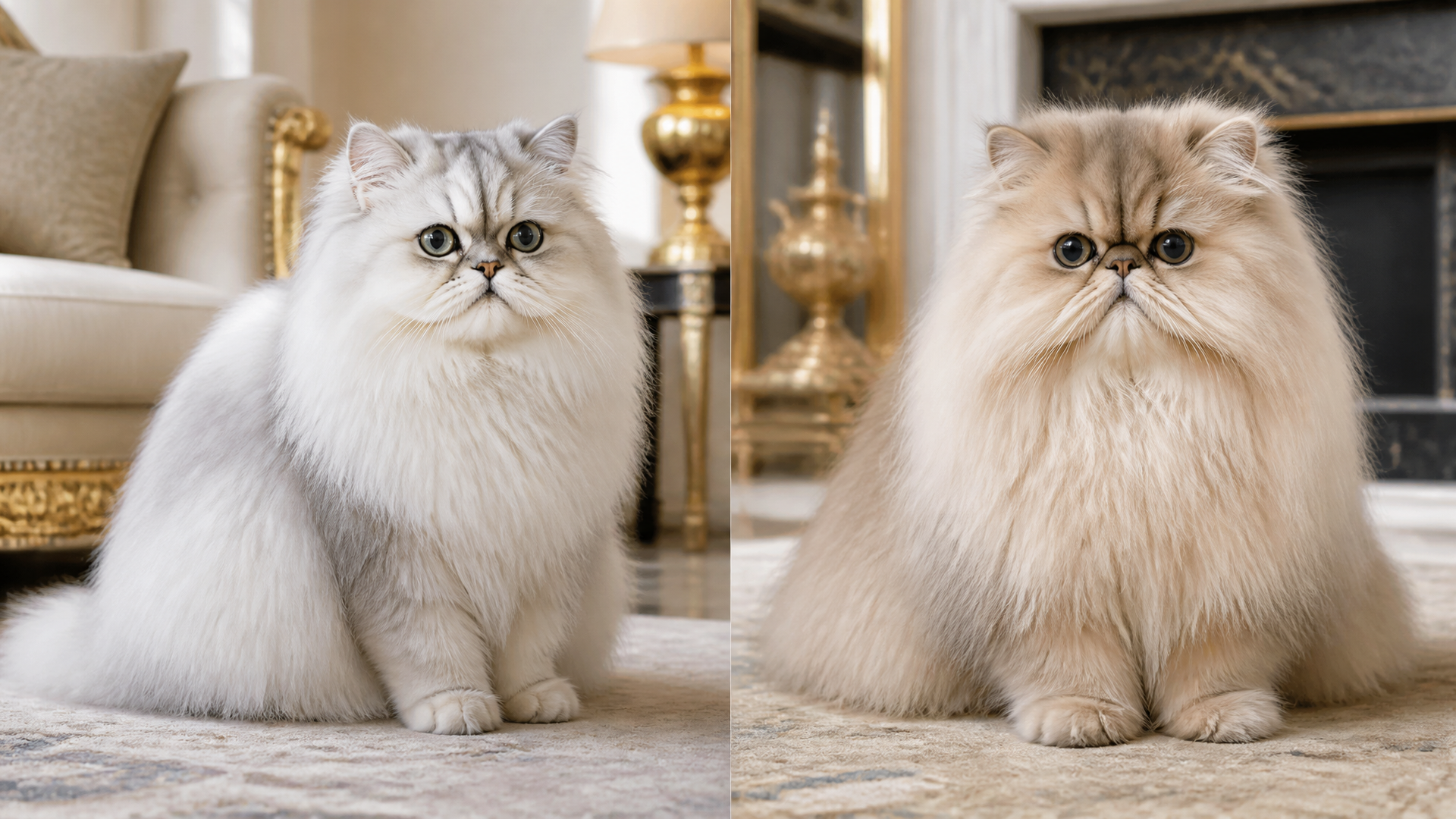
| Face shape | Moderate muzzle, visible nose | Extremely flat, no visible nose |
| Breathing | Normal (mild brachycephaly) | Often stenotic nares, snoring, exercise intolerance |
| Eyes | Almond-shaped, moderate tear staining | Large round eyes, constant epiphora (tear overflow) |
| Grooming | Same long coat, but face easier to clean | Daily eye wiping, face folds need cleaning |
| Health risks | Lower — typical Persian issues (PKD, dental) | Higher — BOAS, eye ulcers, heat stroke, dental crowding |
| Lifespan | 12–15 years (common) | 10–13 years (often shorter due to respiratory issues) |
| Show eligibility | Accepted but not preferred in rings | Breed standard for most registries (CFA, TICA) |
| Price range | $800–$1,500 | $1,500–$3,000+ |
The coat, personality, and grooming schedule are nearly identical. The big difference is in the skull shape — and that changes everything about health expense, daily care time, and quality of life for the cat.
Best-Fit Picks by Use Case
First-time cat owner → Doll Face Persian
- Easier breathing means fewer emergency vet visits.
- Less tear staining means you can keep the face clean with a daily wipe rather than medicated wipes.
- Lower risk of eye ulcers — you don’t have to panic over every dust speck or sneeze.
Show cat or breeding program → Peke-Faced Persian
- This is the modern breed standard. Judges expect the ultra-flat face, round eyes, and no visible nose.
- Be prepared to pay a premium from a breeder who health-tests for PKD and screens for BOAS. Verify that the breeder provides a health guarantee for at least the first year and has a written policy on congenital airway issues.
Hot climate (regular temps above 85°F) → Doll Face Persian
- Peke-Face cats overheat easily because they can’t pant effectively. Air conditioning is non-negotiable. A power outage on a hot day can be life-threatening.
- Doll Face cats handle warm weather better — still need cooling, but less risk of heat stroke.
Lap cat with calm temperament → Either works, but know the Peke-Face trade-off
Both types have the same sweet, low-energy personality. But a Peke-Face may be less active simply because breathing is uncomfortable during play. If you want a cat that can keep up with interactive toys for 10 minutes at a time, the Doll Face is better.
Decision Checklist: Five Fit-or-Don’t-Fit Questions
Answer each yes or no. If any answer is “no,” the Peke-Face is likely a poor fit.
1. Can you wipe your cat’s eyes 2–3 times daily for the next 10–15 years?
If no, choose Doll Face. Peke-Face tears cause rust staining and skin irritation if neglected.
2. Do you have a home that stays below 78°F year-round (with AC backup)?
If no, choose Doll Face. Peke-Face cats cannot cool themselves and will suffer heat stroke at 80°F+.
3. Can you afford $500–$800+ per year in routine vet care and specialist visits (ophthalmologist, possible surgery)?
If no, choose Doll Face. That’s 30–50% more than a Doll Face’s annual vet costs.
4. Are you willing to clean face skin folds daily with a vet-approved wipe or medicated pad?
If no, choose Doll Face. Moisture and bacteria cause yeast infections and pyoderma (skin sores).
5. Do you need a cat that can breathe normally during play, stress, or a mild warm day?
If no, choose Doll Face. Peke-Face cats often cannot run for more than a minute without panting, and they may collapse after mild exercise.
Pass/fail: Answer “yes” to all five to safely consider a Peke-Face. Otherwise, the Doll Face is the correct choice.
Operator Flow: Readiness Check for Either Persian
Use this step-by-step flow to decide if you’re truly ready for a Persian.
Step 1 — Home environment check
Measure your home’s highest summer temp without AC. If it exceeds 80°F, you cannot safely keep a Peke-Face.
Step 2 — Grooming trial
Buy a pack of Eye Envy Tear Stain Wipes (or similar) and a slicker brush (like Chris Christensen Coral Slicker). For one week, simulate daily grooming: 5 minutes brushing, 2 minutes eye wiping on a friend’s cat or a stuffed animal. If you hate it, skip Peke-Face.
Step 3 — Budget check
Open a spreadsheet. Estimate $200–$400/year for a Doll Face (routine vet, food, grooming supplies). For a Peke-Face, add $300–$500 more for annual specialist visits and potential medications.
Step 4 — Emergency plan
Search Google Maps for “emergency vet” within 30 minutes of your home. Call them. Ask: “Do you have a cooling chamber and experience with brachycephalic animals?” If they say no, you need a different vet. Save the number.
Step 5 — Final decision
If you passed all four steps, either face type works. If you hesitated or failed any step, go Doll Face. It’s the safer, lower-maintenance option.
Concrete Verification: How to Check a Persian’s Face Health Before Buying
You can’t always trust photos. Here’s a verification step you can do when visiting a breeder or shelter.
Nostril test: Look at the cat’s nose straight on. Healthy nostrils are oval or kidney-shaped openings at least 2–3 mm in diameter. If the nostrils look like pencil tip slits or are completely covered by the upper lip, that cat has stenotic nares and will need surgical correction later.
Breathing test: Listen while the cat is resting. Occasional light snoring is fine. But if the cat produces loud snorting, gurgling, or labored breathing at rest, that’s a red flag for severe BOAS.
Tear stain test: Run a clean white tissue under the eyes. If the tissue is soaked immediately or the fur is already rust-brown, constant epiphora is present. This can cause skin scalding and eye infections.
What to do with the results: If the cat fails the nostril or breathing test, do not buy it — even if the breeder claims it’s “healthy.” You’ll face $1,500–$4,000 in surgery later. If the cat passes all three tests but still has the ultra-flat Peke face, you may still opt for it, but expect daily eye care. Also try negotiating with your veterinary clinic for a better price or the ability to finance the cost of care over time.
Trade-offs to Know (and What Can Go Wrong)
Breathing and surgery
The Peke-Face skull compresses nasal passages, causing brachycephalic obstructive airway syndrome (BOAS). Most Peke-Face cats eventually need stenotic nares surgery (nostril widening) and possibly a soft palate resection. Without surgery, they risk collapse, heat stroke, and heart strain. A typical BOAS surgery costs $1,500–$4,000 and may not fully resolve symptoms if the cat is extremely flat-faced.
Eye ulcers — a real emergency
Peke-Face cats have bulging eyes that don’t close fully. A simple bump against furniture can cause a corneal ulcer. Left untreated, ulcers can rupture the eye, requiring enucleation (eye removal). Watch for squinting, pawing at the eye, or excessive tearing — those are emergency signs. Doll Face cats have a much lower risk because their eyes sit deeper in the socket.
Dental crowding
The ultra-flat face leaves no room for normal tooth alignment. Peke-Face cats frequently have rotated or impacted incisors, leading to painful gum infection and tooth resorption. You may need annual dental cleanings with extractions, adding $300–$1,000 per visit. Doll Face cats have normal jaw structure and fewer dental problems.
Heat stroke
A Peke-Face cat left in a car for 5 minutes on a 75°F day can suffer fatal heat stroke. Even indoor temperatures above 80°F are dangerous. You must have AC that runs continuously. A power outage on a 90°F afternoon could kill the cat within hours.
Related Questions
Can a Peke-Faced Persian live a normal life?
With meticulous care — climate control, daily eye and face cleaning, soft food for dental issues, and regular vet monitoring — yes. But it’s not a low-maintenance cat. Many owners describe it as a “health project” you happen to love.
Are Doll Face Persians less “pure” than Peke-Faced?
No. Both are purebred Persians. The Doll Face represents the original 19th-century type. The Peke-Face was developed in the mid-20th century through selective breeding for extreme flatness. Neither is more “pure.”
Do both types have the same grooming needs?
Yes — same long coat, same daily brushing, same need for regular baths and sanitary trims. The only difference is the extra face care for the Peke-Face (eye wiping, fold