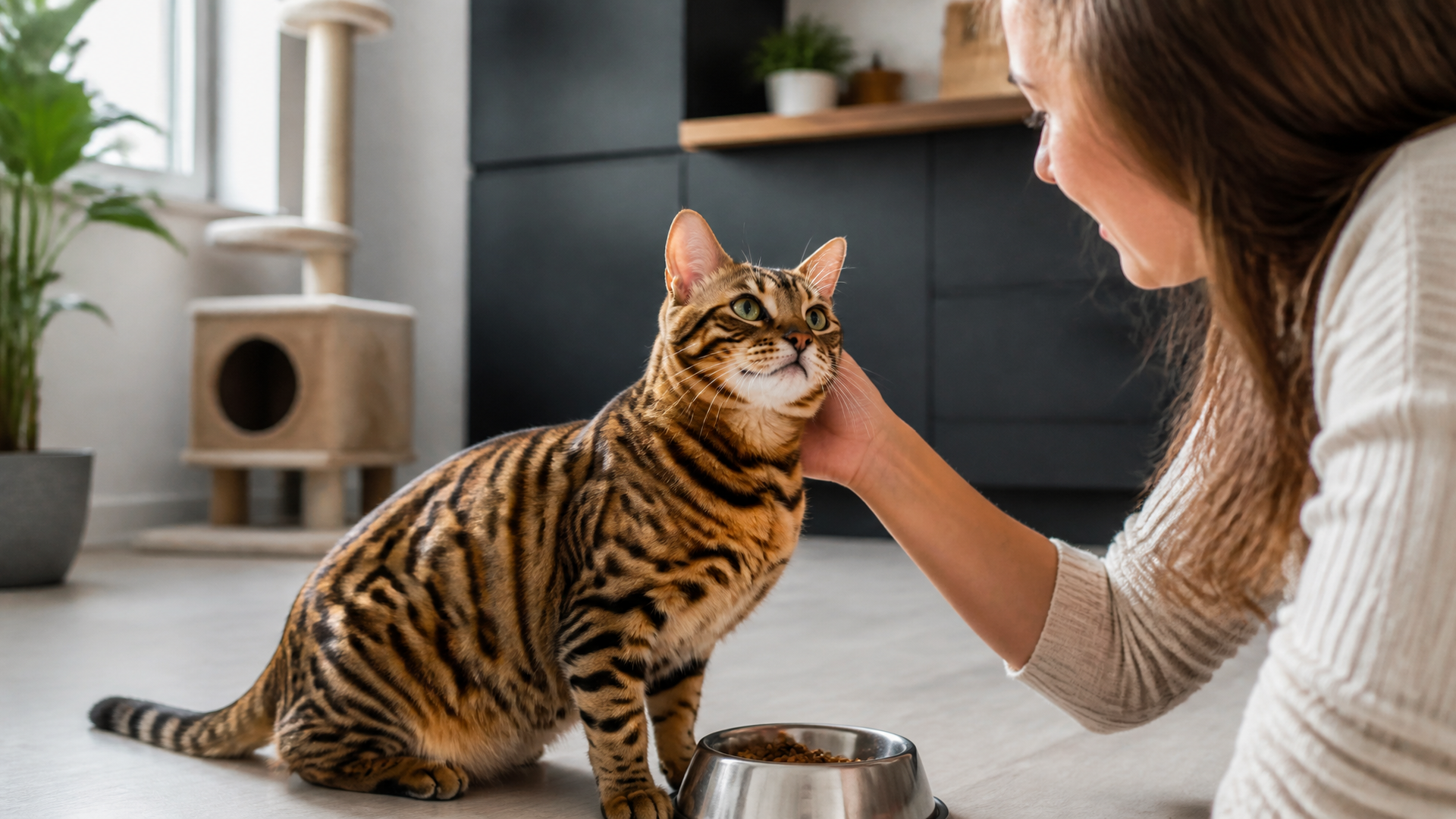
Bengal Cat Care: Daily Routine & Expert Tips
Bengals need more than food and a litter box. Give them a structured daily routine with at least 30 minutes of interactive play, a high-protein diet, and plenty of brain games — or they’ll find their own entertainment by opening cabinets, chewing cords, and knocking things off shelves. This guide covers the exact schedule, feeding plan, enrichment strategies, and grooming steps that work specifically for Bengals.

What You Need Before Starting a Routine
Gather these items first so you’re not scrambling later:
- Interactive toys: Wand toys, fetch toys, and puzzle feeders (at least 3 to rotate)
- Cat tree or wall shelves: Bengals need vertical space — a minimum of 5 feet of climbable height
- High-protein wet food: Canned or commercial raw, with at least 40% protein on a dry-matter basis
- Puzzle feeders: At least 2 different types so you can rotate them
- Childproof cabinet locks: Bengals learn to open doors and drawers fast
- Nail clippers and grooming mitt: Rubber mitts work best for their short coat
Prep check: If you don’t have at least two of these categories covered, your Bengal will likely develop problem behaviors within the first week. Prioritize the interactive toys and cat tree before anything else.
Why Most Bengal Owners Hit Trouble (And How to Catch It Early)
The biggest mistake owners make is underestimating how much active engagement Bengals need. When their energy has no outlet, they don’t just get bored — they get destructive.
Detect it early: If your Bengal starts swatting at your ankles, pacing more than usual, or pulling things off shelves, you’re falling behind on play. Track how much interactive play they actually get in a 24-hour period. Under 30 minutes of directed play (not just toys left out) means you’re in the danger zone.
Quick verification: Add one 15-minute session before your bedtime and monitor behavior for three days. If the destructive behaviors decrease by at least half, you’ve confirmed the root cause. If behaviors don’t change, move on to the escalation signal later in this guide.
The Daily Schedule That Prevents Problem Behavior
Stick to this order even if you shift the times. Bengals thrive on predictability, and the sequence matters as much as the duration.
Morning Play + Breakfast (7:00–8:30 AM)
Start with a 15–20 minute play session before food. This burns off overnight energy and prevents early-morning meowing. Follow with portion-controlled breakfast.
Why this order: Bengals’ natural hunting instinct means they prefer to “hunt” (play) before eating. Skipping the pre-breakfast play often leads to begging and ankle-biting at dawn.
Solo Enrichment (8:30 AM–12:00 PM)
After breakfast, give your Bengal a puzzle toy or access to a window perch. This satisfies their need to watch birds and work for food.
What to leave out: A puzzle feeder with a few kibble-sized treats, a cat tree by a window, and one rotating toy. Change the toy every 2–3 days to keep interest.
Midday Check-In (12:00–12:10 PM)
A short 5–10 minute session — either a quick training drill (yes, Bengals learn tricks fast) or an interactive toy. This prevents boredom chewing and destructive behavior during the afternoon slump.
Afternoon Peak Play (5:00–5:30 PM)
This is the non-negotiable session. Bengals have natural hunting peaks at dawn and dusk. A full 15–20 minute directed play session — wand toy, fetch, or chase — satisfies that instinct.
How to tell it’s working: Your Bengal should be panting lightly and lying down within 5 minutes after the session ends. If they’re still pacing or vocalizing, extend the session by 5 minutes.
Dinner + Wind-Down (6:00–7:00 PM)
Portion-controlled dinner followed by calm bonding time — brushing, lap time, or quiet cuddles. Bengals can be aloof if you skip this step.
Final Bedtime Play (10:00–10:10 PM)
A short 5–10 minute session right before your bedtime. This prevents pre-dawn meowing and helps them sleep through the night.
Success check: After 5–7 days on this schedule, your Bengal should stop waking you before 6 AM and should not be destructive during the day. If either behavior persists, you need more play volume or better enrichment.
Feeding Your Bengal: High-Protein, Portion-Controlled
Bengals have sensitive stomachs and need a high-protein, moderate-fat diet. Wet food — canned or raw — should make up at least 70% of their intake. Dry food alone doesn’t provide enough moisture for their kidneys over the long term.
Choosing the Right Food
- Protein source: Chicken, turkey, or fish (avoid by-product meals). Bengals often do well with novel proteins like rabbit or duck if chicken triggers allergies.
- Wet vs. dry: Aim for at least 70% wet food. A 10-pound Bengal needs roughly 220–260 calories per day split between two meals.
- Raw feeding: Transition slowly over 7–10 days and use a commercial raw that meets AAFCO guidelines. Never feed raw pork or wild-caught fish (possible parasites).
Foods to Never Give a Bengal
- Grapes, raisins, onions, garlic (cause kidney damage)
- Dairy (most adult cats are lactose intolerant)
- Raw eggs (biotin deficiency risk)
- Bones (choking or intestinal tear risk)
- Alcohol, caffeine, or chocolate (toxic at any amount)
Enrichment That Matches Their Brain
Bengals are one of the smartest domestic breeds — and that intelligence turns into trouble without an outlet. They need vertical space (cat trees, wall shelves), puzzle feeders, and daily training sessions. Yes, you can clicker-train a Bengal. They learn faster than most breeds.
Low-Cost Enrichment Ideas
- Cardboard box maze: Cut holes and connect two or three boxes, drop in a treat on occasion.
- Frozen treat puzzle: Freeze wet food or broth into an ice cube tray, then give one cube in a slow feeder bowl.
- Hide-and-seek: Hide a favorite toy under a blanket, then let them hunt it out.
When Playtime Isn’t Enough
If your Bengal still shows unwanted behavior (excessive meowing, biting ankles, knocking things off counters), add one more play session before your bedtime. Consider a cat wheel — Bengals are one of the few breeds that actually use them for sustained running.
Look for a large, sturdy wheel (at least 48 inches in diameter) with a smooth, padded track. A good wheel runs about $200–$400, but it can save your furniture and your sanity. Brands like One Fast Cat and Go Pet Club make models that work well for Bengals.
Escalation signal: If you’ve added play sessions, rotated toys, and introduced a cat wheel but your Bengal is still destructive for more than two weeks, talk to your vet. Some Bengals benefit from a feline behaviorist, and a vet check can rule out medical causes for the restlessness.
Grooming a Bengal: Minimal but Regular
Bengals have a short, dense coat that doesn’t mat easily, but they shed year-round. Their coat has a unique “glitter” effect — the pelt actually reflects light. Regular brushing keeps the oils distributed so that shimmer stays.
| Task | Frequency | Tools |
|---|---|---|
| Brushing | 1–2 times per week | Rubber grooming mitt or soft bristle brush |
| Nail trimming | Every 2 weeks | Cat nail clippers + styptic powder (just in case) |
| Ear cleaning | Monthly | Cotton ball + vet-approved ear cleaner (no Q-tips) |
| Bathing | Only if needed (not routine) | Cat-safe shampoo + non-slip mat |
Bengals often love water — they’re descended from Asian leopard cats, which are strong swimmers. If your Bengal jumps in the shower or splashes in the sink, that’s normal. Just rinse with clean water afterward and dry thoroughly.
Health Watch: Two Conditions Bengals Are Prone To
Bengals are generally healthy, but two conditions are more common in the breed:
- Progressive Retinal Atrophy (PRA): Gradual vision loss starting around 2–3 years. Early sign: your cat bumps into furniture at night. No cure, but you can make your home consistent (don’t rearrange furniture).
- Bengal Progressive Retinal Atrophy (bpra): A specific mutation in some lines. Breeders should test for it. If adopting, ask for PRA DNA test results.
Stop point: Take your Bengal to the vet if you see significant weight loss, vomiting more than once a week, diarrhea that lasts more than 24 hours, or sudden lethargy. Bengals hide illness well. If your cat’s appetite drops for two days, call your vet.
Quick-Reference Care Checklist
Use this to stay on track without missing the important stuff. Mark each item pass or fail.
Daily
- [ ] Two play sessions (at least 15 minutes each)
- [ ] Breakfast and dinner (portion-controlled)
–