How to Groom a Bichon
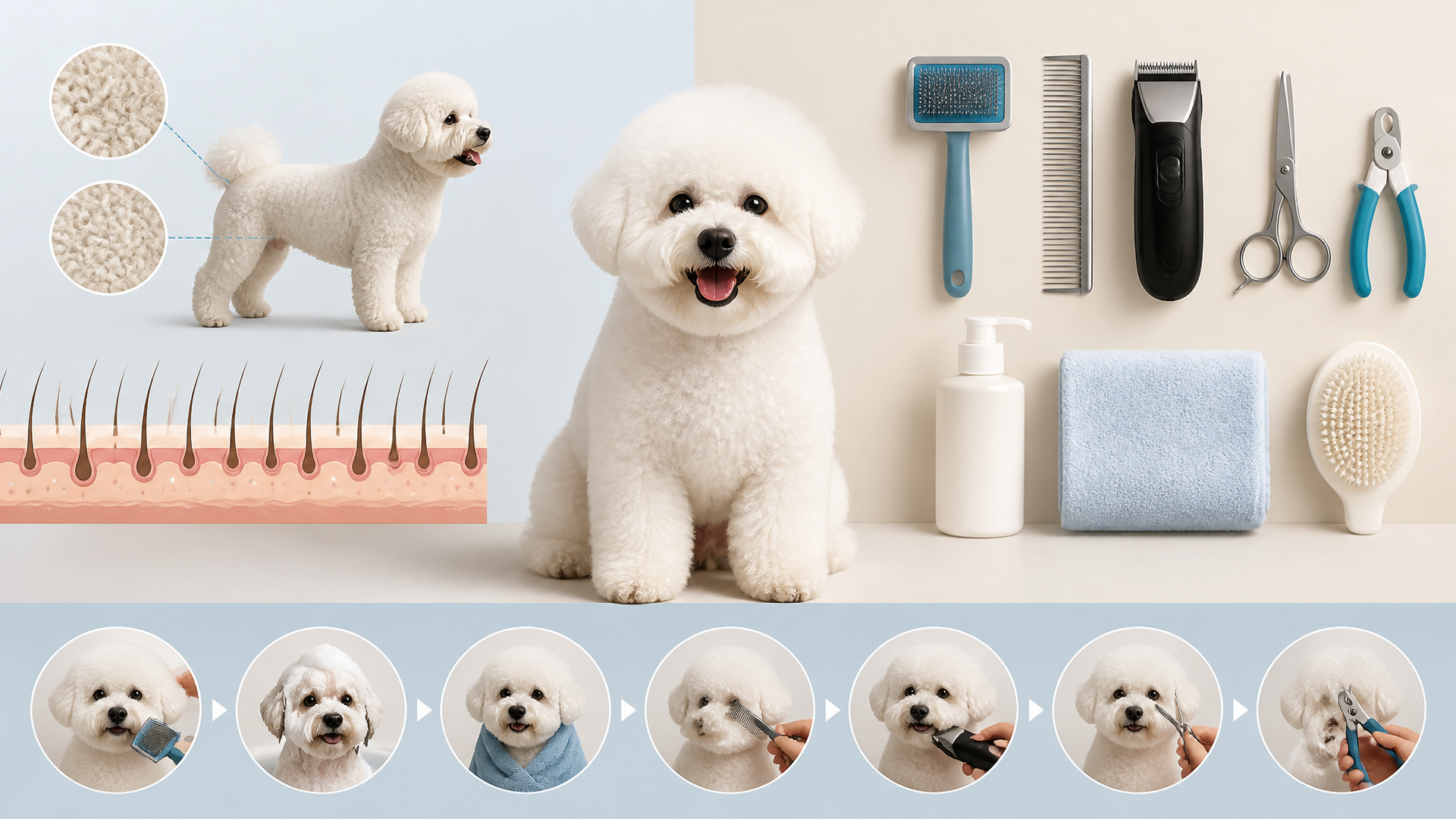
A Bichon Frise needs a full grooming session every 4–6 weeks and brushing every 2–3 days. You can handle most of it yourself if you have the right tools and know when to stop. The key decision point is coat style: a longer show-style clip requires more frequent brushing and more precise shears work, while a shorter pet clip (about ½ inch) is easier to maintain and lets you use clippers on the body.

What You’ll Need Before You Start
Gather everything before you bring the dog to the grooming area. A prepared session runs smoother for both of you.
Brushing tools:
- Slicker brush with medium-firm pins — your main tool for daily brushing
- Pin brush — for fluffing the coat after drying
- Metal greyhound comb — for checking hidden mats behind ears, under legs, and at the tail base
- Dematting tool or mat splitter — use gently only on loose mats; never yank
Bath and drying supplies:
- Whitening shampoo formulated for white coats (Chris Christensen White on White or Wahl Gentle Whitening work well)
- Conditioner formulated for dogs — Bichon coat dries fast but needs the moisture
- High-velocity dryer — essential; a human blow-dryer will not straighten the coat properly
- Microfiber towels for blotting
Trimming and finishing:
- Curved shears for rounded feet and the head silhouette
- Straight shears for body and sanitary areas
- Thinning shears to soften transition lines
- Nail clippers or a grinder
- Styptic powder in case you nick the quick
Disclosure: Some product links in this guide may be affiliate links. We only recommend tools we have used and trust.
Step 1: Brush Before the Bath — With a Critical Checkpoint
Never bathe a matted Bichon. Water makes tangles tighten into hard knots that must be shaved off.
- Line-brush section by section. Part the coat, brush from the skin outward, then drop the next parting line. Do not just skim the surface.
- Focus on the armpits, groin, behind the ears, and the tail plume — the hot spots where mats form first.
- If you find a mat you cannot brush out, use the dematting tool gently or cut it out with safety shears (blade turned away from the skin).
Verification check: After brushing, run the greyhound comb from skin to coat tip across the whole body. If the comb snags anywhere, go back and brush that section again. The coat should feel smooth and the comb should glide through without resistance. Only move to the bath when every section passes this check.
Branch point: If after brushing you find one or two small mats near the skin that you can gently work out with a dematting tool, proceed with the bath. But if you hit multiple tight mats or the coat feels like felt anywhere, stop. Do not bathe. A matted coat that gets wet will shrink and tighten, making the problem worse. In that case, take the dog to a professional groomer who can safely shave the mats out.
Step 2: Bath and Dry — Where Most Owners Go Wrong
Bichon coat is naturally coarse and stands up when clean. The bath process directly affects how fluffy the final result looks.
1. Wet the coat completely with warm water.
2. Apply whitening shampoo and work through the coat, focusing on paws, chin, and the sanitary area.
3. Rinse thoroughly — soap residue causes skin irritation and a dull, yellowing coat.
4. Apply conditioner, let it sit for 2–3 minutes, then rinse completely.
5. Towel blot by pressing the towel against the coat. Do not rub — rubbing creates tangles.
6. Use the high-velocity dryer on low heat. Blow the coat in the direction of hair growth while brushing with the slicker. Keep the nozzle moving so the heat does not concentrate on one spot.
7. Finish drying by fluffing the coat upward with the pin brush. The coat should look like a cotton ball before you start trimming.
Failure mode — the human blow-dryer mistake: Many owners use a regular hair dryer because it is what they have at home. The symptom shows up within 24 hours: the coat lies flat, feels frizzy, and tangles quickly at the skin. The cause is that human dryers lack the air volume and heat control to straighten the Bichon’s double coat. Damp spots near the skin can lead to matting or even skin irritation. The safer next move is to invest in a high-velocity grooming dryer (entry-level models start around $60–$80) or schedule baths with a groomer who has the equipment.
Step 3: Trim the Body and Legs — With a Clear Stop Point
Start with the sanitary areas, then move to the body and legs.
- Use clippers with a #10 blade for the sanitary area: belly, privates, and under the tail.
- For the main body, use shears if you want a rounder, fuller look. If you prefer a shorter trim, use clippers with a longer blade (3/8 inch or ½ inch).
- Trim the legs into rounded columns using curved shears, working from knee to paw.
- Blend the body into the legs so there is no hard transition line.
Stop/escalate threshold: If at any point you find a mat that is pressed flat against the skin, stop. Do not try to shave it yourself — the skin under a tight mat is often wrinkled, and clippers or shears can easily cut it. Take the dog to a professional groomer. This is the single most common injury in at-home Bichon grooming. The rule is simple: if you can see the skin without lifting the mat, that mat is too tight for you to remove safely at home.
Step 4: Face, Feet, and Tail — The Bichon Signature
These three areas define the breed’s look. Take your time here.
Face:
- Trim the head coat into a rounded shape. Hold the muzzle hair between your fingers and use curved shears to create a soft dome.
- Trim the hair between the eyes so the dog can see — but do not go so narrow that it looks like a stripe.
- Leave the beard and mustache longer, but tidy any stray hairs that stick out.
Feet:
- Trim the hair on top of the foot flush with the paw pad.
- Shape each foot into a small circle — the rounded “cat foot” appearance.
- Trim between the paw pads with straight shears or clippers.
Tail:
- Trim the tail plume into a rounded fan shape. The tail should curve over the back when the dog is standing, so keep the hair longer on top and shorter underneath.
Grooming Schedule Quick-Reference
| Task | How Often |
|---|---|
| Full brush-out | Every 2–3 days (daily during seasonal coat changes) |
| Bath + blow-dry | Every 2–3 weeks |
| Full trim (head, body, feet, tail) | Every 4–6 weeks |
| Nail trim | Every 2–4 weeks |
| Ear check and cleaning | Weekly |
| Sanitary trim | Every 2–4 weeks |
At-Home Grooming Checklist — Save This
Run through this list before every home grooming session.
- [ ] Coat is fully brushed with no remaining mats — passes the greyhound comb test
- [ ] High-velocity dryer is ready (not a human blow-dryer)
- [ ] All shears are sharp and clean — dull blades pull hair and cause discomfort
- [ ] Dog is calm and in a secure, non-slip space (a bath mat on the table or floor helps)
- [ ] Whitening shampoo and conditioner are pre-measured and within reach
- [ ] Styptic powder is nearby for nail accidents
- [ ] You have a clear stop line: if you hit a skin-tight mat or the dog is too stressed to continue, stop and call a groomer
When to Call a Professional
Home grooming works well for maintenance between full clips, but not every owner needs to do the whole job. Head to a groomer if:
- The coat is severely matted and you cannot get a comb through it after brushing
- Your Bichon is anxious, squirms, or will not hold still for shears near the face or paws
- You are not confident shaping the head and face into the rounded Bichon silhouette — the face trim takes practice to get right
- You want a full show-style clip — that skill takes time and coaching to master
FAQ
How often should I brush my Bichon at home?
Brush every 2–3 days for 10–15 minutes. Increase to daily brushing during seasonal coat changes in spring and fall.
Can I use human shampoo on my Bichon?
No. Human shampoo disrupts the pH balance of dog skin and strips the natural oils in a Bichon’s coat, leading to dryness, flaking, and a dull white coat.
Why does my Bichon’s coat look yellow even after a bath?
Yellowing usually comes from tear staining, saliva, or urine contact. A whitening shampoo helps, and switching to stainless steel bowls can reduce tear stains. If staining is heavy, check with your vet.
Do I really need a high-velocity dryer?
Yes. Bichon coat does not dry straight with air-drying — it turns frizzy and hard to manage. A high-velocity dryer straightens the hair cuticle and gives the coat its characteristic fluffy volume. It also helps dry the dense undercoat fully.
How short can I cut a Bichon’s coat at home?
A #10 blade (about 1/16 inch) is safe for sanitary areas only. For the body, a 3/8- to ½-inch clip is common for summer. Never shave a Bichon completely bald — the double coat protects the skin from sun, heat, and irritation.
This guide covers the essential steps for at-home Bichon grooming. The key takeaway: brush before you bathe every time, invest in a high-velocity dryer, and know your limits — tight mats and the face trim are the two places where calling a professional saves you trouble and keeps your dog safe.