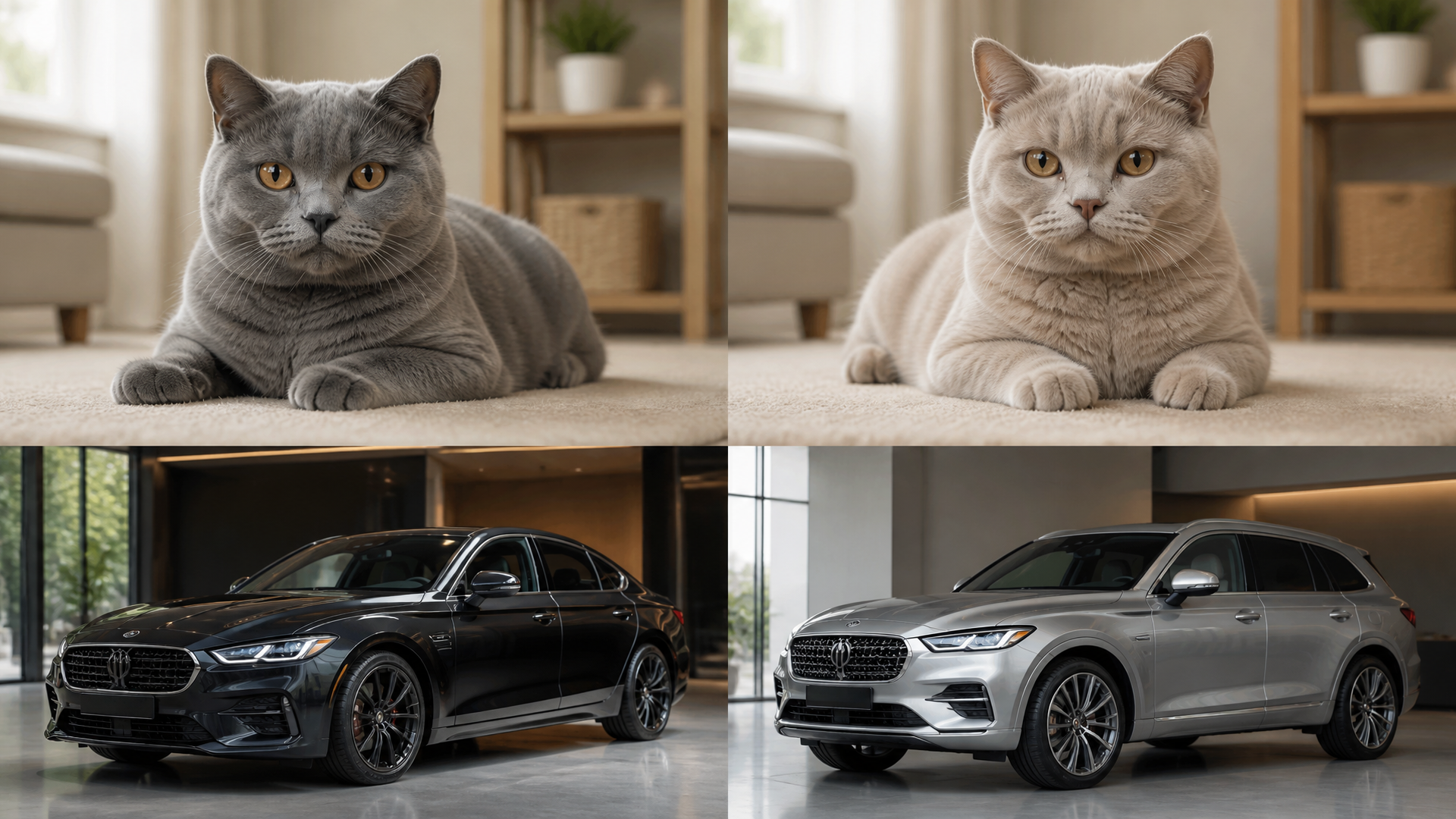
British Shorthair Genetics Color
A British Shorthair’s coat color is controlled by a small handful of genes: B locus (black vs. chocolate), D locus (dense vs. dilute), and O locus (orange vs. non-orange). Base colors are black, blue, chocolate, lilac, cinnamon, and fawn. Patterns like tabby, colorpoint, bicolor, and van add further variety. Understanding these simple inheritance rules lets you predict kitten colors, spot overpriced “rare” colors, and choose a healthy kitten with confidence.

Your key decision split: If you’re buying, knowing genetics tells you whether a high price is fair or inflated. If you’re breeding, it tells you which pairings produce the colors you want — and which combinations are genetically impossible.
How Color Genetics Work
Color inheritance follows dominant/recessive rules. The table below covers the essential gene pairs for British Shorthairs.
| Gene Locus | Dominant | Recessive | Effect |
|---|---|---|---|
| B | B (black) | b (chocolate), b¹ (cinnamon) | Determines base pigment type |
| D | D (dense color) | d (dilute) | Dilutes black to blue, chocolate to lilac |
| O | O (orange) | o (non-orange) | Orange vs. black-based; sex-linked |
| T | T (mackerel tabby) | t⁺ (blotched tabby) | Tabby pattern type |
| C | C (full color) | cs (colorpoint) | Colorpoint restriction (Siamese-like) |
| S | S (bicolor/white spotting) | s (solid) | White patches and spotting degree |
Key takeaway: A solid blue British Shorthair is genetically B/ dd (at least one B, two copies of dilute). A chocolate tabby is bb D/ plus tabby genes. To get a rare lilac, you need bb dd – both recessive genes from each parent.
Practical implication: If you want a blue cat, any pairing of two blues works. But if you want chocolate or lilac, you must verify that both parents carry the recessive b gene. A breeder who shows a chocolate kitten from a blue dam and a black sire without proving both carry chocolate is guessing or misrepresenting.
The 6 Base Colors
All British Shorthair colors are variations of these six bases. Eye color varies by base and pattern.
| Base Color | Genetic Formula | Typical Eye Color |
|---|---|---|
| Black | B/- D/- | Deep copper or gold |
| Blue (dilute black) | B/- dd | Copper or amber |
| Chocolate | b/b D/- | Copper or gold |
| Lilac (dilute chocolate) | b/b dd | Copper or pale gold |
| Cinnamon | b¹/b¹ D/- | Copper or gold |
| Fawn (dilute cinnamon) | b¹/b¹ dd | Pale copper or amber |
Breed-specific detail: Blue is the most common British Shorthair color in the US. Chocolate and lilac are considered rare and command higher prices. Cinnamon and fawn are even rarer.
Trade-off to watch: Rare colors often come from smaller gene pools. A breeder specializing in lilac or cinnamon may have fewer unrelated lines, which can increase the risk of inherited conditions like HCM. Always request health test results alongside color pedigree — never accept color rarity as a substitute for health screening.
Patterns and Markings
British Shorthairs come in four main pattern groups. Use this checklist to identify your cat’s pattern:
- Solid (self): No white, no stripes. Genotype a/a s/s. Eye color copper or gold.
- Tabby: Stripes visible (look for ghosting even on blue or black). Needs at least one A and T gene. Classic tabby = blotched (t⁺/t⁺), mackerel = dominant (T/_), spotted = modified mackerel.
- Colorpoint: Blue eyes + dark points (face, ears, paws, tail). Genotype cs/cs.
- Bicolor / Van / Harlequin: White patches plus colored patches. Bicolor ~50% white, van ~90% white, harlequin in between. Needs at least one S.
Verification step: Take a well-lit photo in natural daylight. Solid cats show no stripe ghosting at any angle. Tabbies show a distinct M on the forehead and banding on the legs. Colorpoints always have blue eyes — if your cat has copper eyes and pale body fur, it’s a low-white bicolor, not a colorpoint.
Rare Colors – When to Pay Premium and When to Walk Away
British Shorthair breeders in the US often list rare colors at higher prices because both parents must carry specific recessive genes.
- Chocolate and Lilac – need b/b from both parents.
- Cinnamon and Fawn – need b¹/b¹ (even rarer).
- Colorpoint (all colors) – need cs/cs from both parents.
- Silver and Golden (Inhibitor gene) – caused by the I gene, adds a striking undercoat.
Decision criterion: If you want a rare color, verify that both parents carry the recessive gene. A breeder who claims “rare color” without providing parent pedigrees may be overcharging. Request DNA test results or walk away. For example, a lilac kitten from two blue parents is impossible unless both blues carry chocolate and dilute – ask for proof.
What can go wrong: Paying a premium without genetic proof can leave you with a cat that “looks” lilac as a kitten but darkens to a muddy blue by 18 months. That’s a $500–$1,000 mistake — avoid it with a simple DNA test. If your breeder can’t confirm genetics, use a cat DNA test like Wisdom Panel or Basepaws to verify hidden recessives yourself.
How to Predict Kitten Colors – A Step-by-Step Flow
Use this flow to estimate possible offspring coat colors before you buy or breed.
Step 1: Identify each parent’s base color and pattern
Example: Parent A is solid blue male (B/- dd a/a s/s). Parent B is chocolate tabby female (b/b D/? A/? T/? S/s?).
Step 2: Write out possible gene combinations
Blue → B or b? (can carry chocolate). Chocolate → b/b only. If both could carry hidden recessives, the litter may show colors neither parent displays.
Step 3: Apply dominant/recessive rules
Black (B) dominates chocolate (b). If one parent is black and one chocolate, kittens can be black or chocolate (if black carries chocolate). Dilute (dd) vs full color (D/_): two full-color cats can produce dilute kittens only if both carry d.
Step 4: Check tabby and colorpoint
Two solid cats (a/a) will never produce tabby kittens unless one is agouti (A/a). Colorpoint requires both parents to carry cs – even if neither is a colorpoint itself.
Early Checkpoint
If both parents are solid blue (dd), every kitten will be diluted (blue, lilac, or fawn depending on B locus). You cannot get a chocolate from two blues unless one carries chocolate.
How to verify: Ask the breeder for the parents’ individual DNA test results from a lab like UC Davis or Wisdom Panel. Look specifically at the B locus (black/chocolate/cinnamon) and D locus (dense/dilute). A cheek-swab kit costs the breeder about $60 and takes two weeks — any serious breeder will have this on file.
Likely Causes of Unexpected Colors
- Hidden recessive genes (chocolate, dilute, colorpoint).
- Incomplete pedigree or mixed ancestry.
- Heat-related color changes in colorpoints (points darken with cooler temperatures).
When to Escalate
If a breeder claims a rare color but cannot provide parent genetic history, request a DNA test or walk away.
Common Misconceptions About British Shorthair Colors
“Blue is the rarest British Shorthair color.” False. Blue is the most common color in the breed. Chocolate, lilac, cinnamon, fawn, and colorpoint are far rarer.
“All blue British Shorthairs have copper eyes.” Most do, but eye color can vary from copper to amber. It should be deep and rich, not pale.
“Kittens’ adult coat color is visible at birth.” Not always. Colorpoint kittens are born white and slowly develop points. Lilac and blue kittens may look nearly identical at 2 weeks – wait until 8 weeks for a confident ID.
“Bicolor British Shorthairs are always part Persian.” No. Bicolor is a legitimate pattern within the breed standard. The white spotting gene is naturally present.
3 Expert Tips for Choosing a Kitten Based on Color
1. Ask for parent photos at the same age.
Kitten coat color can shift as they mature (especially in tabbies and colorpoints). Compare parent photos at 1 year to see the likely adult color.
Common mistake: Choosing a kitten at 6 weeks based on a bright coat that later fades or darkens.
2. Verify health history, not just color.
A rare-colored kitten from a breeder who doesn’t test for genetic health issues (e.g., HCM, PKD) isn’t a bargain.
Common mistake: Paying a premium for color without asking about health testing. Always request hip scoring and heart ultrasound results.
3. Use a DNA test if the breeder can’t confirm recessives.
If you want lilac or chocolate, ask for a simple cheek-swab test (e.g., UC Davis or Wisdom Panel cat DNA) to prove both parents carry the needed genes.
Common mistake: Assuming a visible blue parent automatically carries black or chocolate – it may be homozygous dd and only produce dilute colors.
Save This Guide
Quick Color ID Checklist:
- Base color: black, blue, chocolate, lilac, cinnamon, fawn.
- Dilution: coat looks dusty/soft? Then dd.
- Pattern: solid, tabby, colorpoint, bicolor, van, harlequin.
- White spots: yes/no, how much?
- Eye color: copper/gold = solid or tabby; blue = colorpoint.
Key takeaway: The rarest British Shorthair colors require both parents to carry recessive genes. Always confirm parent genetics before paying a premium. Use the checklist and parent photos to predict your kitten’s adult coat.
Affiliate disclosure: Some links in this guide may earn us a small commission at no extra cost to you.