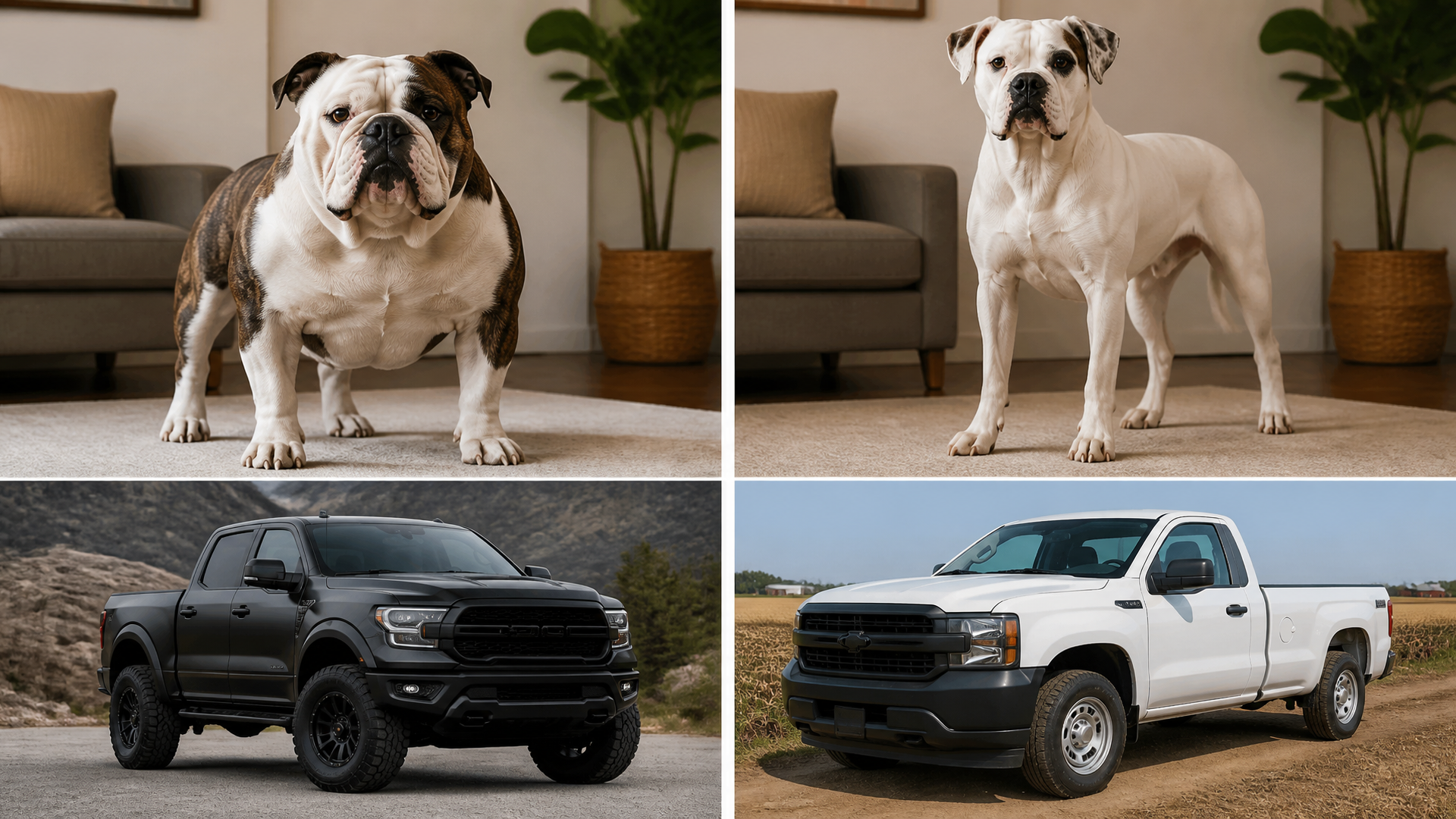
Johnson vs Scott Type American Bulldog
Two distinct bulldog types share the same name, but they couldn’t be more different in build, temperament, and daily care. The Johnson (bully) type is the heavy, broad, low-slung bulldog you probably picture. The Scott (standard) type is taller, leaner, and more athletic. One belongs on the couch; the other belongs on a trail. Here’s exactly what separates them and how to pick the right one for your lifestyle.

Quick answer
The Johnson type is a massive, short-faced bulldog (110–130 lbs) with a calm, low-energy personality—ideal for relaxed homes where he can be a lap dog. The Scott type is a taller, more agile bulldog (70–90 lbs) with higher drive and endurance, suited for active owners who want a hiking partner or working dog.
If you want a dog that sleeps 18 hours a day and rarely needs more than a short walk, go Johnson. If you want a dog you can run, hike, or train for agility, go Scott.
What this means for your next move: Before you contact a breeder, measure your daily routine honestly. A Johnson owner who tries to turn their dog into a trail buddy will fight heat exhaustion and a stubborn refusal to move. A Scott owner who treats theirs like a couch potato will deal with destructive chewing and escape attempts. Match the energy level now, not after the puppy arrives.
How the two types compare
| Trait | Johnson (Bully) Type | Scott (Standard) Type |
|---|---|---|
| Average weight | 110–130 lbs | 70–90 lbs |
| Height at shoulder | 17–20 inches | 20–25 inches |
| Build | Short, wide, thick-boned; massive head and chest | Taller, leaner, more rectangular; longer legs and muzzle |
| Energy level | Low; content with one 20-min walk per day | Moderate to high; needs 45–60 min of exercise |
| Temperament | Calm, gentle, stubborn; excellent with kids | Alert, active, more driven; can be pushy without structure |
| Brachycephalic severity | Severe – very short muzzle, heavy wrinkles | Moderate – longer muzzle, fewer breathing restrictions |
| Lifespan | 8–10 years | 10–13 years |
| Best suited for | Couch potatoes, families with young kids, apartments | Active singles, hikers, owners who want an athletic dog |
Which bulldog is right for you? A 6-point checklist
Run through these questions to see where you land:
- My home has stairs or I live in a multi-level house. → Scott type. Johnsons struggle with stairs due to their heavy front end and breathing issues.
- I want a dog that can handle hot weather. → Scott type. The Johnson’s shorter muzzle makes him prone to heatstroke above 75°F.
- I have small children (under 5). → Johnson type. He’s slower, more tolerant, and less likely to knock a toddler over accidentally.
- I plan to do daily hikes, jogs, or bike rides. → Scott type. Johnsons will overheat or refuse to move after a mile.
- I’m a first-time bulldog owner. → Johnson type. Scotts are more stubborn and need firm, consistent training from someone who can handle a strong-willed dog.
- I want a dog that can live with other dogs. → Either, but Scott types are more likely to show same-sex aggression. Johnsons are generally more social.
Reality check for owners: If you checked three or more items for one side, that’s your answer. If you’re split, consider a cross-line mix (Johnson × Scott) which often lands in the middle on energy and muzzle length. Just know that mixed-line puppies are less predictable—you’re gambling on which traits dominate.
Trade-offs to know before buying
Health risks are real for both, but different
The Johnson type carries classic bulldog problems that are expensive to manage: cherry eye, skin fold infections, hip dysplasia, and severe brachycephalic airway syndrome. Many Johnsons cannot be crated during travel because they can’t cool themselves effectively. You’ll need a padded, ventilated crate and a strict summer exercise ban between 10 a.m. and 5 p.m.
The Scott type avoids some of that (fewer skin folds, longer airway) but introduces joint issues from a more active lifestyle. ACL tears and elbow dysplasia are common in working-line Scotts. If you buy a Scott, look for OFA hip and elbow certifications.
Concrete mismatch example: A first-time owner who buys a Scott thinking it’s “just a bigger bulldog” often underestimates the exercise need. The result: a 90-lb dog that paces, chews drywall, and escapes the yard. That boredom-driven behavior is the #1 reason Scotts end up in rescues. Johnson owners who try to force hikes face a dog that collapses from heat stress after 15 minutes.
Gear to have on hand for either type
Affiliate disclosure: We recommend products we genuinely use. If you buy through links, we may earn a commission.
- A raised, tilted food bowl to reduce bloat risk and neck strain (try the Neater Feeder Raised Pet Bowl).
- A cooling vest for hot days (e.g., Ruffwear Jet Stream).
- An orthopedic bed (the Big Barker line holds up to 130 lbs).
- A gentle leader harness for Scotts who pull on walks (PetSafe Easy Walk).
How to verify you’re getting the right type before you buy
The most common mistake owners make is buying a Johnson-type puppy from a breeder who calls it a “Scott” (or vice versa). Here’s a three-step verification flow you can do before you put down a deposit.
Step 1: Check the breeder’s documentation
Ask for OFA (Orthopedic Foundation for Animals) health clearances for both parents. A reputable Johnson breeder will have cardiac, patella, and hip tests. A reputable Scott breeder will have hip, elbow, and thyroid tests. If they can’t produce these, move on.
Step 2: Use physical markers at 8 weeks
By 8 weeks, a Johnson puppy will have a noticeably wider head and shorter nose than a Scott puppy of the same age. Compare:
- Johnson: Broad, round skull; almost no visible forehead stop; round body like a small barrel.
- Scott: Flatter skull; slight muzzle; leggy appearance, more like a boxer mix.
Ask the breeder for photos of the parents in standing side profile. If the parents don’t match the claimed type, the puppies won’t either.
Step 3: Measure the parents’ height
At 2 years old, a Johnson male should be 17–20 inches at the shoulder; a Scott male 20–25 inches. If the breeder’s “Scott” sire is only 18 inches tall, that’s a Johnson or a cross.
Escalation signal: If the breeder is vague about lineage, says “all bulldogs are the same,” or won’t let you visit the property, walk away. That’s a red flag for a puppy mill with no health testing.
Related questions
Can a Johnson and Scott type be mixed?
Yes—many breeders cross the two lines to create a “middle ground” dog. These hybrids often have moderate energy and a slightly longer muzzle. But without knowing the exact split, you’re gambling on health and temperament. Verify both parents’ OFA scores.
Which type is better for first-time dog owners?
The Johnson type is more forgiving, but both bulldog lines can be stubborn. If you’ve never trained a strong-willed breed, consider working with a professional trainer from day one.
How much should I expect to pay?
A well-bred Johnson or Scott puppy from health-tested parents typically costs $2,500–$5,000. Discounted puppies often come from breeders who skip health screenings—and that vet bill will hit you later.
What’s the most important difference for apartment dwellers?
The Johnson type. He’s quieter, lower energy, and less likely to disturb neighbors. Scotts need room to run and may bark out of boredom in a small space.
Save this guide when comparing breeders. The difference between a Johnson and a Scott isn’t just looks—it determines how much exercise your dog needs, how often you’ll visit the vet, and whether your home is really ready for one. Use the checklist and verification steps before you commit.