do Beagles Need Winter Coats
Yes — many Beagles benefit from a winter coat when temperatures drop below freezing, but not every Beagle needs one, and the decision depends on your individual dog’s coat, age, health, and activity level.

The short double coat of a Beagle provides decent insulation for a dog that was bred as a scent hound in temperate England, but it wasn’t designed for harsh winters. A coat is practical protection, not a fashion choice, for Beagles that spend more than a few minutes outdoors below 32°F.
How to Decide If Your Beagle Needs a Coat
The 3-Second Check
If you’re heading outside for a walk and the temperature is below 45°F, put a hand on your Beagle’s belly. That area has very little fur. If it feels genuinely cold to your touch, your Beagle will feel cold too after a few minutes outside.
For Most Beagles, It Comes Down to Temperature and Time
| Condition | Coat Needed? | Notes |
|---|---|---|
| Above 45°F | No | Most adult Beagles are comfortable |
| 32–45°F | Maybe | Depends on wind, wetness, and activity |
| Below 32°F | Yes | Especially for walks longer than 10 minutes |
| Below 20°F | Definitely | Risk of hypothermia and frostbite |
| Wet + snowy | Yes | Water removes a coat’s insulating value fast |
Likely Causes That Tip the Scale
Some Beagles lose heat faster than others. Check these factors:
- Thin or patchy coat — if you can see skin easily when you part the fur, the undercoat is insufficient
- Underweight Beagle — less body fat means less natural insulation
- Short-coated or field-line Beagle — these are bred for hunting and often have thinner coats than show-line Beagles
- Senior Beagle (7+ years) — loss of muscle mass reduces heat retention
- Puppy under 6 months — their bodies haven’t fully developed thermoregulation
Quick Coat Decision Aid: Does Your Beagle Need One?
Check each item that applies to your Beagle. If you check 3 or more, a winter coat is genuinely useful and worth getting.
- [ ] Temperature is below 32°F during your walk
- [ ] Your Beagle shivers, lifts paws, or tries to turn back home
- [ ] Your Beagle is 7+ years old, under 6 months, or has a health condition
- [ ] Your Beagle has a thin coat, is underweight, or has bare patches (have a vet check the patches)
- [ ] You’re walking longer than 15 minutes in cold weather
- [ ] The ground is wet, snowy, or icy — not just dry cold
- [ ] Your Beagle stands still outdoors for more than a few minutes
If you checked 0–2: Your Beagle can skip the coat for short potty breaks and quick walks.
If you checked 3+: Get a coat. Your Beagle will be more comfortable and safer.
How to Choose and Fit a Winter Coat for Your Beagle
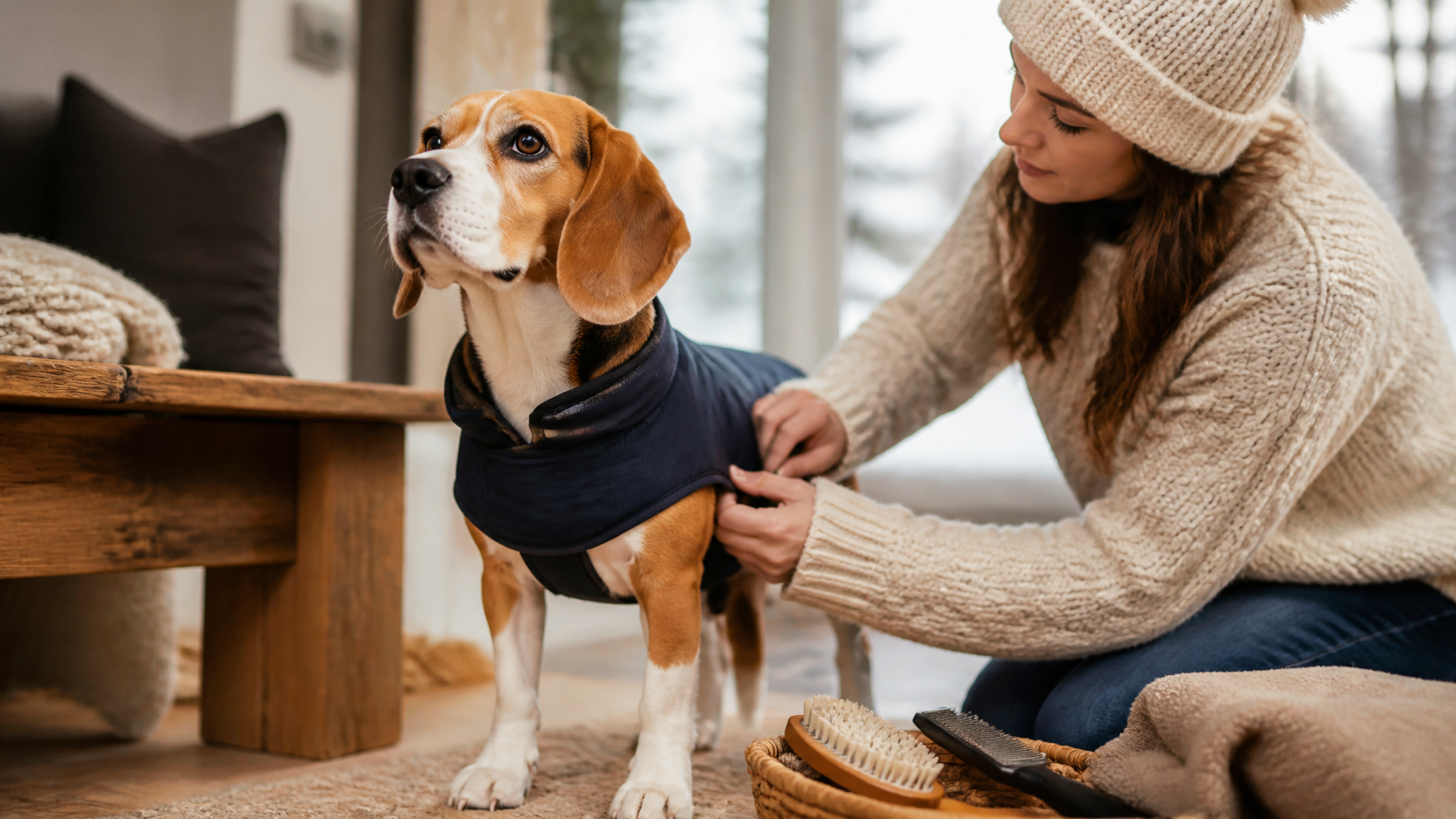
Beagles have a deep chest, sturdy neck, and a body shape that’s longer than it is tall. A coat that fits poorly won’t keep them warm and can actually make them more uncomfortable.
Step 1: Measure Your Beagle Properly
Use a soft measuring tape for three spots:
- Neck circumference — where the collar sits
- Chest girth — the widest point behind the front legs
- Back length — from the base of the neck to the base of the tail
Most adult Beagles fit a Medium in standard brands, but always check the brand’s specific size chart. A coat that’s too tight restricts breathing. One that’s too loose lets cold air in and can trip your dog.
Step 2: Choose the Right Features
| Feature | Why It’s Important for Beagles |
|---|---|
| Water-resistant outer shell | Your Beagle’s nose stays low to the ground — a wet belly gets cold fast |
| Insulated lining | A shell alone won’t keep warmth in below freezing |
| Reflective trim | Beagles come in dark colors; reflective strips keep them visible |
| Harness opening | Beagles are strong pullers — a coat with a harness slot keeps you in control |
| Full belly coverage | That nearly furless belly needs protection the most |
| Velcro + buckle closure | Pull-over styles are nearly impossible with a wiggly Beagle |
Good product types to look for: Water-resistant nylon or polyester shell with polyester or fleece insulation and reflective piping. Brands like Ruffwear, Kurgo, and Hurtta make coats that fit deep-chested dogs well without restricting front leg movement.
Step 3: Check the Fit Before You Cut the Tags
Put the coat on your Beagle and check:
- Neck: Two fingers should fit comfortably under the collar area
- Chest: The coat should close snugly without pulling
- Back length: From base of neck to base of tail — not longer
- Front legs: Full range of motion with no fabric bunching
Walk your Beagle around the house for 10 minutes. If they freeze, try to bite the coat, or walk stiffly, the fit or style doesn’t work. Try a different brand or cut.
Verification Step: How to Confirm the Coat Is Working Before You Head Out
After the 10-minute indoor trial, do a quick warmth check. Press your hand against your Beagle’s belly through the coat fabric — it should feel noticeably warmer than when you first put the coat on. Then touch the tips of their ears; if the ears still feel cold but the body feels warm, the coat is doing its job. Finally, watch for one normal Beagle behavior — a tail wag, a sniff around, or a stretch. If your Beagle is standing still and relaxed instead of shivering or trying to scrape the coat off, you’re good to go.
When to Escalate — The Stop Threshold
If your Beagle absolutely refuses to move in a coat after 3–4 separate attempts (with different fit adjustments or closure styles), do not force it. This is your stop threshold. Prolonged forcing can create a lasting fear response that makes future coat use impossible. Instead:
- Try a different coat style — switch from a full-coverage coat to a lightweight fleece vest or a sweater-style wrap
- Rule out a medical cause — if your Beagle also resists being touched on the back or flinches when you lift them, have a vet check for arthritis, back pain, or skin sensitivity
- If no medical issue is found and your Beagle still won’t accept any coat after 4 attempts, consult a professional trainer who uses positive-reinforcement methods. Some Beagles have sensory sensitivities that require a gradual desensitization plan
When to skip coats entirely: If your Beagle is otherwise healthy but simply cannot tolerate a coat, limit outdoor time to 5-minute potty breaks below 32°F and use a covered, heated dog bed indoors to keep them warm before and after.
Watch for These Cues That Your Beagle Is Too Cold
Beagles are naturally stoic and food-driven — they’ll keep sniffing even when they’re uncomfortable. Don’t rely on them to tell you they’re cold. Watch for these signs:
- Shivering or trembling
- Lifting one or both front paws off the ground
- Tail tucked between the legs (not from fear — from cold)
- Curling into a tight ball when standing still
- Whining or barking when they’re normally quiet
- Slowing down or trying to turn back toward home
- Ears and paws feel cold to your touch
If you see any of these signs, head inside immediately. Warm your Beagle slowly with a dry towel — never use direct heat like a space heater. If shivering continues for more than 20 minutes after coming inside, contact your vet.
When You Can Skip the Coat
These are situations where a winter coat doesn’t help and might cause problems:
- Indoor-only dogs — if your Beagle only goes out for 3-minute potty breaks, no coat needed
- Very active walks — a Beagle running full speed can overheat in a coat, even in cold weather
- Skin conditions — if your Beagle has matting, hot spots, or other skin issues, a coat can trap moisture and make it worse
- Poor fit — a tight coat restricts movement and causes chafing; a loose coat is a tripping hazard
FAQ
Do Beagles need boots too?
Not always, but consider them if your Beagle lifts paws on icy sidewalks or if the roads are salted. Rock salt burns paw pads, and snow between the toes is painful. Look for booties with rubber soles and fleece lining. Start with short indoor wear sessions first — most Beagles need a few tries to adjust.
Can a Beagle sleep outside in a dog house during winter?
No. The Beagle coat is not built for overnight exposure below 40°F, even with a heated shelter. If your Beagle must be outside temporarily, bring them in before temperatures drop at night.
What temperature is too cold for a Beagle walk?
Below 20°F with a coat and booties is risky for extended walks. Below 10°F is unsafe for more than a few minutes. Frostbite can develop on ears, tail, and paws within 30 minutes at these temperatures. Stick to 5-minute potty breaks only.
Do puppies need coats more than adult Beagles?
Yes. Puppies under 6 months have less body fat and a developing coat. They lose heat faster. Below 40°F, a lightweight coat is helpful even for short outings.
Use the decision aid above, measure your Beagle carefully, and watch for signs of cold. A well-fitted coat can make winter walks safer and more comfortable for your hound.