Corgi Fat: Guide: What Every Owner Should Know
Corgis are built like small barrels on short legs, and that fluffy double coat hides a lot. But here’s the truth most owners miss: a Corgi can be 10–15% overweight before it becomes visually obvious. That extra weight puts dangerous pressure on their long spine and tiny joints. This guide gives you the exact checkpoints, weight ranges, and step-by-step plan to get your Corgi back to a healthy weight — without risking injury.

What “Corgi Fat” Actually Means for Their Health
That round, waddling look might seem cute, but it’s a serious health threat for Corgis specifically. Their long back (dachshund-like build) makes them prone to intervertebral disc disease (IVDD) . Every extra pound adds direct compression to the discs between their vertebrae.
Corgi-specific health risks from excess weight:
| Risk | Why Corgis Are Vulnerable |
|---|---|
| IVDD (disc disease) | Long spine + short legs = more stress per pound |
| Hip dysplasia | Already common in the breed; weight accelerates joint damage |
| Arthritis | Carries extra load on small joints |
| Heat intolerance | Fat insulates; Corgis already overheat easily |
| Reduced lifespan | Studies show overweight dogs live 1.5–2 years less |
The counter-intuitive truth: A Corgi’s barrel chest and thick coat are nature’s camouflage for weight gain. Your dog might look “normal” to you while carrying 5–8 extra pounds — that’s 20–30% of their ideal body weight.
What this means for your next decision: If your Corgi is only mildly overweight (you can still feel ribs with firm pressure), you can start the 5-step plan below today — no vet visit needed unless weight loss stalls after 6 weeks. If you cannot feel ribs at all, schedule a vet visit this week before starting any diet changes. The single most impactful action you can take in the next 24 hours is measuring your Corgi’s current food by weight (not cups) and cutting treats in half. That alone often reverses mild weight gain within 4–6 weeks.
3 Simple Ways to Check If Your Corgi Is Overweight
Skip the guesswork. Use these three checks in order. If any one fails, your Corgi is likely carrying extra weight.
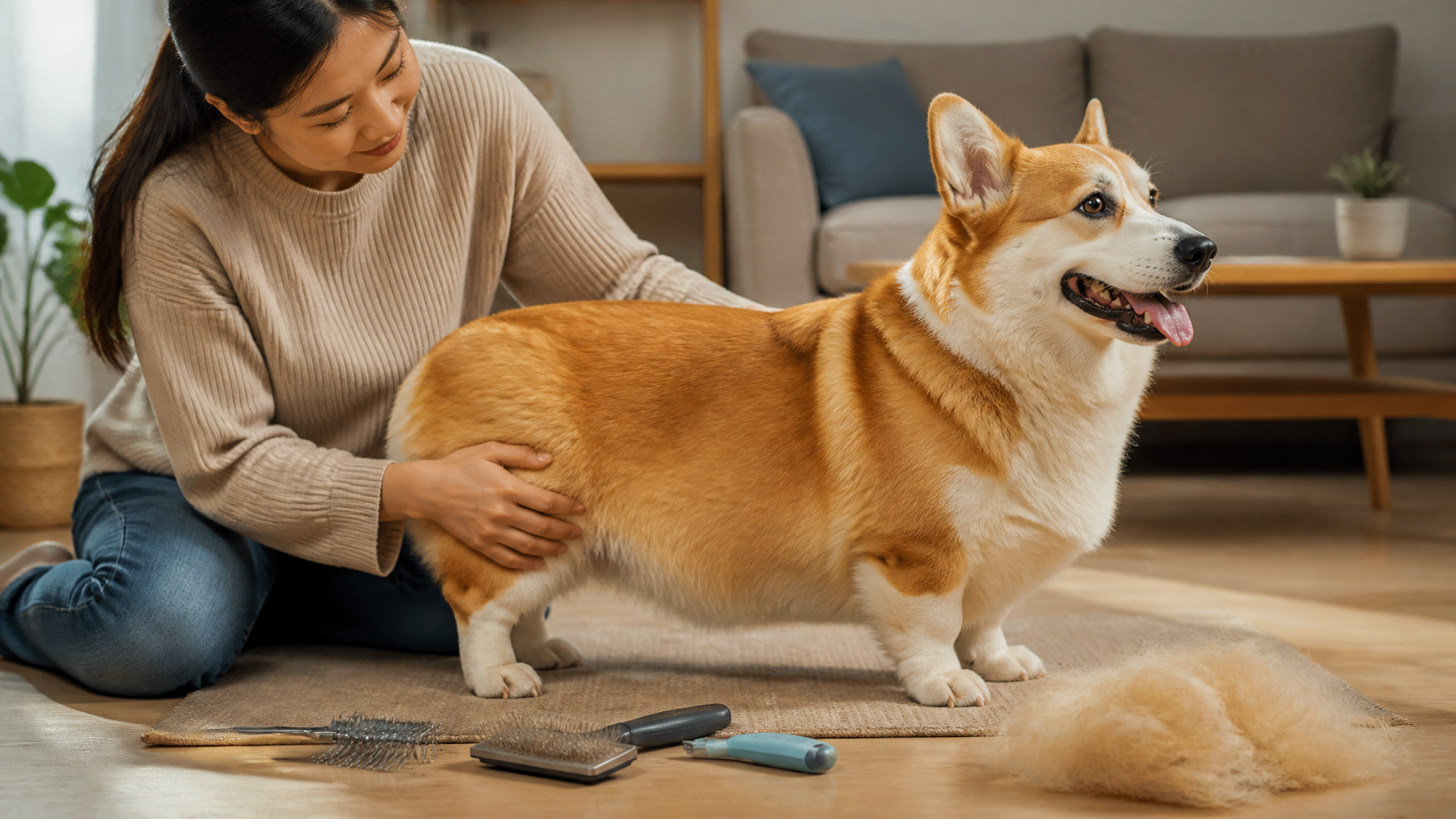
1. The Rib Check
Run your hands along your Corgi’s ribcage with light pressure.
- Healthy: You feel ribs easily under a thin layer of fat (similar to feeling the back of your hand)
- Overweight: You need to press firmly to feel ribs
- Obese: You cannot feel ribs at all
2. The Waist Check
Look at your Corgi from above while they stand.
- Healthy: A visible waist indentation behind the ribs
- Overweight: Straight line from ribs to hips (no dip)
- Obese: Bulging past the ribs
3. The Belly Tuck Check
Look from the side.
- Healthy: An upward tuck from the ribcage to the belly
- Overweight: Sagging belly (no tuck)
Stop point: If you cannot feel ribs at all, schedule a vet visit this week. Do not start a weight loss plan without a veterinary exam first — your vet needs to rule out thyroid issues and measure baseline health.
Corgi Weight Range: Male vs Female
These are general ranges. Individual dogs vary by bone structure. Use them as a starting point, not a final target.
| Sex | Ideal Weight Range | At-Risk Zone | Emergency Vet Alert |
|---|---|---|---|
| Male (Pembroke) | 27–30 lbs | 31–36 lbs | 37+ lbs |
| Female (Pembroke) | 25–28 lbs | 29–33 lbs | 34+ lbs |
| Male (Cardigan) | 30–38 lbs | 39–44 lbs | 45+ lbs |
| Female (Cardigan) | 25–34 lbs | 35–39 lbs | 40+ lbs |
Cardigan Corgis are generally larger and heavier-boned than Pembrokes. If you own a Cardigan, use the higher ranges. If you’re unsure which type you have, check the tail — Cardigans have a long tail, Pembrokes have a docked or naturally short tail.
Verification step: After weighing your Corgi, take a side-view photo of them standing next to a known object (like a 12-oz soda can). Compare the photo to the body condition chart on your vet’s website or the World Small Animal Veterinary Association (WSAVA) body condition score. This gives you a visual baseline you can recheck every two weeks to catch slow creep before it becomes a problem.
5-Step Weight Loss Plan for Corgis
Corgis are food-motivated and will beg relentlessly. Your job is to outsmart them, not feel guilty.
Step 1: Get a Veterinary Baseline
Before any diet change, your vet needs to:
- Confirm current weight and ideal weight
- Check thyroid function (hypothyroidism is common in Corgis)
- Rule out Cushing’s disease
- Approve a target weight and calorie goal
Step 2: Measure Every Meal (No Exceptions)
“Cups” are not precise. Use a kitchen scale.
- Typical target: 200–350 calories per day total (varies by size and activity level)
- Split into 2 meals — never free-feed
Common mistake: Eye-balling portions. A “cup” of kibble can vary by 15–20% depending on how you scoop. Weigh every meal for two weeks until you learn what proper portions look like. A digital kitchen scale (like the Escali or OXO brand) takes the guesswork out completely.
How to verify your portion is correct: After weighing your Corgi’s food, take a photo of the bowl next to a standard object like a soda can or your hand. This gives you a visual reference you can compare against in future weeks to ensure consistency. Also, double-check the calorie-per-cup number on your kibble bag — some brands list calories per “cup” using a 4-ounce measuring cup while others use an 8-ounce cup. If you’re feeding based on volume instead of weight, this discrepancy alone can add 50–100 calories per meal without you realizing it.
Step 3: Replace Treats With Healthy Alternatives
Treats make up 20–40% of many Corgis’ daily calories without owners realizing it.
Swap these:
- Instead of milk bones → baby carrots, green beans, frozen blueberries, or air-popped popcorn (no butter/salt)
- Instead of commercial training treats → plain cooked chicken breast (shredded) or freeze-dried liver (break into tiny pieces)
- Instead of peanut butter (high fat) → a smear of plain pumpkin puree in a Kong
Common mistake: Thinking “light” or “diet” treats are automatically low-calorie. Many diet treats are still 10–15 calories per piece. For a Corgi on a 250-calorie daily plan, just three treats can eat up 18% of their budget. Stick to single-ingredient vegetables and measure them by weight too.
Step 4: Increase Exercise Safely
Corgis are herding dogs with energy, but their short legs and long back limit how much pounding they can handle.
- Safe options: 15–20 minute walks twice daily, supervised play in a fenced yard, or gentle fetch on grass
- Avoid: Running on pavement, jumping off furniture, or stairs (repeated impact hurts their spine)
- Add: Mental exercise — a 10-minute sniffing session or puzzle toy burns as many calories as a walk without stressing joints
Escalation signal: If your Corgi pants heavily, refuses to walk, or limps after exercise, cut intensity immediately. Heavier Corgis overheat and injure faster than lean ones.
Step 5: Track Progress With Weekly Weigh-Ins
Weigh your Corgi every week at the same time (before breakfast, after potty) using a baby scale or a veterinary scale at a pet store.
- Goal: 1–2% body weight loss per week (about 0.3–0.6 lbs for a 30 lb Corgi)
- If no loss after 2 weeks: Drop calories by 10% or add 5 minutes of walking per session
- If loss is faster than 3% per week: Increase food slightly — too-fast weight loss can cause muscle wasting and liver issues
Success check: After 8–12 weeks, you should feel ribs easily, see a waist from above, and your Corgi should move more freely. If weight stalls for more than 2 consecutive weeks despite following steps 1–4, return to the vet — there may be an underlying medical issue.
Save This Guide
Key takeaway: A Corgi’s weight directly impacts their spine and joint health. Use the rib check weekly, weigh food in grams, and swap treats for vegetables. Most overweight Corgis can reach a healthy weight in 2–3 months with consistent portion control and gentle exercise.
Save this guide for quick reference: Keep the weight range table and the 5-step plan where you store your dog’s food. Recheck body condition monthly even after reaching goal weight — Corgis gain weight easily and hide it well under that beautiful coat.
This article contains affiliate links. If you purchase through these links, we may earn a commission at no extra cost to you.