How to Scech a Shit Tzu
You clicked through because you’ve heard scissoring is the way to go for a Shih Tzu — and you’re right. Scissor trimming keeps your Shih Tzu’s soft double coat intact, avoids clipper burn, and gives you total control over their signature look. Here’s exactly how to do it safely, from prep to the final snip.

Why Scissor Instead of Clip?
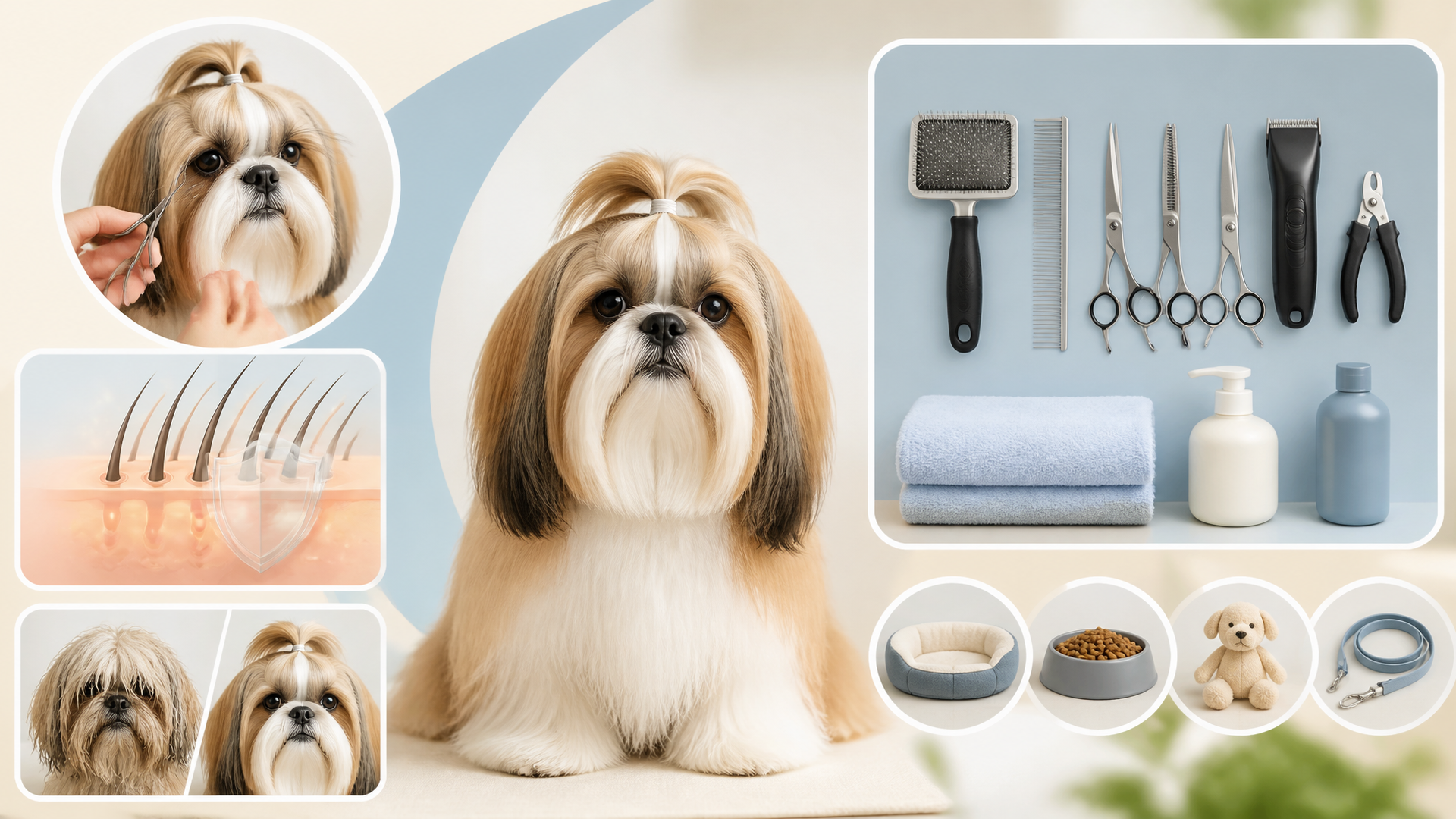
Most Shih Tzu owners reach for clippers first, but that’s often a mistake. Clippers can irritate their sensitive double coat. Blades heat up fast, and a close cut can cause razor burn or ingrown hairs, especially on the face and belly. Scissoring preserves the coat’s natural texture and lets you shape around the eyes, ears, and paws with real precision. The trade-off? It takes longer — expect 45–60 minutes once you’re comfortable — but the results are worth it.
Tools You’ll Need
Don’t start without these. Cheap scissors pull hair and make the job harder.
- Straight shears (6–7 inch) – for the body and back legs
- Curved shears (6–7 inch) – for the face, ears, and rounded shapes
- Thinning shears – to blend lines and soften edges
- Fine-tooth grooming comb – for parting and detangling
- Slicker brush – to remove loose hair before cutting
- A grooming table or non-slip mat – a mat on a countertop works too
- Styptic powder or cornstarch – for accidental nicks
A good starter set like the Wingsbeauty 5-Piece Grooming Kit includes straight, curved, and thinning shears — all you need for the entire trim.
BLOCKQUOTE_0
Step 1: Prepare Your Shih Tzu
Scissoring a dirty or tangled coat is a recipe for frustration — and pain for your dog.
1. Bathe and blow-dry your Shih Tzu completely. Use a high-velocity dryer (or a blow-dryer on low heat) to fluff the coat. A damp coat clumps and makes straight cuts impossible.
2. Brush out all mats with a slicker brush, then follow with a comb. Pay special attention behind the ears, under the collar, and on the belly. If you find a mat you can’t brush out, carefully cut it out with the scissors before you start the trim.
3. Set up on a non-slip surface at waist height. A bathroom counter with a bath mat works if you don’t have a grooming table.
Checkpoint: Run a comb through the whole coat. If it snags anywhere, stop and brush again. Cutting over a mat will leave a choppy patch you can’t fix without going shorter.
What to do if you find skin-level mats: If you brush and still find mats right at the skin that won’t release, stop trying to scissor them out. Switch to a #10 clipper blade and take that area down to the skin. Scissoring over skin-level mats is how cuts happen — the mat hides the skin from view, and the scissors can snip the skin before you even see it. Once that area is clipped short, you can blend it in with thinning shears after the rest of the trim.
Step 2: Scissor the Body
The goal here is to even out the coat length and remove bulk, not to go down to the skin.
Start at the back. Taking small sections, comb the hair straight up, then scissor the tips parallel to the body using straight shears. Work from the neck to the tail, keeping the blade pointed away from the skin. The thickness of your comb is a safe depth to aim for — about ½ inch. For the sides, let the hair fall naturally and trim in a straight line along the ribcage. Shih Tzus have a longer coat on the sides than on the top, so don’t try to match the top line exactly.
Step 3: Legs and Paws
The legs should look full and round, not skinny.
Back legs
Comb the hair down toward the paw. Use straight shears to trim the hair to about 1 inch below the hock joint. Then comb the hair outward and scissor around the leg to create a column shape. Keep the center of the column slightly longer than the edges.
Front legs
Same technique — comb down and trim to match the back legs. Shih Tzu front legs often have more feathering, so take your time to shape them evenly.
Paws
Start by combing the hair on top of the paw forward toward the toes. Trim the hair level with the top of the paw pad. Then use curved shears to round off the edges, creating a neat “cat paw” shape. For the bottom, part the paw pads and carefully trim any hair that touches the ground. A paw with hair between the pads can slip on hardwood floors.
Checkpoint: Stand your Shih Tzu on all fours and look from above. Both front legs and both back legs should be the same length. If one side looks thicker, take a few more snips.
Step 4: Face and Head
The face is the most delicate part. Work slowly and keep your Shih Tzu calm.
Tools: Curved shears (for rounded shapes) and thinning shears (for blending).
Eyes and forehead
Part the hair on top of the head down the middle. Comb the hair forward over the eyes, then scissor a gentle curve from the inner corner of each eye to the outer corner. Don’t cut straight across — that leaves a blunt line. Instead, follow the natural eye socket shape. Use thinning shears to soften any hard edges.
Muzzle and beard
Shih Tzus are famous for their beard. Comb the beard hair forward and trim to a length that stays out of food and water bowls — about 1 inch below the chin is a good starting point. Use straight shears to cut a clean line, then blend with thinning shears.
Cheeks and jawline
Comb the cheek hair downward. Use curved shears to follow the jawline from ear to chin, creating a smooth transition. This area gets tangled fast, so check for small mats behind the whiskers.
Critical safety note: Never point the scissor tips toward your dog’s eyes or nose. Turn the blades parallel to the skin. If your Shih Tzu moves suddenly, stop and wait for them to settle.
Step 5: Ears and Topknot
Ears
Shih Tzu ears are covered in silky hair that can look messy if left untouched. Comb the ear hair straight down. Use straight shears to trim the outer edge of the ear to a clean fringe — about ¼ inch beyond the ear leather. For the inside of the ear, gently lift the flap and trim any long hairs that hang out. Don’t cut into the ear canal.
Topknot
If you keep a topknot, part the hair on top of the head into a circular section. Comb it upward and secure with a soft elastic. Then use curved shears to shape the topknot into a dome. Trim any stray hairs that stick out past the elastic. Thinning shears help soften the transition between the topknot and the rest of the head.
No topknot? Just blend the forehead hair into the sides using thinning shears. Avoid making it look like a bowl cut.
Step 6: Tail and Finishing Touches
Shih Tzu tails curl over the back. Comb the tail hair outward in all directions, then use curved shears to round it into a fluffy chrysanthemum shape. Trim to about 2 inches long — longer looks messy, shorter looks stubby.
Final blend: Go over the entire body with thinning shears. Work through any transition points: where the body meets the legs, where the face meets the neck, and around the ears. Hold the thinning shears at a 45-degree angle and make gentle snips along the coat’s growth direction. This removes weight without leaving lines.
Success check: Run a comb through the entire coat. It should glide without snagging. Step back and look at your Shih Tzu from all angles. The silhouette should be even and rounded — no flat spots, no tufts.
Before You Start: Quick Readiness Checklist
Use this pass/fail checklist before you pick up scissors:
- [ ] Coat is fully dry and brushed with no tangles
- [ ] All skin-level mats are clipped out (not scissored)
- [ ] Your Shih Tzu has had a potty break and is calm
- [ ] Tools are clean, sharp, and within reach
- [ ] You have styptic powder or cornstarch nearby in case of a nick
If you can’t check every box, do that step first. Rushing leads to mistakes.
Common Troubleshooting
Your Shih Tzu won’t hold still: Take breaks every 5–10 minutes. Use high-value treats (tiny pieces of chicken or cheese) to reward calm behavior. Never force a position — let them stand naturally.
You accidentally cut too short: Don’t panic. Use thinning shears to blend the area into the surrounding coat. If the patch is bare, it will grow back in 2–4 weeks. Until then, keep that spot dry and brush around it.
The face looks uneven: It happens. Use curved shears to round out the muzzle or cheek again. Thinning shears are your best friend for fixing mistakes without taking more length off.
Save This Guide
Scissoring a Shih Tzu takes practice, but the control and coat health benefits make it worth the effort. Start with the body and legs to build confidence, then move to the face. Keep your tools sharp, take breaks, and always brush before you cut. The first time might take over an hour — your third time will be half that.
Key takeaway: A well-scissored Shih Tzu looks like a fluffy cloud, not a shaved toy. Stick with it, and you’ll get there.