do Beagles Point: Guide: What Every Owner Should Know
No, Beagles do not point in the traditional sense. They are scent hounds, not pointing breeds. Beagles track game with their nose to the ground and give voice (bay) when they find something, rather than freezing and pointing like a Pointer or Setter. Some Beagles may briefly pause or lift a paw when a scent is especially strong, but this is not the same as the genetically wired pointing behavior found in dedicated pointing breeds.

What “Pointing” Actually Means in a Dog
Pointing is a specific hunting behavior where a dog freezes, lifts one front paw, and aims its nose and body toward hidden game. This instinct is genetically programmed into breeds like:
- English Pointer
- German Shorthaired Pointer
- Brittany
- English Setter
The dog holds this stance until the hunter moves in to flush the game. A pointing dog is telling you where the game is. A Beagle does the opposite — it follows the scent trail to the game, then chases.
Key difference: Pointing is a freeze-and-hold behavior. Beagle trailing is a follow-and-chase behavior. They accomplish two different jobs in the field.
How Beagles Hunt: Nose Down, Voice On
Beagles were bred to hunt small game — rabbits and hares mostly — by following a ground scent. Here’s what that looks like in practice:
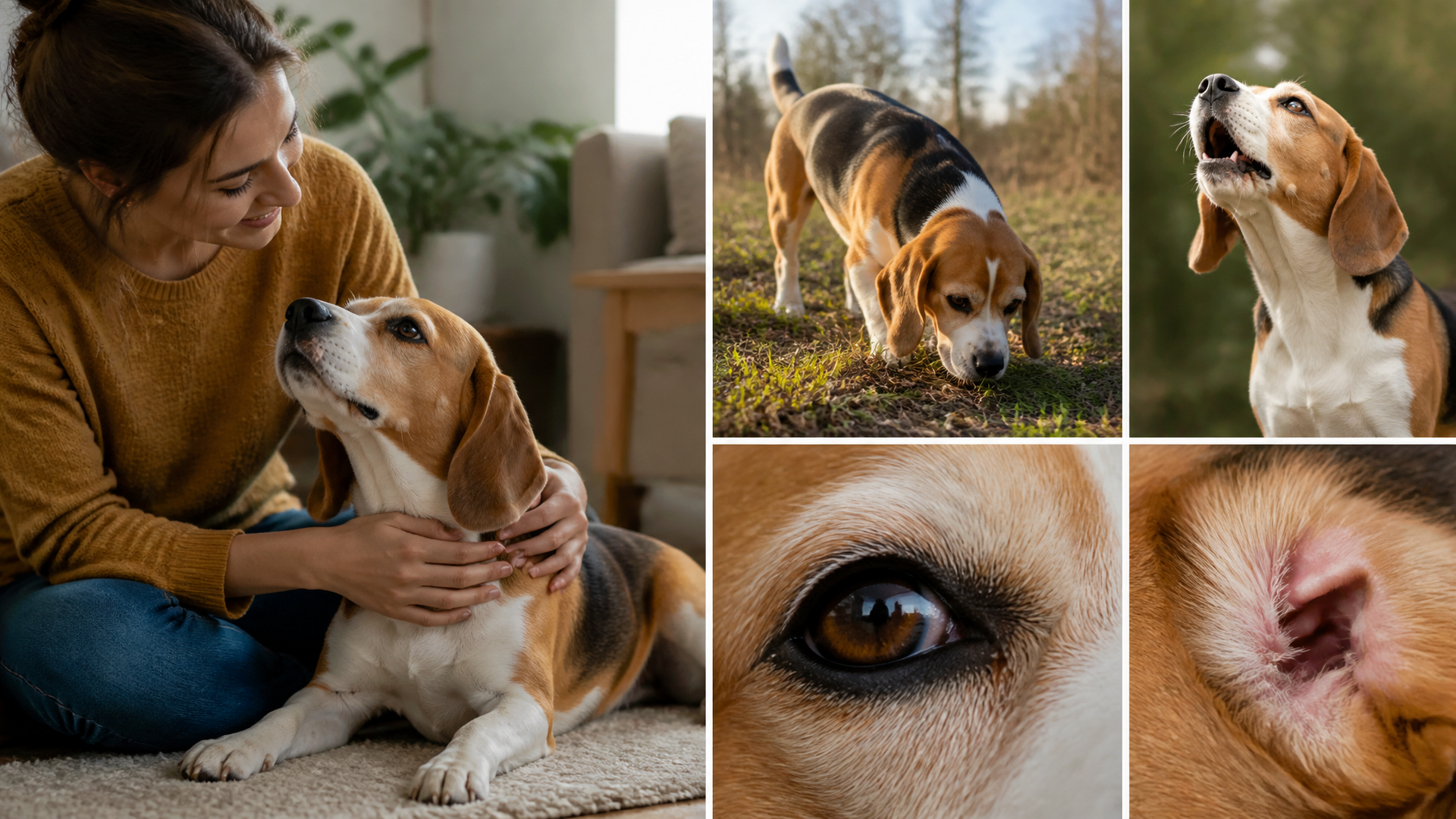
- Nose to the ground — The Beagle works a scent trail, often in a zigzag pattern.
- Baying when found — Once the Beagle catches the scent, it opens up with a distinctive baying howl to alert the hunter.
- Chasing, not pointing — The Beagle pursues the game, driving it in a circle so the hunter can get a shot.
This is called “trailing” or “scenting,” not pointing. The Beagle’s job is to find and chase, not to freeze and indicate.
One exception worth noting: A Beagle may briefly stop and raise its head (sometimes lifting a paw) when a scent is overwhelming or right under its nose. Hunters sometimes call this a “flash point” or “stall.” It usually lasts only a second or two before the Beagle drops its nose and follows the trail. This is not true pointing — it’s a momentary pause while the dog processes the scent information.
Can a Beagle Learn to Point?
The short answer is no — not reliably. The pointing instinct is bred into specific breeds over generations. You cannot train a Beagle to become a consistent pointing dog any more than you can train a Pointer to trail rabbits with its nose to the ground.
What You Might See Instead
| Behavior | What It Looks Like | Is This Pointing? |
|---|---|---|
| Flash point | Dog freezes for 1–3 seconds, paw may lift | No — momentary scent processing |
| Head-up sniffing | Dog raises head to catch airborne scent | No — typical scenting behavior |
| Stalking | Dog crouches and creeps forward | No — pre-chase posture |
| True point | Dog holds frozen stance for 10+ seconds | No — Beagles almost never do this |
The decision criterion that matters: If you need a dog that holds a point for a hunter to approach, choose a pointing breed. If you want a family dog that also hunts rabbits by trailing and baying, a Beagle is an excellent choice. They are two different tools for two different jobs.
When the Answer Changes: Your Hunting Context Matters
The answer to “do Beagles point” depends heavily on what you expect from the dog in the field.
- If you hunt upland birds and need a dog that stands still while you walk in for a flush — the answer is no. Beagles will not fill that role.
- If you do casual backyard scent games or nose work trials — some Beagles show a brief 1–3 second pause, but it’s inconsistent. That pause is not a reliable pointing behavior you can count on in competition or real hunting.
- If you hunt rabbits or hares — Beagles are perfect. They trail and bay, which is exactly what small-game hunters need. In this context, the question “do Beagles point” is irrelevant; you don’t want them to point.
Bottom line: The answer flips from “no, never” to “maybe a flash, but not reliable” based on your specific situation. Pointing breeds are the only safe choice if you need a consistent freeze.
What This Means for Your Next Choice
If you want a pointing dog and buy a Beagle instead, you will end up frustrated. Your Beagle will chase instead of hold, bay instead of stay quiet, and work independently instead of looking to you for direction. That mismatch will likely lead to nagging behavioral issues — the dog may get corrected repeatedly for doing what it was bred to do, eroding its confidence and turning hunting trips into stressful experiences.
Practical implication: Save yourself the heartache. Choose the breed that matches your primary need. If pointing is non-negotiable, go with a GSP, English Pointer, Brittany, or English Setter. If you’re flexible and want a friendly, persistent rabbit hunter, the Beagle is outstanding — just don’t expect point.
How to Check If Your Beagle Might Show a Flash Point
Wondering whether your particular Beagle ever pauses like a pointer? Here’s a quick way to verify:
1. Set up a strong scent trail — Drag a rabbit pelt or a scented training rag across your yard or field.
2. Let your Beagle sniff the starting point, then give the “find it” cue.
3. Watch the moment your Beagle locates the scent source — video record if possible.
4. Time the freeze, if any. A true point lasts 10+ seconds with the dog locked in place. Anything under 3 seconds is a flash point, not genuine pointing.
5. Repeat 5 times on different days. If you never see a freeze longer than 3 seconds, your Beagle has no pointing instinct worth training.
What to do with this info: If your Beagle never flash-points, skip any “pointing” training and focus on trailing games. If it occasionally flash-points, you can reward that pause with a “whoa” cue, but expect it to break quickly when the chase instinct kicks in.
The Trade-Off You Need to Accept
Owning a Beagle means accepting a dog that works independently, bays loudly, and follows its nose anywhere. That’s a strength for rabbit hunting but a major mismatch for owners who want close handler focus.
Concrete consequence: If you try to force pointing behavior, you may end up with a confused dog that stops working altogether. Beagles that get repeatedly scolded for chasing may become anxious, stop using their nose, or develop submissive urination during training. The trade-off is clear: you can have a happy, natural Beagle that trails and bays, or you can have a frustrated Beagle that you keep trying (and failing) to turn into a pointer. Pick one.
Beagle vs. Pointing Breeds: Quick Comparison
| Trait | Beagle | Pointing Breed (e.g., GSP, English Pointer) |
|---|---|---|
| Primary hunting method | Trailing with nose down | Pointing with freeze stance |
| Vocalization | Bays and howls when on scent | Usually quiet on point |
| Game type | Rabbits, hares | Birds (upland game) |
| Pointing instinct | No — occasional flash point | Yes — genetically programmed |
| Trainability for pointing | Very low | Very high |
| Good family dog | Yes | Yes (with exercise needs met) |
3 Tips for Owners Who Want More “Pointing” Behavior
If you’re hoping your Beagle shows some pointing-like behavior, these tips can help you recognize and encourage natural pauses — but keep expectations realistic.
Tip 1: Work on “Whoa” or Stop Commands
Actionable step: Teach a solid “whoa” or “stop” cue using a long leash. Practice in low-distraction settings first, then add scent distractions.
Common mistake to avoid: Expecting your Beagle to hold a stop for more than a few seconds near a strong scent. They are hardwired to chase, not hold. Corrections for breaking will confuse the dog.
Tip 2: Use Scent Work Games That Encourage Pausing
Actionable step: Hide a scented toy or treat, then ask your Beagle to “find it.” When they locate it, ask for a “down” or “wait” before releasing them to claim the reward. This builds a pause before the chase.
Common mistake to avoid: Rushing the release. If you let your Beagle grab the toy immediately, you reinforce chasing, not pausing. Wait at least 3 seconds before the release cue.
Tip 3: Choose Hunting Scenarios That Fit Beagle Strengths
Actionable step: If you hunt, use your Beagle for rabbit or hare trailing — not upland bird pointing. Let them do what they were bred to do.
Common mistake to avoid: Frustration. Your Beagle is not “failing” to point. They are succeeding at being a scent hound. Adjust your expectations to the breed. A Beagle that trails and bays well is a success story, not a disappointment.
Quick Decision Guide: Is a Beagle Right for You?
Use these five checks before deciding if a Beagle fits your needs:
- [ ] Do you need a dog that points and holds for birds? → Choose a pointing breed instead. Beagles do not point reliably.
- [ ] Do you want a dog that trails rabbits or hares? → A Beagle is one of the best choices for this job.
- [ ] Is a baying hound okay with your neighbors? → Beagles are vocal. They bay when hunting and bark at home. Not ideal for quiet neighborhoods.
- [ ] Do you have a fenced yard? → Beagles follow their nose. They will wander off if not contained. A secure fence is non-negotiable.
- [ ] Are you okay with a dog that works independently? → Beagles were bred to hunt in packs and follow scent. They are not as handler-focused as pointing breeds.
Pass all five checks? A Beagle is a strong fit. Fail checks #1 or #5? A pointing breed like a GSP or English Pointer is a better match.
Products That Channel Your Beagle’s Natural Instincts
These tools help your Beagle do what it does best — trail, scent, and work — without frustration for either of you.
- Long tracking leash (20–30 feet) — Gives your Beagle room to trail while you maintain control. Biothane or nylon with a padded handle works well.
- Scent training kit (with rabbit or raccoon scent) — Lets you set up backyard tracking exercises. Look for kits with a drag rag and scent vials.
- Harness for scent work — A front-clip or Y-shaped harness distributes pressure evenly and prevents neck strain during long trailing sessions.
- Interactive scent puzzle toys — Great for rainy days. Hide treats in a snuffle mat or a rolling puzzle toy to satisfy their nose-driven brain.
Disclosure: As an Amazon Associate, we may earn from qualifying purchases at no extra cost to you.
Frequently Asked Questions
Do Beagles point at birds?
No. Beagles typically ignore birds or chase them briefly. They lack the genetic instinct to freeze and point at bird game.
Can a Beagle be trained to point like a GSP?
No, not reliably. The pointing drive is bred into specific lines over centuries. Training can teach a Beagle to pause, but never to hold a true point.
Why does my Beagle sometimes lift a paw and freeze?
This is a “flash point” — a momentary pause when a scent is very strong. It usually lasts 1–3 seconds before your Beagle drops its nose and follows the trail. It is not true pointing.
What breed points better than a Beagle?
English Pointer, German Shorthaired Pointer, Brittany, and English Setter all point reliably. If pointing is your priority, choose one of these breeds instead.
Is a Beagle good for hunting?
Yes — for rabbit and hare hunting. Beagles excel at trailing and baying, which is exactly what small-game hunters need. They are not suitable for upland bird hunting where pointing is required.
BLOCKQUOTE_0