Sphynx Cat Colors: Guide: What Every Owner Should Know
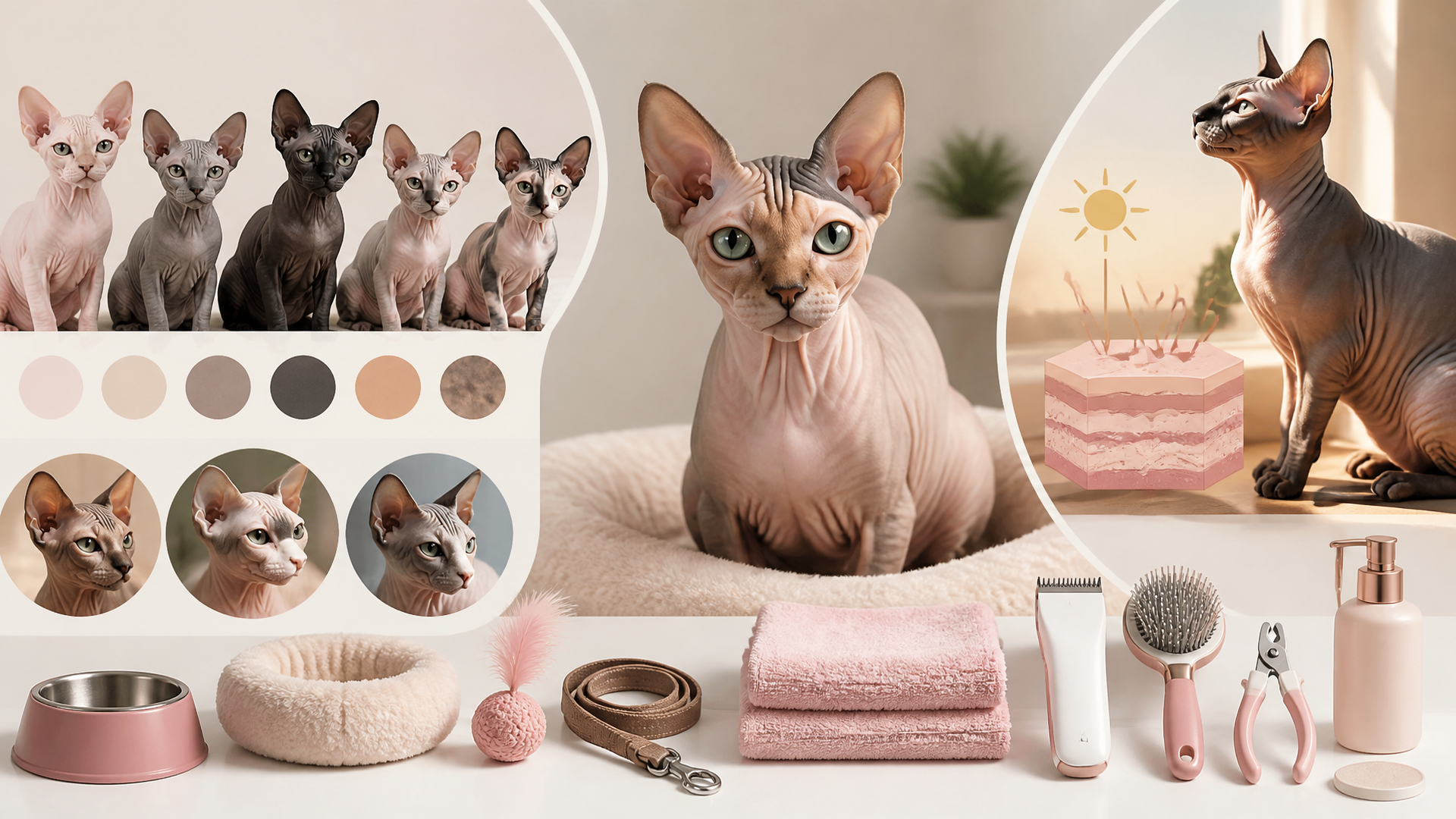
Sphynx cats come in every color and pattern imaginable – and because they’re hairless, those colors show directly on their skin. But here’s the catch: your cat’s color determines how quickly they can sunburn. Light-colored Sphynx need protection within minutes, while darker ones can handle a bit more sun. Here’s what every owner needs to know about Sphynx cat colors, from the basic palette to daily care that keeps their skin safe.

Quick Reference: Sphynx Color & Pattern Guide
Knowing the main categories helps you identify your cat’s type and understand sun risk at a glance. Use this table as a quick cheat sheet:
| Color/Pattern | Description | Sun Sensitivity |
|---|---|---|
| Solid (white, black, blue, red, cream) | One uniform color across the body | White and cream = highest risk; black and blue absorb more heat but burn less |
| Tabby (classic, mackerel, spotted, ticked) | Stripes, spots, or swirls on any base color | Depends on base – light tabbies need extra protection |
| Tortoiseshell / Calico | Patches of black, red, cream; calico adds white | White patches are most vulnerable |
| Bicolor / Van | White with colored patches on head, tail, back | White areas = highest risk |
| Pointed (colorpoint) | Darker color on ears, face, paws, tail; lighter body | Body is lighter, so moderate burn risk; points darker but still need caution |
| Mink / Sepia | Points with darker body color than pointed | Less extreme contrast; risk similar to solid medium shades |
Key takeaway: Light-colored Sphynx (white, cream, light blue, light red) have less melanin protection and burn faster. Darker colors absorb more heat but still need limited sun exposure.
How Your Sphynx’s Color Changes Daily Care
Without a fur coat, your Sphynx’s skin is directly exposed to UV rays. The color tells you how much melanin is there to provide natural protection. Here’s what changes based on your cat’s color:
- Sunscreen is non-negotiable for light-colored Sphynx. White, cream, and light blue Sphynx should never sit in direct sun for more than a few minutes without protection. Use a cat-safe sunscreen (avoid zinc oxide – it’s toxic if licked). Apply to ears, nose, and any pink skin patches.
- Check for sunburn daily. After sun exposure, look for pinkness, redness, or peeling. Light-colored cats show sunburn faster. Darker cats can still burn if they stay out long enough.
- Consider UV-protective clothing. A lightweight cotton shirt or a designated cat sunsuit covers the body while letting your Sphynx explore outside safely. This is especially useful for white Sphynx and for cats that enjoy sunbathing.
Expert Tips for Color-Based Care
1. Take a photo of your Sphynx’s skin in natural light once a month. This creates a baseline so you can spot new freckles, moles, or color changes early. Common mistake: assuming all dark spots are normal – some may be sun damage. If a new spot grows or changes shape, see your vet.
2. Use a mineral-based, zinc-free baby sunscreen for your light-colored Sphynx. Rub a tiny amount on the ears and nose 10 minutes before sun exposure. Common mistake: applying human sunscreen with zinc oxide – this is toxic if ingested during grooming.
3. Rotate sunbathing spots indoors. A window with direct UV rays can still burn a pale Sphynx. Move their bed or window perch out of the direct beam after 15–20 minutes. Common mistake: thinking glass blocks all UV – it blocks UVB but not UVA, which can still cause skin damage over time.
Sphynx Color Genetics (for the Curious Owner)
Sphynx cats inherit color genes the same way as other cats, but the visible result is on their skin and fine peach fuzz (vellus hair) rather than a full coat. Key points:
- Solid colors are dominant (black, blue, red, cream, white). White is actually a masking gene that hides underlying color – a white Sphynx may have faint shading from colored patches underneath.
- Patterns like tabby and tortoiseshell are sex-linked (tortoiseshell is almost always female because it requires two X chromosomes).
- Pointed Sphynx carry the Himalayan gene (same as Siamese) – the cooler body temperature causes darker pigment on extremities. This means a pointed Sphynx will darken slightly in cooler weather and lighten in warmth.
- Color can change with age, especially in pointed and mink Sphynx. Kittens are born lighter and darken within the first year. Solid-colored Sphynx tend to stay stable.
Sun Protection Operator Flow for Sphynx Owners
If your Sphynx loves sunbathing or you take them outside on a harness, follow this simple flow:
Step 1 – Assess risk based on color
- Light (white, cream, light blue, light red) → high risk. Proceed to Step 2A.
- Medium (blue, red, chocolate) → moderate risk. Proceed to Step 2B.
- Dark (black, dark blue) → lower risk. Still proceed to Step 2B.
Step 2 – Choose protection method
- A: High-risk cats → Apply cat-safe sunscreen or dress in a UV-blocking shirt before any sun exposure.
- B: Moderate/low-risk cats → Apply sunscreen or a shirt if you plan to be out longer than 20 minutes.
Step 3 – Apply sunscreen correctly
- Use mineral-based, zinc-free sunscreen (baby-safe). Apply to ears, nose, and any thin-skinned areas (belly, inner thighs).
- Rub in gently 10 minutes before sun exposure. Distract with a treat to prevent immediate licking.
Step 4 – Set a timer
- Light-colored Sphynx: limit direct sun to 15 minutes.
- Darker Sphynx: limit direct sun to 30 minutes.
- Move to shade or go indoors when the timer goes off.
Step 5 – Post-sun check
- Examine skin for redness, warmth, or tenderness. If normal, you’re done.
- If you see pinkness that doesn’t fade within an hour, apply a cool damp cloth and keep out of sun for 24 hours.
Verification step – Confirm if it’s sunburn or normal heat flush: Gently press on the reddened area with your finger. If the skin turns white briefly under pressure (blanches), it’s likely a normal heat flush. If the redness stays, it’s sunburn – proceed with cooling care.
Trade-off to know: A UV-blocking shirt protects well but can trap heat in warm weather. Your Sphynx may overheat if the shirt is worn for more than 20 minutes on a hot day. Choose a lightweight, breathable fabric (cotton or mesh) and remove it as soon as you’re back indoors.
Escalation signal: If redness lasts more than a day, blisters form, or your cat seems painful, see your vet immediately.
Likely cause of sunburn in Sphynx: Overestimating how much sun their skin can handle. Even a dark-colored Sphynx can burn after 45 minutes of direct midday sun.
Stop point: You can safely let your Sphynx enjoy supervised sunbathing for short periods as long as you follow the steps above. If you can’t supervise, keep them indoors with filtered window light.
FAQ: Sphynx Cat Colors
Are some Sphynx colors rarer than others?
Yes, pointed and mink patterns are less common than solid or tabby, but any color can appear depending on the breeder’s lines. White with blue eyes (blue-eyed white Sphynx) is particularly rare and often associated with higher deafness risk – reputable breeders test for this.
Can my Sphynx’s color change over time?
Yes, especially pointed Sphynx will darken as they age. Sun exposure can also lighten or darken skin pigment temporarily. Solid colors are more stable.
Does color affect a Sphynx’s personality or health beyond sunburn?
No – personality is unrelated to color. However, blue-eyed white Sphynx have a higher incidence of congenital deafness, so ethical breeders screen for this. Otherwise, color does not impact lifespan, temperament, or common Sphynx health issues (hypertrophic cardiomyopathy, skin allergies).
How do I know if my Sphynx is sunburned?
Look for pink or red skin that doesn’t fade within a few hours of going indoors, tenderness when touched, or peeling skin. Light-colored Sphynx show it faster. If the skin blisters or your cat cries when touched, see a vet immediately.
Save This Guide
Your Sphynx’s color isn’t just for show – it tells you how much sun protection they need. Light-colored Sphynx need sunscreen or UV clothing for even short outdoor time. Darker Sphynx can handle a bit more sun but still need limits. Use the operator flow above for daily sun safety, and check your cat’s skin regularly for changes. The takeaway: know your cat’s color, protect accordingly, and act fast if you see signs of sunburn. Bookmark this guide for quick reference whenever you need it.
Disclosure: This article contains general product recommendations. As an Amazon Associate, we may earn from qualifying purchases made through links in this guide.